

Large Internal Solitary Waves in Shallow Waters
101
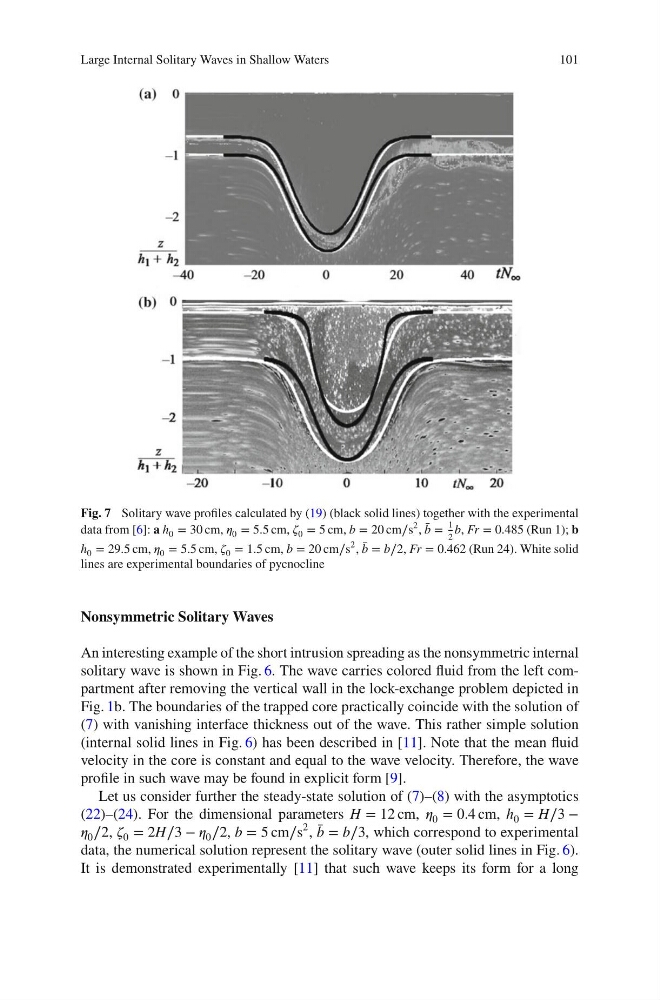
Fig. 7 Solitary wave profiles calculated by (19) (black solid lines) together with the experimental
data from [6]: a h 0 = 30 cm, í µí¼ 0 = 5.5 cm, í µí¼ 0 = 5 cm, b = 20 cm∕s
2 , ̄
b =
1
2
b, Fr = 0.485 (Run 1); b
h 0 = 29.5 cm, í µí¼ 0 = 5.5 cm, í µí¼ 0 = 1.5 cm, b = 20 cm∕s
2 , ̄
b = b∕2, Fr = 0.462 (Run 24). White solid
lines are experimental boundaries of pycnocline
Nonsymmetric Solitary Waves
An interesting example of the short intrusion spreading as the nonsymmetric internal
solitary wave is shown in Fig. 6. The wave carries colored fluid from the left compartment after removing the vertical wall in the lock-exchange problem depicted in
Fig. 1b. The boundaries of the trapped core practically coincide with the solution of
(7) with vanishing interface thickness out of the wave. This rather simple solution
(internal solid lines in Fig. 6) has been described in [11]. Note that the mean fluid
velocity in the core is constant and equal to the wave velocity. Therefore, the wave
profile in such wave may be found in explicit form [9].
Let us consider further the steady-state solution of (7)–(8) with the asymptotics
(22)–(24). For the dimensional parameters H = 12 cm, í µí¼ 0 = 0.4 cm, h 0 = H∕3 −
í µí¼ 0 ∕2, í µí¼ 0 = 2H∕3 − í µí¼ 0 ∕2, b = 5 cm∕s
2 , ̄
b = b∕3, which correspond to experimental
data, the numerical solution represent the solitary wave (outer solid lines in Fig. 6).
It is demonstrated experimentally [11] that such wave keeps its form for a long
101
Fig. 7 Solitary wave profiles calculated by (19) (black solid lines) together with the experimental
data from [6]: a h 0 = 30 cm, í µí¼ 0 = 5.5 cm, í µí¼ 0 = 5 cm, b = 20 cm∕s
2 , ̄
b =
1
2
b, Fr = 0.485 (Run 1); b
h 0 = 29.5 cm, í µí¼ 0 = 5.5 cm, í µí¼ 0 = 1.5 cm, b = 20 cm∕s
2 , ̄
b = b∕2, Fr = 0.462 (Run 24). White solid
lines are experimental boundaries of pycnocline
Nonsymmetric Solitary Waves
An interesting example of the short intrusion spreading as the nonsymmetric internal
solitary wave is shown in Fig. 6. The wave carries colored fluid from the left compartment after removing the vertical wall in the lock-exchange problem depicted in
Fig. 1b. The boundaries of the trapped core practically coincide with the solution of
(7) with vanishing interface thickness out of the wave. This rather simple solution
(internal solid lines in Fig. 6) has been described in [11]. Note that the mean fluid
velocity in the core is constant and equal to the wave velocity. Therefore, the wave
profile in such wave may be found in explicit form [9].
Let us consider further the steady-state solution of (7)–(8) with the asymptotics
(22)–(24). For the dimensional parameters H = 12 cm, í µí¼ 0 = 0.4 cm, h 0 = H∕3 −
í µí¼ 0 ∕2, í µí¼ 0 = 2H∕3 − í µí¼ 0 ∕2, b = 5 cm∕s
2 , ̄
b = b∕3, which correspond to experimental
data, the numerical solution represent the solitary wave (outer solid lines in Fig. 6).
It is demonstrated experimentally [11] that such wave keeps its form for a long