

Chapter 2: SEA SURFACE MICROLAYER
With no solar radiation and precipitation effects, convective instability of
a thermal molecular sublayer occurs at low wind speeds. Under moderate
and high wind speeds, the molecular sublayers are controlled by the wind
stress and surface waves.
Laboratory experimentation involving visualization techniques helps to
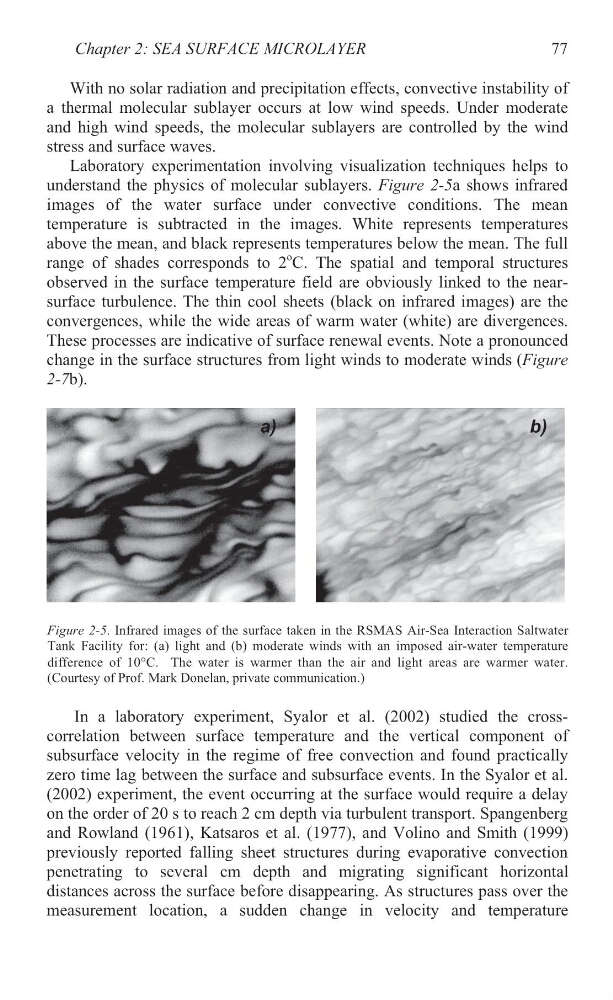
understand the physics of molecular sublayers. Figure 2-5a shows infrared
images of the water surface under convective conditions. The mean
temperature is subtracted in the images. White represents temperatures
above the mean, and black represents temperatures below the mean. The full
range of shades corresponds to 2
o C. The spatial and temporal structures
observed in the surface temperature field are obviously linked to the nearsurface turbulence. The thin cool sheets (black on infrared images) are the
convergences, while the wide areas of warm water (white) are divergences.
These processes are indicative of surface renewal events. Note a pronounced
change in the surface structures from light winds to moderate winds (Figure
In a laboratory experiment, Syalor et al. (2002) studied the crosscorrelation between surface temperature and the vertical component of
subsurface velocity in the regime of free convection and found practically
zero time lag between the surface and subsurface events. In the Syalor et al.
(2002) experiment, the event occurring at the surface would require a delay
on the order of 20 s to reach 2 cm depth via turbulent transport. Spangenberg
and Rowland (1961), Katsaros et al. (1977), and Volino and Smith (1999)
previously reported falling sheet structures during evaporative convection
penetrating to several cm depth and migrating significant horizontal
distances across the surface before disappearing. As structures pass over the
measurement location, a sudden change in velocity and temperature
a)
b)
77
2-7b).
Figure 2-5. Infrared images of the surface taken in the RSMAS Air-Sea Interaction Saltwater
Tank Facility for: (a) light and (b) moderate winds with an imposed air-water temperature
difference of 10qC. The water is warmer than the air and light areas are warmer water.
(Courtesy of Prof. Mark Donelan, private communication.)
With no solar radiation and precipitation effects, convective instability of
a thermal molecular sublayer occurs at low wind speeds. Under moderate
and high wind speeds, the molecular sublayers are controlled by the wind
stress and surface waves.
Laboratory experimentation involving visualization techniques helps to
understand the physics of molecular sublayers. Figure 2-5a shows infrared
images of the water surface under convective conditions. The mean
temperature is subtracted in the images. White represents temperatures
above the mean, and black represents temperatures below the mean. The full
range of shades corresponds to 2
o C. The spatial and temporal structures
observed in the surface temperature field are obviously linked to the nearsurface turbulence. The thin cool sheets (black on infrared images) are the
convergences, while the wide areas of warm water (white) are divergences.
These processes are indicative of surface renewal events. Note a pronounced
change in the surface structures from light winds to moderate winds (Figure
In a laboratory experiment, Syalor et al. (2002) studied the crosscorrelation between surface temperature and the vertical component of
subsurface velocity in the regime of free convection and found practically
zero time lag between the surface and subsurface events. In the Syalor et al.
(2002) experiment, the event occurring at the surface would require a delay
on the order of 20 s to reach 2 cm depth via turbulent transport. Spangenberg
and Rowland (1961), Katsaros et al. (1977), and Volino and Smith (1999)
previously reported falling sheet structures during evaporative convection
penetrating to several cm depth and migrating significant horizontal
distances across the surface before disappearing. As structures pass over the
measurement location, a sudden change in velocity and temperature
a)
b)
77
2-7b).
Figure 2-5. Infrared images of the surface taken in the RSMAS Air-Sea Interaction Saltwater
Tank Facility for: (a) light and (b) moderate winds with an imposed air-water temperature
difference of 10qC. The water is warmer than the air and light areas are warmer water.
(Courtesy of Prof. Mark Donelan, private communication.)