

Chapter 2: SEA SURFACE MICROLAYER
and a seawater bath, which substantially reduced the error due to the signal
reflected from clouds. TOGA COARE exploited an advanced version of
Grassl’s method: From 30 January to 24 February 1993, measurements were
taken from the R/V Vickers in the western equatorial Pacific Ocean (156
o E,
2
o S). The skin temperature measured with this setup was accurate to 0.05
o C.
Fiedler and Bakan (1997) and Minnett et al. (2001) have developed a
multi-channel infrared interferometer, which does not require a reference
seawater bath. This approach can provide large high quality datasets of the
cool skin of the ocean.
For calculating the temperature difference across the cool skin from the
infrared SST measurement it is also necessary to know the bulk water
temperature below the cool skin. Unfortunately, measurements with sensors
towed behind or near the ship are disturbed by the ship’s wake, which may
introduce substantial errors. The alternative approach is to derive the bulk
water temperature from a ship’s thermosalinograph, which takes in water
from 3 to 5 m depth; although, a shallow diurnal or rain-formed thermocline
may result in a vertical temperature gradient between the depth of the
thermosalinograph intake and the cool skin layer. An appropriate
temperature correction can be calculated with a diurnal mixed layer model
forced with the air-sea momentum, heat, and precipitation fluxes, assuming
these are available. This correction, however, may introduce outliers by itself
due to errors of the model and atmospheric forcing data.
2.1.3 Diffusion sublayer
The near-surface molecular diffusion sublayer is a crucial element in airsea gas exchange. The resistance to air-sea gas transfer for water-side limited
gases is mainly due to the diffusion sublayer in water, which is of the order of
50 Pm thick (Bolin,1960).
The diffusion sublayer associated with salinity transport has
approximately the same thickness as the gas diffusion sublayer (Fedorov and
Ginzburg, 1979). Under evaporative conditions, the sea surface salinity is
higher than in the bulk of water, while during rainy conditions, a freshwater
skin of the ocean is formed (
et al., 1997).
There are no direct observations of the diffusion molecular sublayer in
the open ocean because of the complexity of the microscale measurements
near the moving air-sea interface. Some parameters of the aqueous diffusion
sublayer can be evaluated from data on the gas transfer velocity if
practically all gas concentration difference is in the ocean rather than the
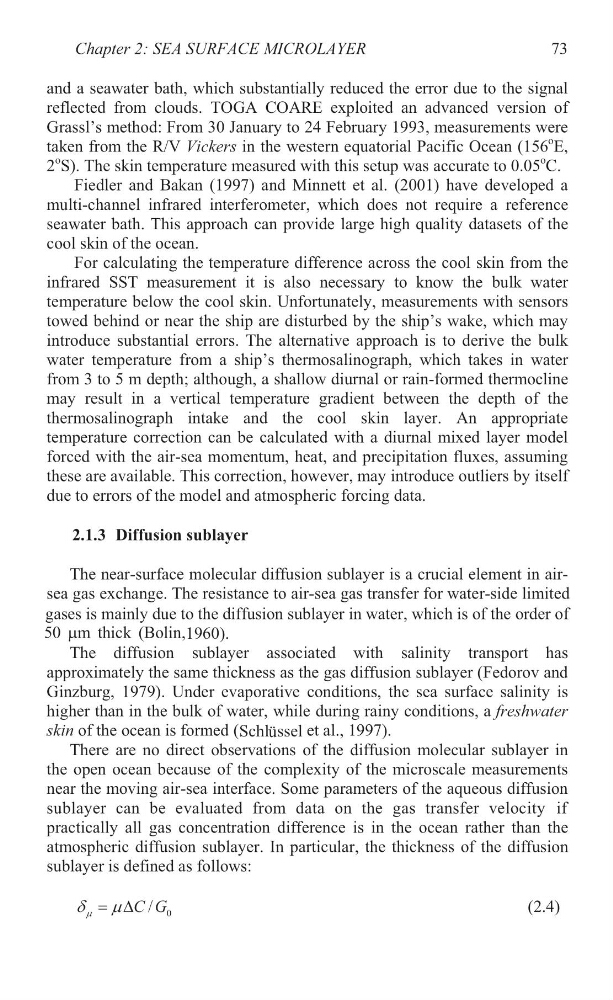
atmospheric diffusion sublayer. In particular, the thickness of the diffusion
sublayer is defined as follows:
0
/
C G
P
G
P '
(2.4)
73
Schl ssel
ü
and a seawater bath, which substantially reduced the error due to the signal
reflected from clouds. TOGA COARE exploited an advanced version of
Grassl’s method: From 30 January to 24 February 1993, measurements were
taken from the R/V Vickers in the western equatorial Pacific Ocean (156
o E,
2
o S). The skin temperature measured with this setup was accurate to 0.05
o C.
Fiedler and Bakan (1997) and Minnett et al. (2001) have developed a
multi-channel infrared interferometer, which does not require a reference
seawater bath. This approach can provide large high quality datasets of the
cool skin of the ocean.
For calculating the temperature difference across the cool skin from the
infrared SST measurement it is also necessary to know the bulk water
temperature below the cool skin. Unfortunately, measurements with sensors
towed behind or near the ship are disturbed by the ship’s wake, which may
introduce substantial errors. The alternative approach is to derive the bulk
water temperature from a ship’s thermosalinograph, which takes in water
from 3 to 5 m depth; although, a shallow diurnal or rain-formed thermocline
may result in a vertical temperature gradient between the depth of the
thermosalinograph intake and the cool skin layer. An appropriate
temperature correction can be calculated with a diurnal mixed layer model
forced with the air-sea momentum, heat, and precipitation fluxes, assuming
these are available. This correction, however, may introduce outliers by itself
due to errors of the model and atmospheric forcing data.
2.1.3 Diffusion sublayer
The near-surface molecular diffusion sublayer is a crucial element in airsea gas exchange. The resistance to air-sea gas transfer for water-side limited
gases is mainly due to the diffusion sublayer in water, which is of the order of
50 Pm thick (Bolin,1960).
The diffusion sublayer associated with salinity transport has
approximately the same thickness as the gas diffusion sublayer (Fedorov and
Ginzburg, 1979). Under evaporative conditions, the sea surface salinity is
higher than in the bulk of water, while during rainy conditions, a freshwater
skin of the ocean is formed (
et al., 1997).
There are no direct observations of the diffusion molecular sublayer in
the open ocean because of the complexity of the microscale measurements
near the moving air-sea interface. Some parameters of the aqueous diffusion
sublayer can be evaluated from data on the gas transfer velocity if
practically all gas concentration difference is in the ocean rather than the
atmospheric diffusion sublayer. In particular, the thickness of the diffusion
sublayer is defined as follows:
0
/
C G
P
G
P '
(2.4)
73
Schl ssel
ü