

THE NEAR-SURFACE LAYER OF THE OCEAN
, ,
, ,
,
,
z
x
t
t
x t
x t
xt
xt
I
K
I
K K
K
.
(1.96)
At the bottom,
b
z
h
, the kinematic bottom boundary condition is as
follows:
,
,
0
z
b
x h t
I
.
(1.97)
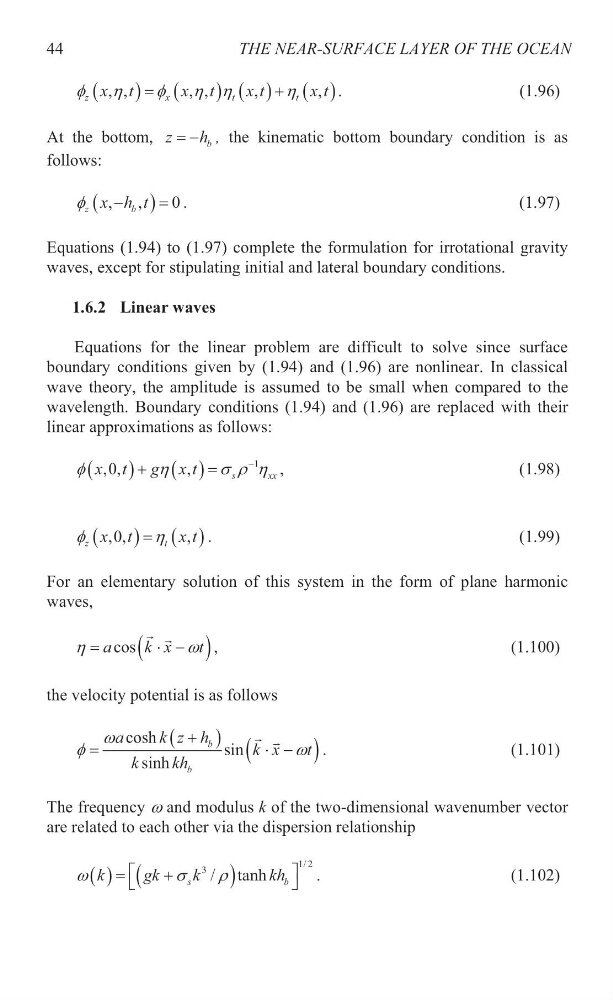
Equations (1.94) to (1.97) complete the formulation for irrotational gravity
waves, except for stipulating initial and lateral boundary conditions.
1.6.2 Linear waves
Equations for the linear problem are difficult to solve since surface
boundary conditions given by (1.94) and (1.96) are nonlinear. In classical
wave theory, the amplitude is assumed to be small when compared to the
wavelength. Boundary conditions (1.94) and (1.96) are replaced with their
linear approximations as follows:
1
,0,
,
s
xx
x t g x t
I
K
V U K
,
(1.98)
,0,
,
z
t
x t
xt
I
K
.
(1.99)
For an elementary solution of this system in the form of plane harmonic
waves,
cos
a
k x
t
K
Z
G G
,
(1.100)
the velocity potential is as follows
cosh
sin
sinh
b
b
a
k z h
k x
t
k
kh
Z
I
Z
G G
.
(1.101)
The frequency Z and modulus k of the two-dimensional wavenumber vector
are related to each other via the dispersion relationship
1/ 2
3 / tanh
s
b
k
gk
k
kh
Z
V
U
ª
º
¬
¼ .
(1.102)
44
, ,
, ,
,
,
z
x
t
t
x t
x t
xt
xt
I
K
I
K K
K
.
(1.96)
At the bottom,
b
z
h
, the kinematic bottom boundary condition is as
follows:
,
,
0
z
b
x h t
I
.
(1.97)
Equations (1.94) to (1.97) complete the formulation for irrotational gravity
waves, except for stipulating initial and lateral boundary conditions.
1.6.2 Linear waves
Equations for the linear problem are difficult to solve since surface
boundary conditions given by (1.94) and (1.96) are nonlinear. In classical
wave theory, the amplitude is assumed to be small when compared to the
wavelength. Boundary conditions (1.94) and (1.96) are replaced with their
linear approximations as follows:
1
,0,
,
s
xx
x t g x t
I
K
V U K
,
(1.98)
,0,
,
z
t
x t
xt
I
K
.
(1.99)
For an elementary solution of this system in the form of plane harmonic
waves,
cos
a
k x
t
K
Z
G G
,
(1.100)
the velocity potential is as follows
cosh
sin
sinh
b
b
a
k z h
k x
t
k
kh
Z
I
Z
G G
.
(1.101)
The frequency Z and modulus k of the two-dimensional wavenumber vector
are related to each other via the dispersion relationship
1/ 2
3 / tanh
s
b
k
gk
k
kh
Z
V
U
ª
º
¬
¼ .
(1.102)
44