

Chapter 1: INTRODUCTION
,
u
w
x
z
I
I
w
w
w
w
,
(1.91)
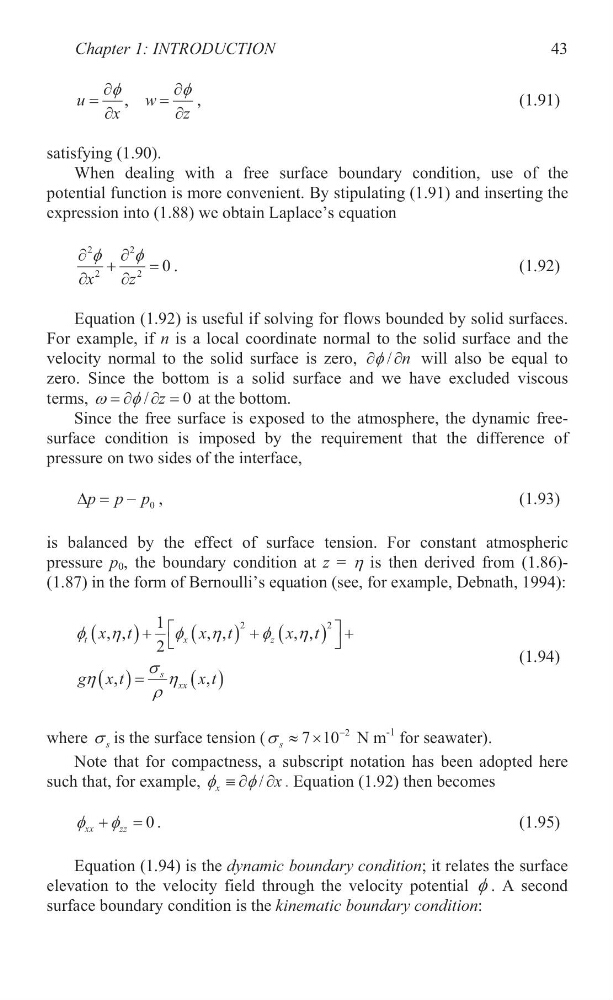
satisfying (1.90).
When dealing with a free surface boundary condition, use of the
potential function is more convenient. By stipulating (1.91) and inserting the
expression into (1.88) we obtain Laplace’s equation
2
2
2
2
0
x
z
I
I
w
w
w
w
.
(1.92)
Equation (1.92) is useful if solving for flows bounded by solid surfaces.
For example, if n is a local coordinate normal to the solid surface and the
velocity normal to the solid surface is zero,
/ n
I
w w will also be equal to
zero. Since the bottom is a solid surface and we have excluded viscous
terms,
/
0
z
Z I
w w
at the bottom.
Since the free surface is exposed to the atmosphere, the dynamic freesurface condition is imposed by the requirement that the difference of
pressure on two sides of the interface,
0
p p p
'
,
(1.93)
is balanced by the effect of surface tension. For constant atmospheric
pressure p 0 , the boundary condition at z = K is then derived from (1.86)(1.87) in the form of Bernoulli’s equation (see, for example, Debnath, 1994):
2
2
1
, ,
, ,
, ,
2
,
,
t
x
z
s
xx
x t
x t
x t
g x t
x t
I K
I
K
I
K
V
K
K
U
ª
º
¬
¼
(1.94)
where s
V is the surface tension (
2
7 10
s
V
| u
N m
-1 for seawater).
Note that for compactness, a subscript notation has been adopted here
such that, for example,
/
x
x
I
I
{ w w . Equation (1.92) then becomes
0
xx
zz
I I
.
(1.95)
Equation (1.94) is the dynamic boundary condition; it relates the surface
elevation to the velocity field through the velocity potential I . A second
surface boundary condition is the kinematic boundary condition:
43
,
u
w
x
z
I
I
w
w
w
w
,
(1.91)
satisfying (1.90).
When dealing with a free surface boundary condition, use of the
potential function is more convenient. By stipulating (1.91) and inserting the
expression into (1.88) we obtain Laplace’s equation
2
2
2
2
0
x
z
I
I
w
w
w
w
.
(1.92)
Equation (1.92) is useful if solving for flows bounded by solid surfaces.
For example, if n is a local coordinate normal to the solid surface and the
velocity normal to the solid surface is zero,
/ n
I
w w will also be equal to
zero. Since the bottom is a solid surface and we have excluded viscous
terms,
/
0
z
Z I
w w
at the bottom.
Since the free surface is exposed to the atmosphere, the dynamic freesurface condition is imposed by the requirement that the difference of
pressure on two sides of the interface,
0
p p p
'
,
(1.93)
is balanced by the effect of surface tension. For constant atmospheric
pressure p 0 , the boundary condition at z = K is then derived from (1.86)(1.87) in the form of Bernoulli’s equation (see, for example, Debnath, 1994):
2
2
1
, ,
, ,
, ,
2
,
,
t
x
z
s
xx
x t
x t
x t
g x t
x t
I K
I
K
I
K
V
K
K
U
ª
º
¬
¼
(1.94)
where s
V is the surface tension (
2
7 10
s
V
| u
N m
-1 for seawater).
Note that for compactness, a subscript notation has been adopted here
such that, for example,
/
x
x
I
I
{ w w . Equation (1.92) then becomes
0
xx
zz
I I
.
(1.95)
Equation (1.94) is the dynamic boundary condition; it relates the surface
elevation to the velocity field through the velocity potential I . A second
surface boundary condition is the kinematic boundary condition:
43