

THE NEAR-SURFACE LAYER OF THE OCEAN
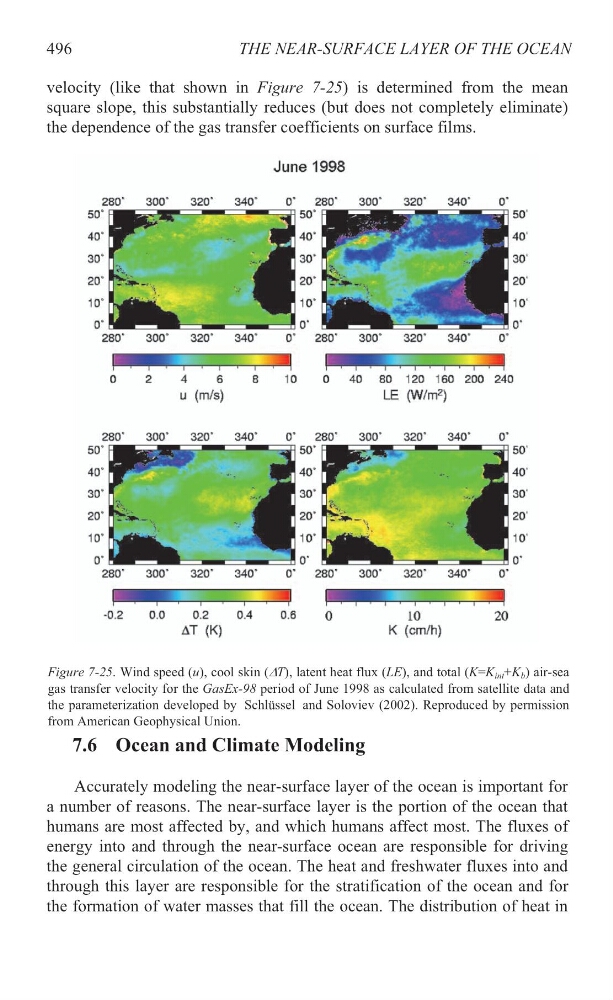
velocity (like that shown in Figure 7-25) is determined from the mean
square slope, this substantially reduces (but does not completely eliminate)
the dependence of the gas transfer coefficients on surface films.
7.6 Ocean and Climate Modeling
Accurately modeling the near-surface layer of the ocean is important for
a number of reasons. The near-surface layer is the portion of the ocean that
humans are most affected by, and which humans affect most. The fluxes of
energy into and through the near-surface ocean are responsible for driving
the general circulation of the ocean. The heat and freshwater fluxes into and
through this layer are responsible for the stratification of the ocean and for
the formation of water masses that fill the ocean. The distribution of heat in
496
Figure 7-25. Wind speed (u), cool skin ('T), latent heat flux (LE), and total (K=K int +K b ) air-sea
gas transfer velocity for the GasEx-98 period of June 1998 as calculated from satellite data and
the parameterization developed by Schl ssel and Soloviev (2002). Reproduced by permission
from American Geophysical Union.
ü
velocity (like that shown in Figure 7-25) is determined from the mean
square slope, this substantially reduces (but does not completely eliminate)
the dependence of the gas transfer coefficients on surface films.
7.6 Ocean and Climate Modeling
Accurately modeling the near-surface layer of the ocean is important for
a number of reasons. The near-surface layer is the portion of the ocean that
humans are most affected by, and which humans affect most. The fluxes of
energy into and through the near-surface ocean are responsible for driving
the general circulation of the ocean. The heat and freshwater fluxes into and
through this layer are responsible for the stratification of the ocean and for
the formation of water masses that fill the ocean. The distribution of heat in
496
Figure 7-25. Wind speed (u), cool skin ('T), latent heat flux (LE), and total (K=K int +K b ) air-sea
gas transfer velocity for the GasEx-98 period of June 1998 as calculated from satellite data and
the parameterization developed by Schl ssel and Soloviev (2002). Reproduced by permission
from American Geophysical Union.
ü