

Chapter 7: APPLICATIONS
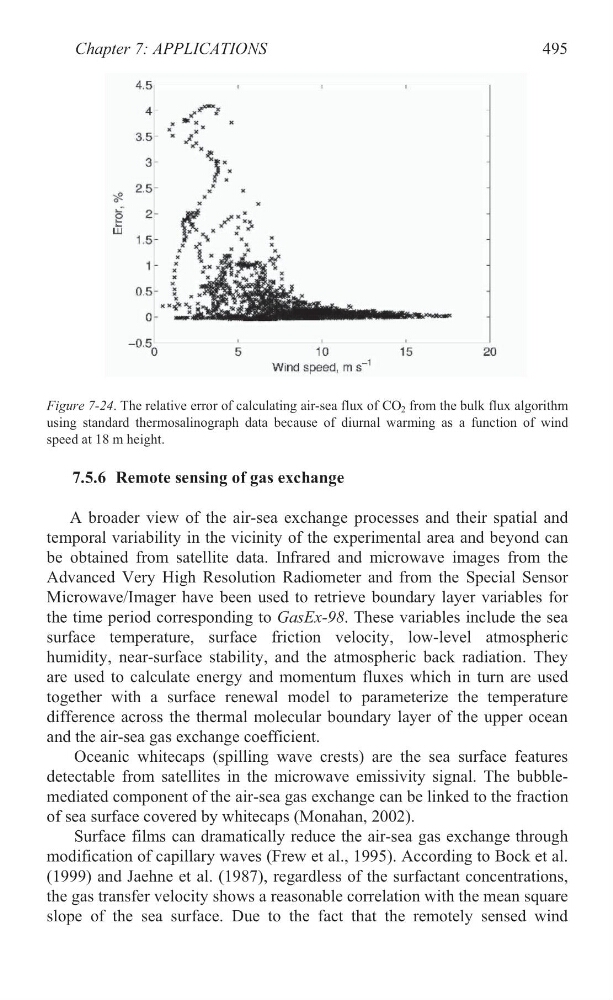
Figure 7-24. The relative error of calculating air-sea flux of CO 2 from the bulk flux algorithm
using standard thermosalinograph data because of diurnal warming as a function of wind
speed at 18 m height.
7.5.6 Remote sensing of gas exchange
A broader view of the air-sea exchange processes and their spatial and
temporal variability in the vicinity of the experimental area and beyond can
be obtained from satellite data. Infrared and microwave images from the
Advanced Very High Resolution Radiometer and from the Special Sensor
Microwave/Imager have been used to retrieve boundary layer variables for
the time period corresponding to GasEx-98. These variables include the sea
surface temperature, surface friction velocity, low-level atmospheric
humidity, near-surface stability, and the atmospheric back radiation. They
are used to calculate energy and momentum fluxes which in turn are used
together with a surface renewal model to parameterize the temperature
difference across the thermal molecular boundary layer of the upper ocean
and the air-sea gas exchange coefficient.
Oceanic whitecaps (spilling wave crests) are the sea surface features
detectable from satellites in the microwave emissivity signal. The bubblemediated component of the air-sea gas exchange can be linked to the fraction
of sea surface covered by whitecaps (Monahan, 2002).
Surface films can dramatically reduce the air-sea gas exchange through
modification of capillary waves (Frew et al., 1995). According to Bock et al.
(1999) and Jaehne et al. (1987), regardless of the surfactant concentrations,
the gas transfer velocity shows a reasonable correlation with the mean square
slope of the sea surface. Due to the fact that the remotely sensed wind
495
Figure 7-24. The relative error of calculating air-sea flux of CO 2 from the bulk flux algorithm
using standard thermosalinograph data because of diurnal warming as a function of wind
speed at 18 m height.
7.5.6 Remote sensing of gas exchange
A broader view of the air-sea exchange processes and their spatial and
temporal variability in the vicinity of the experimental area and beyond can
be obtained from satellite data. Infrared and microwave images from the
Advanced Very High Resolution Radiometer and from the Special Sensor
Microwave/Imager have been used to retrieve boundary layer variables for
the time period corresponding to GasEx-98. These variables include the sea
surface temperature, surface friction velocity, low-level atmospheric
humidity, near-surface stability, and the atmospheric back radiation. They
are used to calculate energy and momentum fluxes which in turn are used
together with a surface renewal model to parameterize the temperature
difference across the thermal molecular boundary layer of the upper ocean
and the air-sea gas exchange coefficient.
Oceanic whitecaps (spilling wave crests) are the sea surface features
detectable from satellites in the microwave emissivity signal. The bubblemediated component of the air-sea gas exchange can be linked to the fraction
of sea surface covered by whitecaps (Monahan, 2002).
Surface films can dramatically reduce the air-sea gas exchange through
modification of capillary waves (Frew et al., 1995). According to Bock et al.
(1999) and Jaehne et al. (1987), regardless of the surfactant concentrations,
the gas transfer velocity shows a reasonable correlation with the mean square
slope of the sea surface. Due to the fact that the remotely sensed wind
495