

Chapter 7: APPLICATIONS
resonance frequency of these sound-dominating bubble sizes. The
“large” drops produce the spectral peak between 2 and 5 kHz, while
the peak for the very large drop category extends down to 1–2 kHz.
The sound energy radiated by very large raindrops is relatively large
compared to their water volume. In order to address this problem, the
Nystuen (2001) constrained algorithm performs an iterative inversion. If the
number of very large drops per square meter of sea surface per second
appears to be greater than a chosen value, 10 m
-2 s
-1 , then very large drops
are assumed to be present. If very large drops are not present, the second
iteration of the inversion is repeated with the very large drop population set
to zero.
Since the medium raindrops have a weak acoustic signal, another
constraint is imposed. The medium raindrops are difficult to hear, especially
on the background of very large raindrops. Unrealistic values of the medium
drop category produced by inversion algorithms are unfortunately common.
Medium-sized raindrops, however, often comprise a significant part of the
477
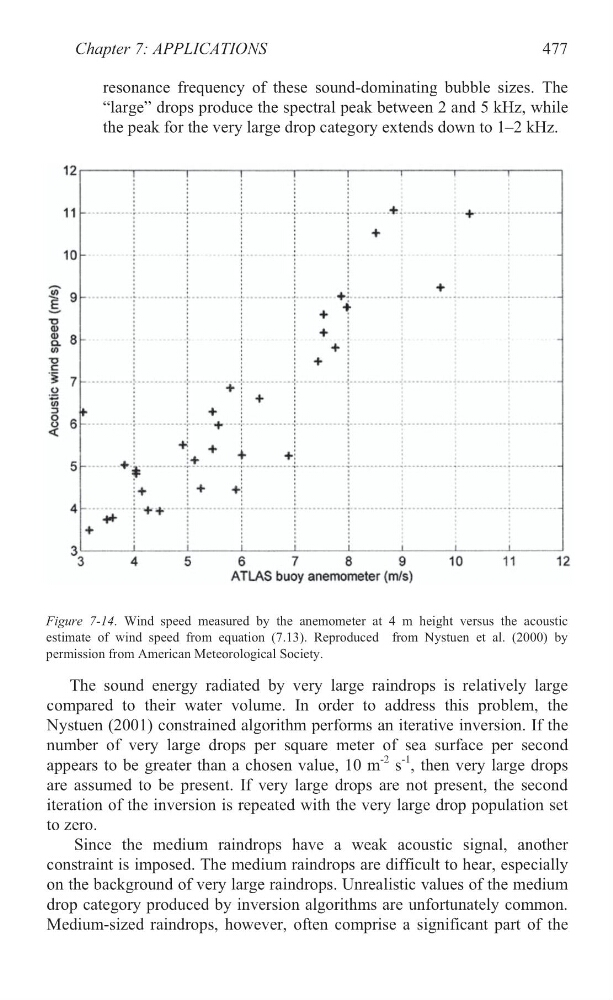
Figure 7-14. Wind speed measured by the anemometer at 4 m height versus the acoustic
estimate of wind speed from equation (7.13). Reproduced from Nystuen et al. (2000) by
permission from American Meteorological Society.
resonance frequency of these sound-dominating bubble sizes. The
“large” drops produce the spectral peak between 2 and 5 kHz, while
the peak for the very large drop category extends down to 1–2 kHz.
The sound energy radiated by very large raindrops is relatively large
compared to their water volume. In order to address this problem, the
Nystuen (2001) constrained algorithm performs an iterative inversion. If the
number of very large drops per square meter of sea surface per second
appears to be greater than a chosen value, 10 m
-2 s
-1 , then very large drops
are assumed to be present. If very large drops are not present, the second
iteration of the inversion is repeated with the very large drop population set
to zero.
Since the medium raindrops have a weak acoustic signal, another
constraint is imposed. The medium raindrops are difficult to hear, especially
on the background of very large raindrops. Unrealistic values of the medium
drop category produced by inversion algorithms are unfortunately common.
Medium-sized raindrops, however, often comprise a significant part of the
477
Figure 7-14. Wind speed measured by the anemometer at 4 m height versus the acoustic
estimate of wind speed from equation (7.13). Reproduced from Nystuen et al. (2000) by
permission from American Meteorological Society.