

THE NEAR-SURFACE LAYER OF THE OCEAN
In addition to the known geophysical sounds created by air-sea
interaction (wind, precipitation, subsurface bubbles), the ocean is also full of
natural and anthropogenic noise sources. Shipping is one the most common
anthropogenic noises in the ocean. Human activities other than shipping can
also create loud sounds. Marine mammals produce significant acoustic
signals. In addition, snapping shrimps can produce a very loud, broadband
sound that can dominate the underwater sound field. Fortunately, these
shrimp live on hard substrata in shallow tropical water and are not present in
the open ocean. There are also unidentified sources of sound in the ocean.
All together, 7.1% of the noise recorded by Nystuen et al. (2000) in the
South China Sea was contaminated by unrelated sounds. Removal of
contaminating sounds is an important part of identifying acoustical signals
produced by wind, precipitation, and sub-surface bubbles. Fortunately, the
spectral properties of these sounds are usually distinctively different from
the other (contaminating) sounds.
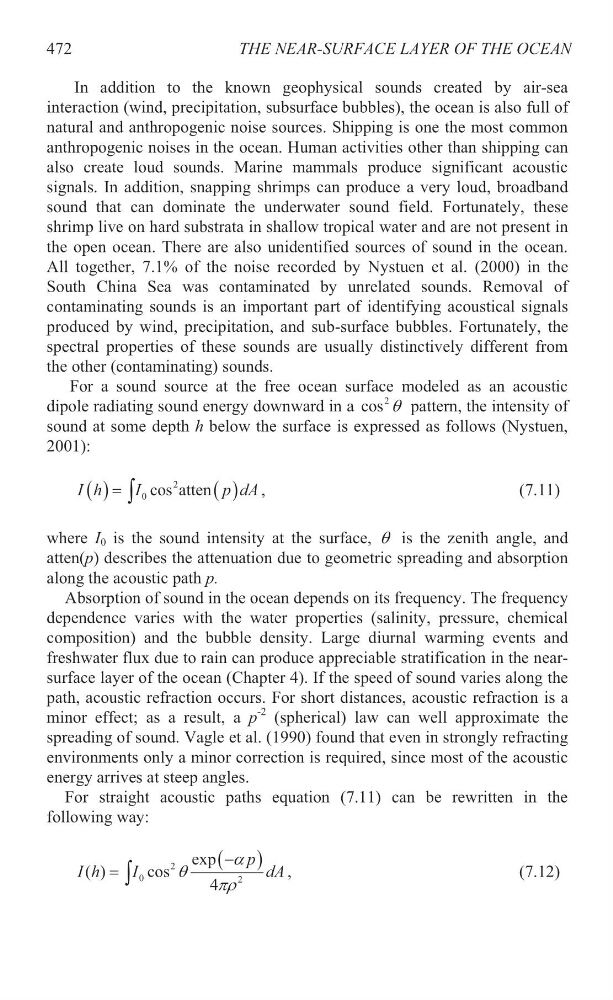
For a sound source at the free ocean surface modeled as an acoustic
dipole radiating sound energy downward in a
2
cos T pattern, the intensity of
sound at some depth h below the surface is expressed as follows (Nystuen,
2001):
2
0 cos atten
I h
I
p dA
³
,
(7.11)
where I 0 is the sound intensity at the surface, T is the zenith angle, and
atten(p) describes the attenuation due to geometric spreading and absorption
along the acoustic path p.
Absorption of sound in the ocean depends on its frequency. The frequency
dependence varies with the water properties (salinity, pressure, chemical
composition) and the bubble density. Large diurnal warming events and
freshwater flux due to rain can produce appreciable stratification in the nearsurface layer of the ocean (Chapter 4). If the speed of sound varies along the
path, acoustic refraction occurs. For short distances, acoustic refraction is a
minor effect; as a result, a p
-2 (spherical) law can well approximate the
spreading of sound. Vagle et al. (1990) found that even in strongly refracting
environments only a minor correction is required, since most of the acoustic
energy arrives at steep angles.
For straight acoustic paths equation (7.11) can be rewritten in the
following way:
2
0
2
exp
( )
cos
4
p
I h
I
dA
D
T
SU
³
,
(7.12)
472
In addition to the known geophysical sounds created by air-sea
interaction (wind, precipitation, subsurface bubbles), the ocean is also full of
natural and anthropogenic noise sources. Shipping is one the most common
anthropogenic noises in the ocean. Human activities other than shipping can
also create loud sounds. Marine mammals produce significant acoustic
signals. In addition, snapping shrimps can produce a very loud, broadband
sound that can dominate the underwater sound field. Fortunately, these
shrimp live on hard substrata in shallow tropical water and are not present in
the open ocean. There are also unidentified sources of sound in the ocean.
All together, 7.1% of the noise recorded by Nystuen et al. (2000) in the
South China Sea was contaminated by unrelated sounds. Removal of
contaminating sounds is an important part of identifying acoustical signals
produced by wind, precipitation, and sub-surface bubbles. Fortunately, the
spectral properties of these sounds are usually distinctively different from
the other (contaminating) sounds.
For a sound source at the free ocean surface modeled as an acoustic
dipole radiating sound energy downward in a
2
cos T pattern, the intensity of
sound at some depth h below the surface is expressed as follows (Nystuen,
2001):
2
0 cos atten
I h
I
p dA
³
,
(7.11)
where I 0 is the sound intensity at the surface, T is the zenith angle, and
atten(p) describes the attenuation due to geometric spreading and absorption
along the acoustic path p.
Absorption of sound in the ocean depends on its frequency. The frequency
dependence varies with the water properties (salinity, pressure, chemical
composition) and the bubble density. Large diurnal warming events and
freshwater flux due to rain can produce appreciable stratification in the nearsurface layer of the ocean (Chapter 4). If the speed of sound varies along the
path, acoustic refraction occurs. For short distances, acoustic refraction is a
minor effect; as a result, a p
-2 (spherical) law can well approximate the
spreading of sound. Vagle et al. (1990) found that even in strongly refracting
environments only a minor correction is required, since most of the acoustic
energy arrives at steep angles.
For straight acoustic paths equation (7.11) can be rewritten in the
following way:
2
0
2
exp
( )
cos
4
p
I h
I
dA
D
T
SU
³
,
(7.12)
472