

Chapter 7: APPLICATIONS
rain. Farmer and Lemon (1984) observed the deviations at frequencies over
10 kHz that were caused by acoustic absorption by bubbles (but for sea-state
conditions with U 10 > 10 m s
1 with high levels of wave breaking).
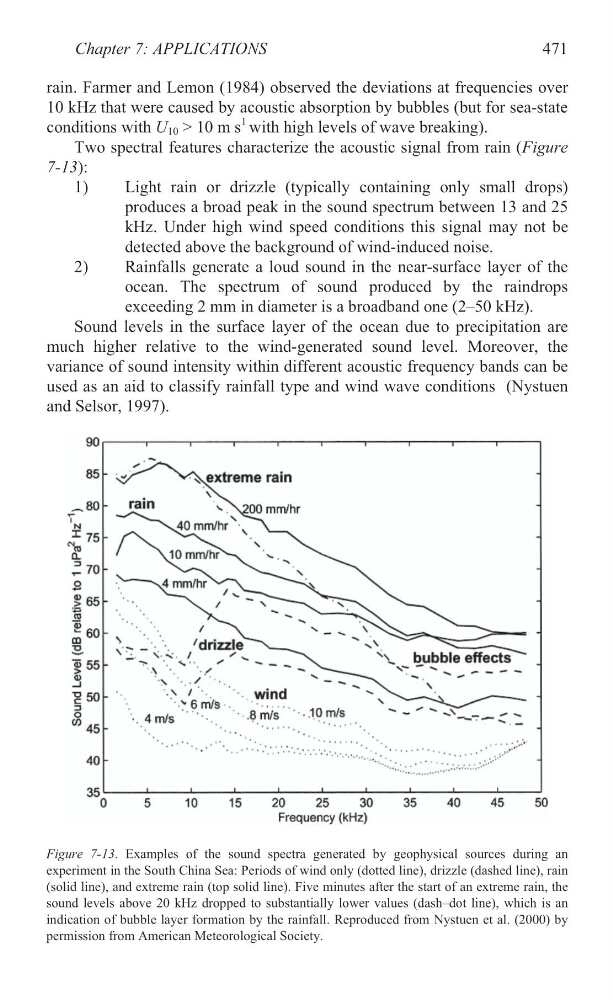
Two spectral features characterize the acoustic signal from rain (Figure
7-13):
1)
Light rain or drizzle (typically containing only small drops)
produces a broad peak in the sound spectrum between 13 and 25
kHz. Under high wind speed conditions this signal may not be
detected above the background of wind-induced noise.
2)
Rainfalls generate a loud sound in the near-surface layer of the
ocean. The spectrum of sound produced by the raindrops
exceeding 2 mm in diameter is a broadband one (2–50 kHz).
Sound levels in the surface layer of the ocean due to precipitation are
much higher relative to the wind-generated sound level. Moreover, the
variance of sound intensity within different acoustic frequency bands can be
used as an aid to classify rainfall type and wind wave conditions (Nystuen
and Selsor, 1997).
471
Figure 7-13. Examples of the sound spectra generated by geophysical sources during an
experiment in the South China Sea: Periods of wind only (dotted line), drizzle (dashed line), rain
(solid line), and extreme rain (top solid line). Five minutes after the start of an extreme rain, the
sound levels above 20 kHz dropped to substantially lower values (dash–dot line), which is an
indication of bubble layer formation by the rainfall. Reproduced from Nystuen et al. (2000) by
permission from American Meteorological Society.
rain. Farmer and Lemon (1984) observed the deviations at frequencies over
10 kHz that were caused by acoustic absorption by bubbles (but for sea-state
conditions with U 10 > 10 m s
1 with high levels of wave breaking).
Two spectral features characterize the acoustic signal from rain (Figure
7-13):
1)
Light rain or drizzle (typically containing only small drops)
produces a broad peak in the sound spectrum between 13 and 25
kHz. Under high wind speed conditions this signal may not be
detected above the background of wind-induced noise.
2)
Rainfalls generate a loud sound in the near-surface layer of the
ocean. The spectrum of sound produced by the raindrops
exceeding 2 mm in diameter is a broadband one (2–50 kHz).
Sound levels in the surface layer of the ocean due to precipitation are
much higher relative to the wind-generated sound level. Moreover, the
variance of sound intensity within different acoustic frequency bands can be
used as an aid to classify rainfall type and wind wave conditions (Nystuen
and Selsor, 1997).
471
Figure 7-13. Examples of the sound spectra generated by geophysical sources during an
experiment in the South China Sea: Periods of wind only (dotted line), drizzle (dashed line), rain
(solid line), and extreme rain (top solid line). Five minutes after the start of an extreme rain, the
sound levels above 20 kHz dropped to substantially lower values (dash–dot line), which is an
indication of bubble layer formation by the rainfall. Reproduced from Nystuen et al. (2000) by
permission from American Meteorological Society.