

Chapter 7: APPLICATIONS
currents (due to the passage of an eddy that spun off the nearby Gulf Stream)
on the small-scale wave breaking and the sound speed pattern in the nearsurface layer of the ocean.
7.4.4 Acoustic technique for measuring bubble size distributions
Vagle and Farmer (1998) published a fine review of acoustical methods
to measure bubble size distributions in the near-surface layer of the ocean
including the acoustical resonator (Breitz and Medwin, 1989; Farmer et al.,
1998; Su et al., 1994), acoustic pulse propagation sensor (Lamarre and
Melville, 1994; Terrill and Melville, 2000), backscatter measurement with
multiple- and single-frequency sonars (Thorpe, 1982; Vagle and Farmer,
1992). We discuss here in detail only the acoustic pulse propagation
approach.
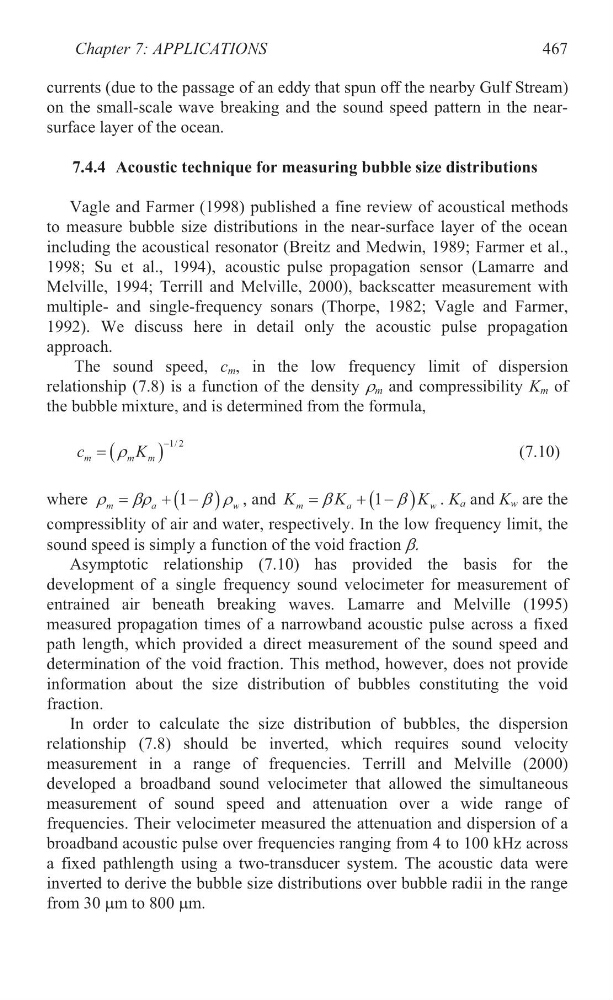
The sound speed, c m , in the low frequency limit of dispersion
relationship (7.8) is a function of the density U m and compressibility K m of
the bubble mixture, and is determined from the formula,
1/ 2
m
m m
c
K
U
(7.10)
where
1
m
a
w
U
EU
E U
, and
1
m
a
w
K
K
K
E
E
. K a and K w are the
compressiblity of air and water, respectively. In the low frequency limit, the
sound speed is simply a function of the void fraction E
Asymptotic relationship (7.10) has provided the basis for the
development of a single frequency sound velocimeter for measurement of
entrained air beneath breaking waves. Lamarre and Melville (1995)
measured propagation times of a narrowband acoustic pulse across a fixed
path length, which provided a direct measurement of the sound speed and
determination of the void fraction. This method, however, does not provide
information about the size distribution of bubbles constituting the void
fraction.
In order to calculate the size distribution of bubbles, the dispersion
relationship (7.8) should be inverted, which requires sound velocity
measurement in a range of frequencies. Terrill and Melville (2000)
developed a broadband sound velocimeter that allowed the simultaneous
measurement of sound speed and attenuation over a wide range of
frequencies. Their velocimeter measured the attenuation and dispersion of a
broadband acoustic pulse over frequencies ranging from 4 to 100 kHz across
a fixed pathlength using a two-transducer system. The acoustic data were
inverted to derive the bubble size distributions over bubble radii in the range
from 30 Pm to 800Pm.
467
currents (due to the passage of an eddy that spun off the nearby Gulf Stream)
on the small-scale wave breaking and the sound speed pattern in the nearsurface layer of the ocean.
7.4.4 Acoustic technique for measuring bubble size distributions
Vagle and Farmer (1998) published a fine review of acoustical methods
to measure bubble size distributions in the near-surface layer of the ocean
including the acoustical resonator (Breitz and Medwin, 1989; Farmer et al.,
1998; Su et al., 1994), acoustic pulse propagation sensor (Lamarre and
Melville, 1994; Terrill and Melville, 2000), backscatter measurement with
multiple- and single-frequency sonars (Thorpe, 1982; Vagle and Farmer,
1992). We discuss here in detail only the acoustic pulse propagation
approach.
The sound speed, c m , in the low frequency limit of dispersion
relationship (7.8) is a function of the density U m and compressibility K m of
the bubble mixture, and is determined from the formula,
1/ 2
m
m m
c
K
U
(7.10)
where
1
m
a
w
U
EU
E U
, and
1
m
a
w
K
K
K
E
E
. K a and K w are the
compressiblity of air and water, respectively. In the low frequency limit, the
sound speed is simply a function of the void fraction E
Asymptotic relationship (7.10) has provided the basis for the
development of a single frequency sound velocimeter for measurement of
entrained air beneath breaking waves. Lamarre and Melville (1995)
measured propagation times of a narrowband acoustic pulse across a fixed
path length, which provided a direct measurement of the sound speed and
determination of the void fraction. This method, however, does not provide
information about the size distribution of bubbles constituting the void
fraction.
In order to calculate the size distribution of bubbles, the dispersion
relationship (7.8) should be inverted, which requires sound velocity
measurement in a range of frequencies. Terrill and Melville (2000)
developed a broadband sound velocimeter that allowed the simultaneous
measurement of sound speed and attenuation over a wide range of
frequencies. Their velocimeter measured the attenuation and dispersion of a
broadband acoustic pulse over frequencies ranging from 4 to 100 kHz across
a fixed pathlength using a two-transducer system. The acoustic data were
inverted to derive the bubble size distributions over bubble radii in the range
from 30 Pm to 800Pm.
467