

THE NEAR-SURFACE LAYER OF THE OCEAN
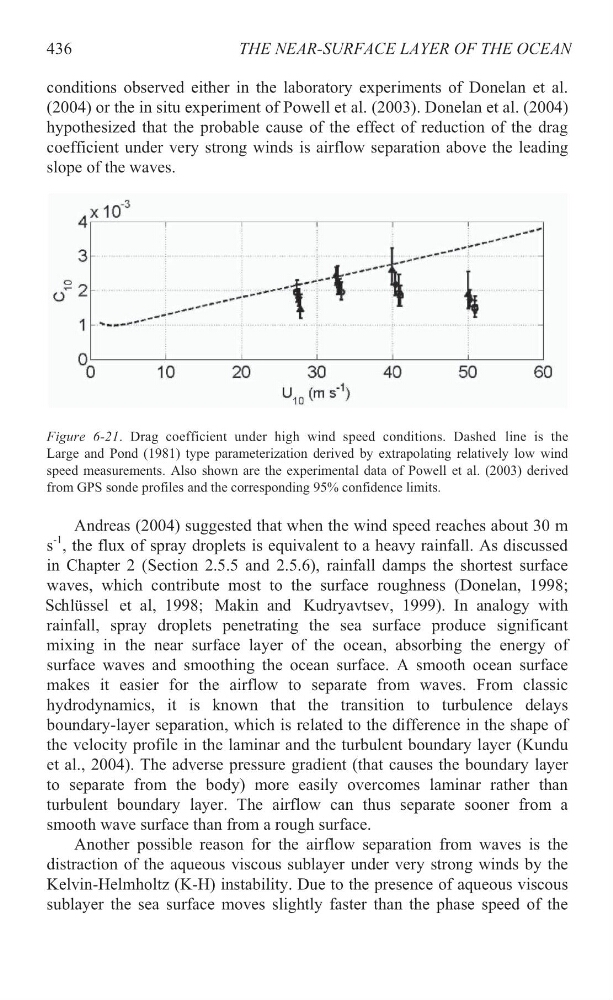
conditions observed either in the laboratory experiments of Donelan et al.
(2004) or the in situ experiment of Powell et al. (2003). Donelan et al. (2004)
hypothesized that the probable cause of the effect of reduction of the drag
coefficient under very strong winds is airflow separation above the leading
slope of the waves.
Figure 6-21. Drag coefficient under high wind speed conditions. Dashed line is the
Large and Pond (1981) type parameterization derived by extrapolating relatively low wind
speed measurements. Also shown are the experimental data of Powell et al. (2003) derived
from GPS sonde profiles and the corresponding 95% confidence limits.
Andreas (2004) suggested that when the wind speed reaches about 30 m
s
-1 , the flux of spray droplets is equivalent to a heavy rainfall. As discussed
in Chapter 2 (Section 2.5.5 and 2.5.6), rainfall damps the shortest surface
waves, which contribute most to the surface roughness (Donelan, 1998;
et al, 1998; Makin and Kudryavtsev, 1999). In analogy with
rainfall, spray droplets penetrating the sea surface produce significant
mixing in the near surface layer of the ocean, absorbing the energy of
surface waves and smoothing the ocean surface. A smooth ocean surface
makes it easier for the airflow to separate from waves. From classic
hydrodynamics, it is known that the transition to turbulence delays
boundary-layer separation, which is related to the difference in the shape of
the velocity profile in the laminar and the turbulent boundary layer (Kundu
et al., 2004). The adverse pressure gradient (that causes the boundary layer
to separate from the body) more easily overcomes laminar rather than
turbulent boundary layer. The airflow can thus separate sooner from a
smooth wave surface than from a rough surface.
Another possible reason for the airflow separation from waves is the
distraction of the aqueous viscous sublayer under very strong winds by the
Kelvin-Helmholtz (K-H) instability. Due to the presence of aqueous viscous
sublayer the sea surface moves slightly faster than the phase speed of the
436
Schl ssel
ü
conditions observed either in the laboratory experiments of Donelan et al.
(2004) or the in situ experiment of Powell et al. (2003). Donelan et al. (2004)
hypothesized that the probable cause of the effect of reduction of the drag
coefficient under very strong winds is airflow separation above the leading
slope of the waves.
Figure 6-21. Drag coefficient under high wind speed conditions. Dashed line is the
Large and Pond (1981) type parameterization derived by extrapolating relatively low wind
speed measurements. Also shown are the experimental data of Powell et al. (2003) derived
from GPS sonde profiles and the corresponding 95% confidence limits.
Andreas (2004) suggested that when the wind speed reaches about 30 m
s
-1 , the flux of spray droplets is equivalent to a heavy rainfall. As discussed
in Chapter 2 (Section 2.5.5 and 2.5.6), rainfall damps the shortest surface
waves, which contribute most to the surface roughness (Donelan, 1998;
et al, 1998; Makin and Kudryavtsev, 1999). In analogy with
rainfall, spray droplets penetrating the sea surface produce significant
mixing in the near surface layer of the ocean, absorbing the energy of
surface waves and smoothing the ocean surface. A smooth ocean surface
makes it easier for the airflow to separate from waves. From classic
hydrodynamics, it is known that the transition to turbulence delays
boundary-layer separation, which is related to the difference in the shape of
the velocity profile in the laminar and the turbulent boundary layer (Kundu
et al., 2004). The adverse pressure gradient (that causes the boundary layer
to separate from the body) more easily overcomes laminar rather than
turbulent boundary layer. The airflow can thus separate sooner from a
smooth wave surface than from a rough surface.
Another possible reason for the airflow separation from waves is the
distraction of the aqueous viscous sublayer under very strong winds by the
Kelvin-Helmholtz (K-H) instability. Due to the presence of aqueous viscous
sublayer the sea surface moves slightly faster than the phase speed of the
436
Schl ssel
ü