

0.2 µm, salinity does not affect the original droplet production, just the size
of the residual dry aerosol. Note that at formation, droplets are assumed to
have the salinity of the seawater (Andreas, 1998). Figure 6-10 thus indicates
different droplet formation processes for particles with D p smaller than ~0.2
µm and for particles larger than this size.
Aerosol number size distributions for four water temperatures are
presented in Figure 6-11. For D p > 0.35 µm, the number concentration
increases with increasing temperature, and the shapes of the size
distributions are similar at all temperatures. For D p < 0.07 µm, the number
concentration decreased with increasing temperature. The curves cross in a
transitional range 0.07 < D p < 0.35 µm, however no clear trend with water
temperature has been revealed for this transition. Similar to the salinity
dependence (Figure 6-10), the temperature dependence in Figure 6-11
indicates different droplet formation processes, in this case below and above
0.07–0.35 µm D p .
6.2.5 Marine aerosol generation function
The large concentration of aerosols in the sub-micrometer particle size
range observed in laboratory air-sea interaction tanks is consistent with
existing field data. The particle size distribution for dry aerosol particles
includes two modes producing a peak near the 2 Pm (median) diameter due
to jet drops and a peak near 0.2 Pm (median) diameter due to film drops
(O’Dowd and Smith, 1993). The marine aerosol size distributions increase
rapidly with wind speed for both modes.
Below we consider a recent parameterization for the primary marine
aerosol generation function proposed by Mårtensson et al. (2003). This
parameterization, intended for the dry diameter of aerosol particles in the
0.02 Pm < D p < 3 Pm range, is as follows:
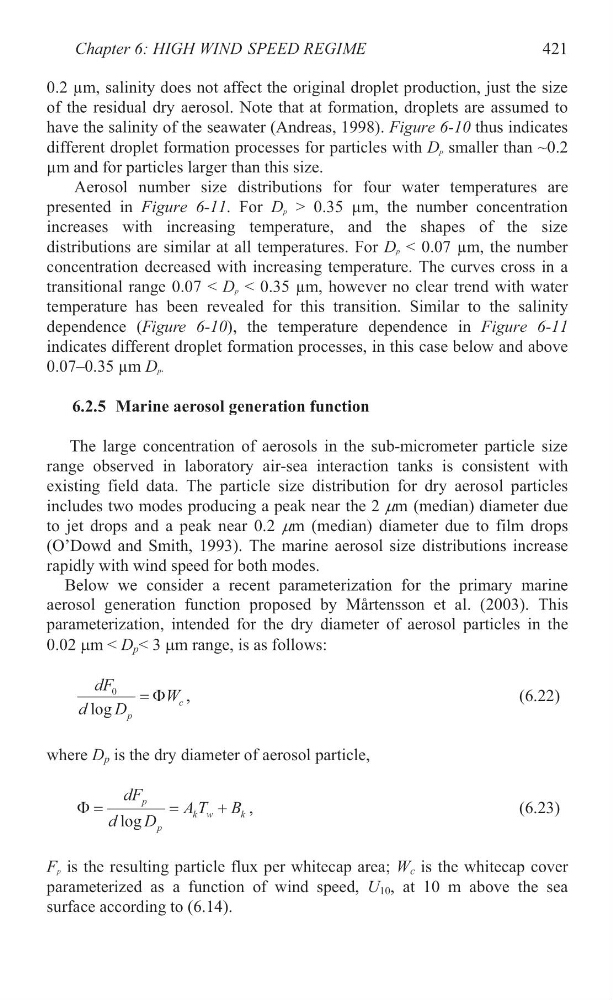
0
log
c
p
dF
W
d
D
) ,
(6.22)
where D p is the dry diameter of aerosol particle,
log
p
k w
k
p
dF
A T B
d
D
)
,
(6.23)
F p is the resulting particle flux per whitecap area; W c is the whitecap cover
parameterized as a function of wind speed, U 10 , at 10 m above the sea
surface according to (6.14).
Chapter 6: HIGH WIND SPEED REGIME
421
of the residual dry aerosol. Note that at formation, droplets are assumed to
have the salinity of the seawater (Andreas, 1998). Figure 6-10 thus indicates
different droplet formation processes for particles with D p smaller than ~0.2
µm and for particles larger than this size.
Aerosol number size distributions for four water temperatures are
presented in Figure 6-11. For D p > 0.35 µm, the number concentration
increases with increasing temperature, and the shapes of the size
distributions are similar at all temperatures. For D p < 0.07 µm, the number
concentration decreased with increasing temperature. The curves cross in a
transitional range 0.07 < D p < 0.35 µm, however no clear trend with water
temperature has been revealed for this transition. Similar to the salinity
dependence (Figure 6-10), the temperature dependence in Figure 6-11
indicates different droplet formation processes, in this case below and above
0.07–0.35 µm D p .
6.2.5 Marine aerosol generation function
The large concentration of aerosols in the sub-micrometer particle size
range observed in laboratory air-sea interaction tanks is consistent with
existing field data. The particle size distribution for dry aerosol particles
includes two modes producing a peak near the 2 Pm (median) diameter due
to jet drops and a peak near 0.2 Pm (median) diameter due to film drops
(O’Dowd and Smith, 1993). The marine aerosol size distributions increase
rapidly with wind speed for both modes.
Below we consider a recent parameterization for the primary marine
aerosol generation function proposed by Mårtensson et al. (2003). This
parameterization, intended for the dry diameter of aerosol particles in the
0.02 Pm < D p < 3 Pm range, is as follows:
0
log
c
p
dF
W
d
D
) ,
(6.22)
where D p is the dry diameter of aerosol particle,
log
p
k w
k
p
dF
A T B
d
D
)
,
(6.23)
F p is the resulting particle flux per whitecap area; W c is the whitecap cover
parameterized as a function of wind speed, U 10 , at 10 m above the sea
surface according to (6.14).
Chapter 6: HIGH WIND SPEED REGIME
421