

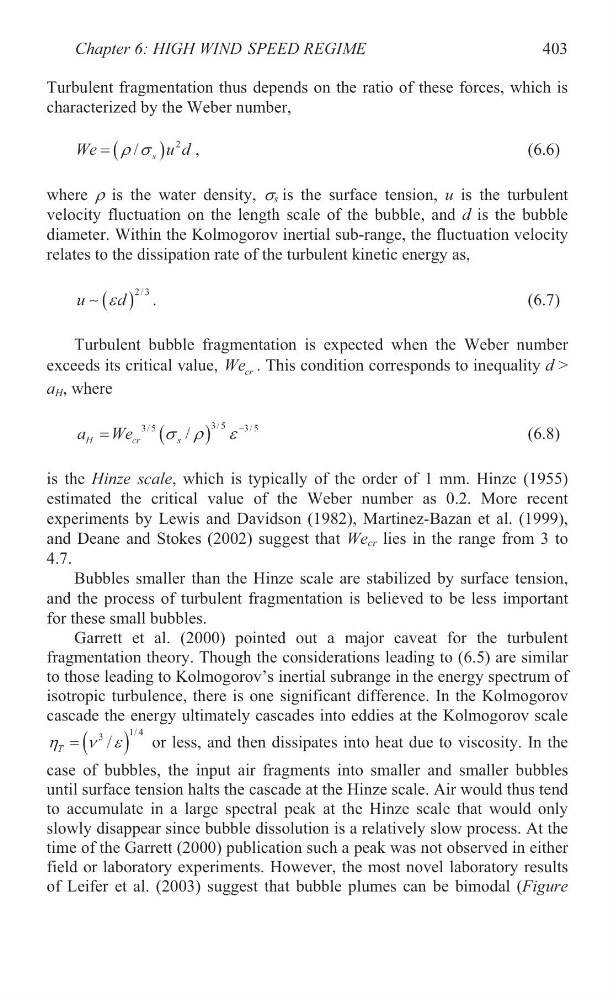
Turbulent fragmentation thus depends on the ratio of these forces, which is
characterized by the Weber number,
2
/ s
We
u d
U V
,
(6.6)
where U is the water density, V s is the surface tension, u is the turbulent
velocity fluctuation on the length scale of the bubble, and d is the bubble
diameter. Within the Kolmogorov inertial sub-range, the fluctuation velocity
relates to the dissipation rate of the turbulent kinetic energy as,
2 / 3
u
d
H
.
(6.7)
Turbulent bubble fragmentation is expected when the Weber number
exceeds its critical value,
cr
We . This condition corresponds to inequality d >
a H , where
3/ 5
3/ 5
3/ 5
/
H
c r
s
a
We
V U H
(6.8)
is the Hinze scale, which is typically of the order of 1 mm. Hinze (1955)
estimated the critical value of the Weber number as 0.2. More recent
experiments by Lewis and Davidson (1982), Martinez-Bazan et al. (1999),
and Deane and Stokes (2002) suggest that We cr lies in the range from 3 to
4.7.
Bubbles smaller than the Hinze scale are stabilized by surface tension,
and the process of turbulent fragmentation is believed to be less important
for these small bubbles.
Garrett et al. (2000) pointed out a major caveat for the turbulent
fragmentation theory. Though the considerations leading to (6.5) are similar
to those leading to Kolmogorov’s inertial subrange in the energy spectrum of
isotropic turbulence, there is one significant difference. In the Kolmogorov
cascade the energy ultimately cascades into eddies at the Kolmogorov scale
1/ 4
3 /
T
K
Q H
or less, and then dissipates into heat due to viscosity. In the
case of bubbles, the input air fragments into smaller and smaller bubbles
until surface tension halts the cascade at the Hinze scale. Air would thus tend
to accumulate in a large spectral peak at the Hinze scale that would only
slowly disappear since bubble dissolution is a relatively slow process. At the
time of the Garrett (2000) publication such a peak was not observed in either
field or laboratory experiments. However, the most novel laboratory results
of Leifer et al. (2003) suggest that bubble plumes can be bimodal (Figure
Chapter 6: HIGH WIND SPEED REGIME
403
characterized by the Weber number,
2
/ s
We
u d
U V
,
(6.6)
where U is the water density, V s is the surface tension, u is the turbulent
velocity fluctuation on the length scale of the bubble, and d is the bubble
diameter. Within the Kolmogorov inertial sub-range, the fluctuation velocity
relates to the dissipation rate of the turbulent kinetic energy as,
2 / 3
u
d
H
.
(6.7)
Turbulent bubble fragmentation is expected when the Weber number
exceeds its critical value,
cr
We . This condition corresponds to inequality d >
a H , where
3/ 5
3/ 5
3/ 5
/
H
c r
s
a
We
V U H
(6.8)
is the Hinze scale, which is typically of the order of 1 mm. Hinze (1955)
estimated the critical value of the Weber number as 0.2. More recent
experiments by Lewis and Davidson (1982), Martinez-Bazan et al. (1999),
and Deane and Stokes (2002) suggest that We cr lies in the range from 3 to
4.7.
Bubbles smaller than the Hinze scale are stabilized by surface tension,
and the process of turbulent fragmentation is believed to be less important
for these small bubbles.
Garrett et al. (2000) pointed out a major caveat for the turbulent
fragmentation theory. Though the considerations leading to (6.5) are similar
to those leading to Kolmogorov’s inertial subrange in the energy spectrum of
isotropic turbulence, there is one significant difference. In the Kolmogorov
cascade the energy ultimately cascades into eddies at the Kolmogorov scale
1/ 4
3 /
T
K
Q H
or less, and then dissipates into heat due to viscosity. In the
case of bubbles, the input air fragments into smaller and smaller bubbles
until surface tension halts the cascade at the Hinze scale. Air would thus tend
to accumulate in a large spectral peak at the Hinze scale that would only
slowly disappear since bubble dissolution is a relatively slow process. At the
time of the Garrett (2000) publication such a peak was not observed in either
field or laboratory experiments. However, the most novel laboratory results
of Leifer et al. (2003) suggest that bubble plumes can be bimodal (Figure
Chapter 6: HIGH WIND SPEED REGIME
403