

THE NEAR-SURFACE LAYER OF THE OCEAN
5.6.6 Vorticity waves in shear flows
The vorticity waves introduced in Section 5.4.3 for a stratified ocean (in
relation to sharp frontal interfaces) can also exist in a uniform density fluid
(Lin, 1966). In stratified flows the vorticity waves are not directly affected
by stratification, though the presence of stratification may affect the vorticity
waves indirectly, via modifying the mean velocity profile or due to
resonance with the internal waves that can develop in the underlying
stratified layer (Section 5.4.3).
The theoretical analysis below is based on the hypothesis that ramp-like
structures are associated with vorticity waves. Ramp-like structures have
been observed within the actively mixed turbulent boundary layer (i.e., at Ri
< Ri cr = 1/4) that, according to condition (5.25) (or (5.27)), can be far from
internal wave–shear resonance. The system of equations describing the
internal wave–shear flow resonance in Section 5.4.3 is replaced with a single
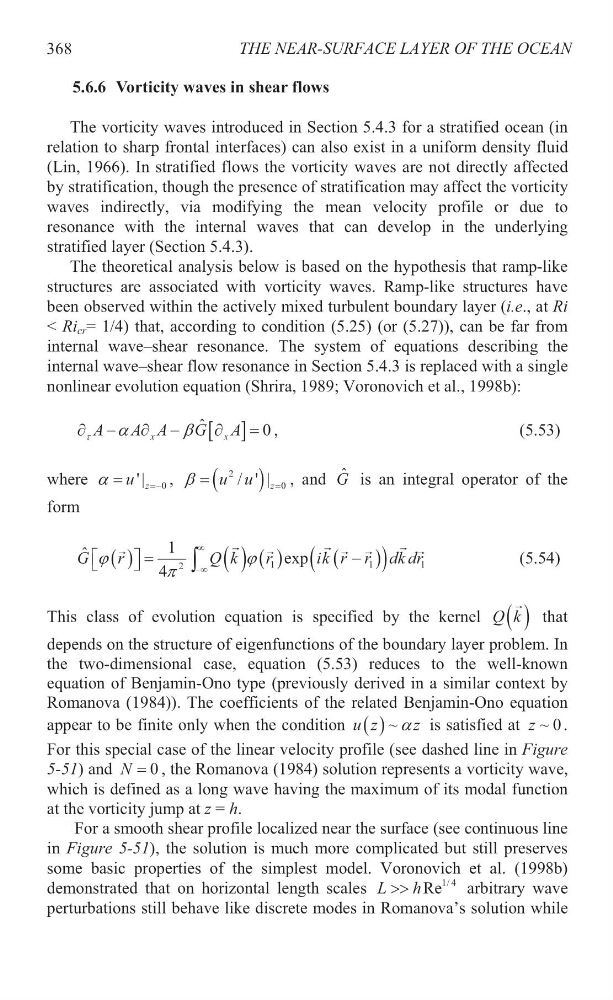
nonlinear evolution equation (Shrira, 1989; Voronovich et al., 1998b):
> @
ˆ
0
x
x
A
A A
G A
W
D
E
w w
w
,
(5.53)
where
0
' | z
u
D
,
2
0
/ ' | z
u u
E
, and ˆ
G is an integral operator of the
form
1
1
1
2
1
ˆ
exp
4
G
r
Q k
r
ik r r dkdr
M
M
S
f
f
ª
º
¬
¼
³
G
G
G
G
G
G G
G
(5.54)
This class of evolution equation is specified by the kernel
Q k
G
that
depends on the structure of eigenfunctions of the boundary layer problem. In
the two-dimensional case, equation (5.53) reduces to the well-known
equation of Benjamin-Ono type (previously derived in a similar context by
Romanova (1984)). The coefficients of the related Benjamin-Ono equation
appear to be finite only when the condition ~
u z
z
D is satisfied at ~ 0
z
.
For this special case of the linear velocity profile (see dashed line in Figure
5-51) and
0
N
, the Romanova (1984) solution represents a vorticity wave,
which is defined as a long wave having the maximum of its modal function
at the vorticity jump at z = h.
For a smooth shear profile localized near the surface (see continuous line
in Figure 5-51), the solution is much more complicated but still preserves
some basic properties of the simplest model. Voronovich et al. (1998b)
demonstrated that on horizontal length scales
1/ 4
Re
L
h
!!
arbitrary wave
perturbations still behave like discrete modes in Romanova’s solution while
368
5.6.6 Vorticity waves in shear flows
The vorticity waves introduced in Section 5.4.3 for a stratified ocean (in
relation to sharp frontal interfaces) can also exist in a uniform density fluid
(Lin, 1966). In stratified flows the vorticity waves are not directly affected
by stratification, though the presence of stratification may affect the vorticity
waves indirectly, via modifying the mean velocity profile or due to
resonance with the internal waves that can develop in the underlying
stratified layer (Section 5.4.3).
The theoretical analysis below is based on the hypothesis that ramp-like
structures are associated with vorticity waves. Ramp-like structures have
been observed within the actively mixed turbulent boundary layer (i.e., at Ri
< Ri cr = 1/4) that, according to condition (5.25) (or (5.27)), can be far from
internal wave–shear resonance. The system of equations describing the
internal wave–shear flow resonance in Section 5.4.3 is replaced with a single
nonlinear evolution equation (Shrira, 1989; Voronovich et al., 1998b):
> @
ˆ
0
x
x
A
A A
G A
W
D
E
w w
w
,
(5.53)
where
0
' | z
u
D
,
2
0
/ ' | z
u u
E
, and ˆ
G is an integral operator of the
form
1
1
1
2
1
ˆ
exp
4
G
r
Q k
r
ik r r dkdr
M
M
S
f
f
ª
º
¬
¼
³
G
G
G
G
G
G G
G
(5.54)
This class of evolution equation is specified by the kernel
Q k
G
that
depends on the structure of eigenfunctions of the boundary layer problem. In
the two-dimensional case, equation (5.53) reduces to the well-known
equation of Benjamin-Ono type (previously derived in a similar context by
Romanova (1984)). The coefficients of the related Benjamin-Ono equation
appear to be finite only when the condition ~
u z
z
D is satisfied at ~ 0
z
.
For this special case of the linear velocity profile (see dashed line in Figure
5-51) and
0
N
, the Romanova (1984) solution represents a vorticity wave,
which is defined as a long wave having the maximum of its modal function
at the vorticity jump at z = h.
For a smooth shear profile localized near the surface (see continuous line
in Figure 5-51), the solution is much more complicated but still preserves
some basic properties of the simplest model. Voronovich et al. (1998b)
demonstrated that on horizontal length scales
1/ 4
Re
L
h
!!
arbitrary wave
perturbations still behave like discrete modes in Romanova’s solution while
368