

Chapter 5. SPATIALLY-COHERENT STRUCTURES
The phenomenological model of McNaughton and Brunet (2002)
justifies some important underlying assumptions made in the theory of
coherent structures as vorticity waves described in the next section (Section
5.6.6):
1)
Wall streaks can form within fully-turbulent layers
2)
A zone of strong shear is created between the faster and slower air
streams, and
3)
On certain time scales the viscosity effects are negligible.
Since temperature transport is significantly affected, the dimensional
assumptions of Monin-Oboukhov theory are undermined. This circumstance
has important application for mixing parameterizations, which can no longer
rely on local diffusion only but must include nonlocal transport due to
coherent structures.
367
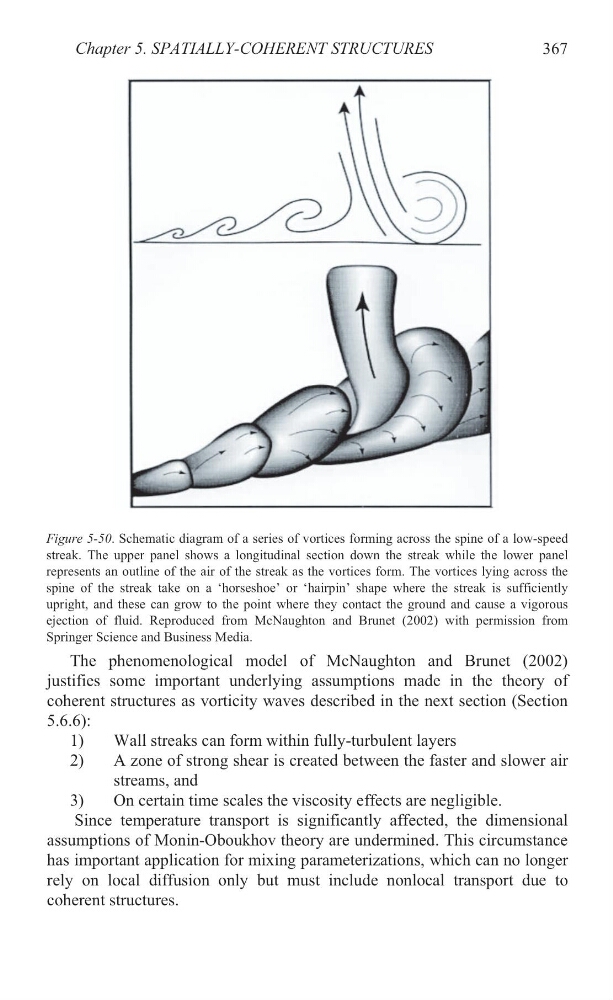
Figure 5-50. Schematic diagram of a series of vortices forming across the spine of a low-speed
streak. The upper panel shows a longitudinal section down the streak while the lower panel
represents an outline of the air of the streak as the vortices form. The vortices lying across the
spine of the streak take on a ‘horseshoe’ or ‘hairpin’ shape where the streak is sufficiently
upright, and these can grow to the point where they contact the ground and cause a vigorous
ejection of fluid. Reproduced from McNaughton and Brunet (2002) with permission from
Springer Science and Business Media.
The phenomenological model of McNaughton and Brunet (2002)
justifies some important underlying assumptions made in the theory of
coherent structures as vorticity waves described in the next section (Section
5.6.6):
1)
Wall streaks can form within fully-turbulent layers
2)
A zone of strong shear is created between the faster and slower air
streams, and
3)
On certain time scales the viscosity effects are negligible.
Since temperature transport is significantly affected, the dimensional
assumptions of Monin-Oboukhov theory are undermined. This circumstance
has important application for mixing parameterizations, which can no longer
rely on local diffusion only but must include nonlocal transport due to
coherent structures.
367
Figure 5-50. Schematic diagram of a series of vortices forming across the spine of a low-speed
streak. The upper panel shows a longitudinal section down the streak while the lower panel
represents an outline of the air of the streak as the vortices form. The vortices lying across the
spine of the streak take on a ‘horseshoe’ or ‘hairpin’ shape where the streak is sufficiently
upright, and these can grow to the point where they contact the ground and cause a vigorous
ejection of fluid. Reproduced from McNaughton and Brunet (2002) with permission from
Springer Science and Business Media.