

Chapter 1: INTRODUCTION
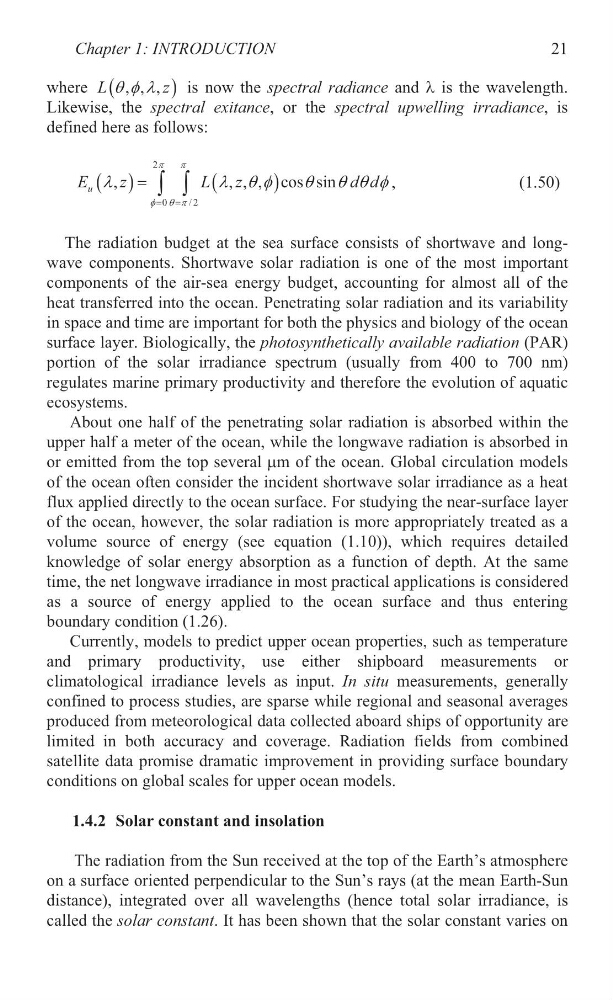
where
, , ,
L
z
T I O
is now the spectral radiance and O is the wavelength.
Likewise, the spectral exitance, or the spectral upwelling irradiance, is
defined here as follows:
2
0
/2
,
,,, c o s s i n
u
E
z
L z
d d
S
S
I T S
O
O TI
T T T I
³ ³
,
(1.50)
The radiation budget at the sea surface consists of shortwave and longwave components. Shortwave solar radiation is one of the most important
components of the air-sea energy budget, accounting for almost all of the
heat transferred into the ocean. Penetrating solar radiation and its variability
in space and time are important for both the physics and biology of the ocean
surface layer. Biologically, the photosynthetically available radiation (PAR)
portion of the solar irradiance spectrum (usually from 400 to 700 nm)
regulates marine primary productivity and therefore the evolution of aquatic
ecosystems.
About one half of the penetrating solar radiation is absorbed within the
upper half a meter of the ocean, while the longwave radiation is absorbed in
or emitted from the top several Pm of the ocean. Global circulation models
of the ocean often consider the incident shortwave solar irradiance as a heat
flux applied directly to the ocean surface. For studying the near-surface layer
of the ocean, however, the solar radiation is more appropriately treated as a
volume source of energy (see equation (1.10)), which requires detailed
knowledge of solar energy absorption as a function of depth. At the same
time, the net longwave irradiance in most practical applications is considered
as a source of energy applied to the ocean surface and thus entering
boundary condition (1.26).
Currently, models to predict upper ocean properties, such as temperature
and primary productivity, use either shipboard measurements or
climatological irradiance levels as input. In situ measurements, generally
confined to process studies, are sparse while regional and seasonal averages
produced from meteorological data collected aboard ships of opportunity are
limited in both accuracy and coverage. Radiation fields from combined
satellite data promise dramatic improvement in providing surface boundary
conditions on global scales for upper ocean models.
1.4.2 Solar constant and insolation
The radiation from the Sun received at the top of the Earth’s atmosphere
on a surface oriented perpendicular to the Sun’s rays (at the mean Earth-Sun
distance), integrated over all wavelengths (hence total solar irradiance, is
called the solar constant. It has been shown that the solar constant varies on
21
where
, , ,
L
z
T I O
is now the spectral radiance and O is the wavelength.
Likewise, the spectral exitance, or the spectral upwelling irradiance, is
defined here as follows:
2
0
/2
,
,,, c o s s i n
u
E
z
L z
d d
S
S
I T S
O
O TI
T T T I
³ ³
,
(1.50)
The radiation budget at the sea surface consists of shortwave and longwave components. Shortwave solar radiation is one of the most important
components of the air-sea energy budget, accounting for almost all of the
heat transferred into the ocean. Penetrating solar radiation and its variability
in space and time are important for both the physics and biology of the ocean
surface layer. Biologically, the photosynthetically available radiation (PAR)
portion of the solar irradiance spectrum (usually from 400 to 700 nm)
regulates marine primary productivity and therefore the evolution of aquatic
ecosystems.
About one half of the penetrating solar radiation is absorbed within the
upper half a meter of the ocean, while the longwave radiation is absorbed in
or emitted from the top several Pm of the ocean. Global circulation models
of the ocean often consider the incident shortwave solar irradiance as a heat
flux applied directly to the ocean surface. For studying the near-surface layer
of the ocean, however, the solar radiation is more appropriately treated as a
volume source of energy (see equation (1.10)), which requires detailed
knowledge of solar energy absorption as a function of depth. At the same
time, the net longwave irradiance in most practical applications is considered
as a source of energy applied to the ocean surface and thus entering
boundary condition (1.26).
Currently, models to predict upper ocean properties, such as temperature
and primary productivity, use either shipboard measurements or
climatological irradiance levels as input. In situ measurements, generally
confined to process studies, are sparse while regional and seasonal averages
produced from meteorological data collected aboard ships of opportunity are
limited in both accuracy and coverage. Radiation fields from combined
satellite data promise dramatic improvement in providing surface boundary
conditions on global scales for upper ocean models.
1.4.2 Solar constant and insolation
The radiation from the Sun received at the top of the Earth’s atmosphere
on a surface oriented perpendicular to the Sun’s rays (at the mean Earth-Sun
distance), integrated over all wavelengths (hence total solar irradiance, is
called the solar constant. It has been shown that the solar constant varies on
21