

THE NEAR-SURFACE LAYER OF THE OCEAN
Ideally, the temperature difference across the millimeter-thick cool skin
should be accounted for. Yet the temperature profile in the top few
millimeters of the ocean is extremely difficult to measure. In many locations
of the ocean the temperature in the upper few mm differs from the
temperature at 0.5 m or more below the surface by less than 0.5 K. In some
places and times, the difference can be as much as 4-5 K, making a
correction to the bulk temperature necessary in order to closely approximate
the skin temperature (Fairall et al., 1996).
1.4 Solar Radiation
1.4.1 Definitions
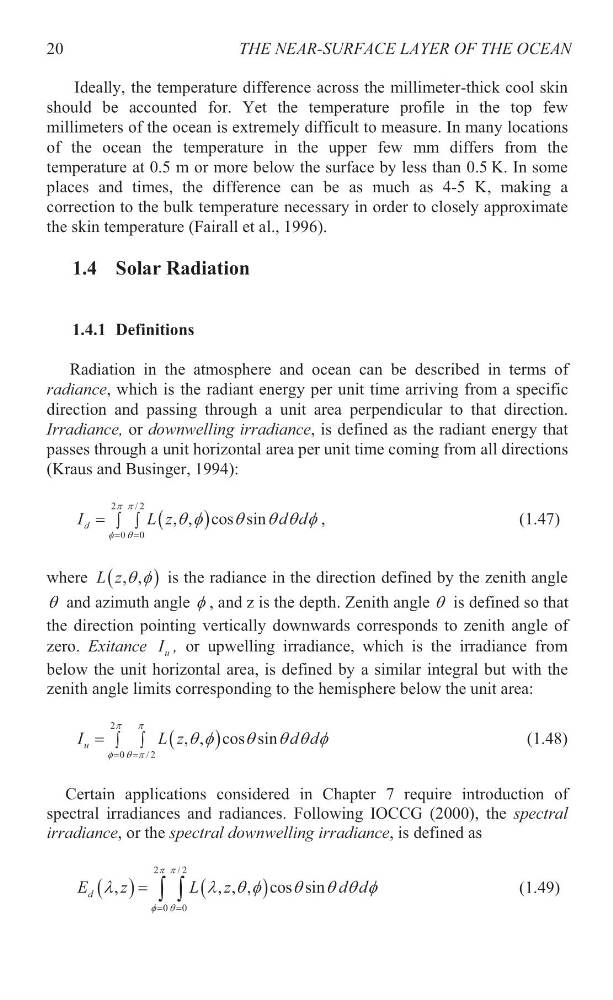
Radiation in the atmosphere and ocean can be described in terms of
radiance, which is the radiant energy per unit time arriving from a specific
direction and passing through a unit area perpendicular to that direction.
Irradiance, or downwelling irradiance, is defined as the radiant energy that
passes through a unit horizontal area per unit time coming from all directions
(Kraus and Businger, 1994):
2
/2
0 0
, , cos sin
d
I
L z
d d
S S
I T
T I
T T T I
³ ³
,
(1.47)
where
, ,
L z T I is the radiance in the direction defined by the zenith angle
T and azimuth angle I , and z is the depth. Zenith angle T is defined so that
the direction pointing vertically downwards corresponds to zenith angle of
zero. Exitance u
I , or upwelling irradiance, which is the irradiance from
below the unit horizontal area, is defined by a similar integral but with the
zenith angle limits corresponding to the hemisphere below the unit area:
2
0
/2
, , cos sin
u
I
L z
d d
S
S
I T S
T I
T T T I
³ ³
(1.48)
Certain applications considered in Chapter 7 require introduction of
spectral irradiances and radiances. Following IOCCG (2000), the spectral
irradiance, or the spectral downwelling irradiance, is defined as
2
/2
0 0
,
,, , c o s s i n
d
E
z
L z
d d
S S
I T
O
O TI
T T T I
³ ³
(1.49)
20
Ideally, the temperature difference across the millimeter-thick cool skin
should be accounted for. Yet the temperature profile in the top few
millimeters of the ocean is extremely difficult to measure. In many locations
of the ocean the temperature in the upper few mm differs from the
temperature at 0.5 m or more below the surface by less than 0.5 K. In some
places and times, the difference can be as much as 4-5 K, making a
correction to the bulk temperature necessary in order to closely approximate
the skin temperature (Fairall et al., 1996).
1.4 Solar Radiation
1.4.1 Definitions
Radiation in the atmosphere and ocean can be described in terms of
radiance, which is the radiant energy per unit time arriving from a specific
direction and passing through a unit area perpendicular to that direction.
Irradiance, or downwelling irradiance, is defined as the radiant energy that
passes through a unit horizontal area per unit time coming from all directions
(Kraus and Businger, 1994):
2
/2
0 0
, , cos sin
d
I
L z
d d
S S
I T
T I
T T T I
³ ³
,
(1.47)
where
, ,
L z T I is the radiance in the direction defined by the zenith angle
T and azimuth angle I , and z is the depth. Zenith angle T is defined so that
the direction pointing vertically downwards corresponds to zenith angle of
zero. Exitance u
I , or upwelling irradiance, which is the irradiance from
below the unit horizontal area, is defined by a similar integral but with the
zenith angle limits corresponding to the hemisphere below the unit area:
2
0
/2
, , cos sin
u
I
L z
d d
S
S
I T S
T I
T T T I
³ ³
(1.48)
Certain applications considered in Chapter 7 require introduction of
spectral irradiances and radiances. Following IOCCG (2000), the spectral
irradiance, or the spectral downwelling irradiance, is defined as
2
/2
0 0
,
,, , c o s s i n
d
E
z
L z
d d
S S
I T
O
O TI
T T T I
³ ³
(1.49)
20