

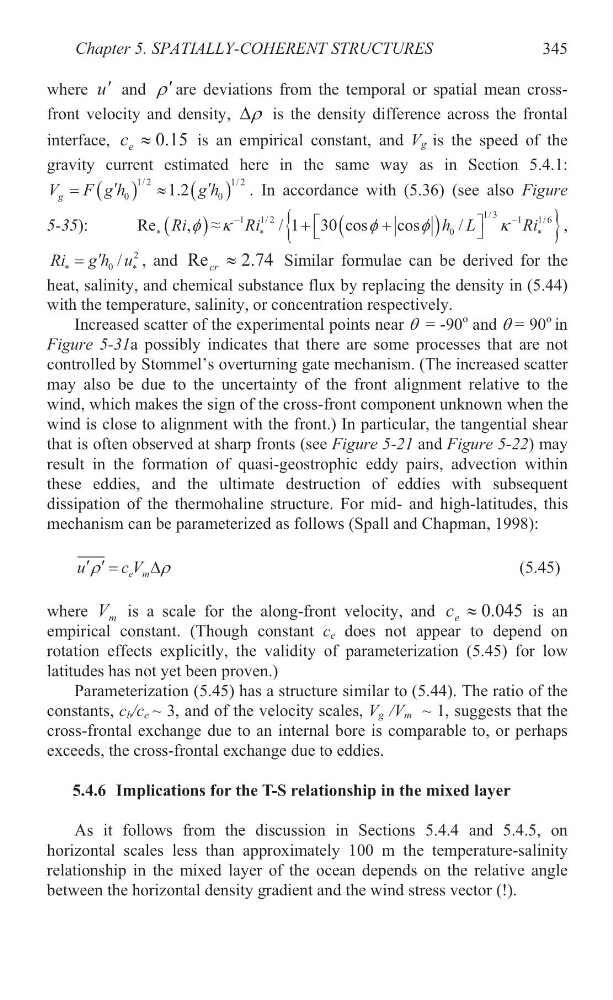
Chapter 5. SPATIALLY-COHERENT STRUCTURES
where uc and Uc are deviations from the temporal or spatial mean crossfront velocity and density, U
' is the density difference across the frontal
interface,
15
.
0
|
e
c
is an empirical constant, and V g is the speed of the
gravity current estimated here in the same way as in Section 5.4.1:
1/ 2
1/ 2
0
0
1.2
g
V F g h
g h
c
c
|
. In accordance with (5.36) (see also Figure
5-35):
Re
,
Ri I
§
^
`
1/ 3
1
1/2
1
1/6
0
/ 1 30 cos
cos
/
Ri
hL
R i
N
I
I
N
ª
º
¬
¼
,
2
0 /
Ri g h u
c
, and
74
.
2
Re |
cr
Similar formulae can be derived for the
heat, salinity, and chemical substance flux by replacing the density in (5.44)
with the temperature, salinity, or concentration respectively.
Increased scatter of the experimental points near T= -90
o and T = 90
o in
Figure 5-31a possibly indicates that there are some processes that are not
controlled by Stommel’s overturning gate mechanism. (The increased scatter
may also be due to the uncertainty of the front alignment relative to the
wind, which makes the sign of the cross-front component unknown when the
wind is close to alignment with the front.) In particular, the tangential shear
that is often observed at sharp fronts (see Figure 5-21 and Figure 5-22) may
result in the formation of quasi-geostrophic eddy pairs, advection within
these eddies, and the ultimate destruction of eddies with subsequent
dissipation of the thermohaline structure. For mid- and high-latitudes, this
mechanism can be parameterized as follows (Spall and Chapman, 1998):
e m
u
cV
U
U
c c
'
(5.45)
where m
V is a scale for the along-front velocity, and
045
.
0
|
e
c
is an
empirical constant. (Though constant c e does not appear to depend on
rotation effects explicitly, the validity of parameterization (5.45) for low
latitudes has not yet been proven.)
Parameterization (5.45) has a structure similar to (5.44). The ratio of the
constants, c b /c e ~ 3, and of the velocity scales, V g /V m ~ 1, suggests that the
cross-frontal exchange due to an internal bore is comparable to, or perhaps
exceeds, the cross-frontal exchange due to eddies.
5.4.6 Implications for the T-S relationship in the mixed layer
As it follows from the discussion in Sections 5.4.4 and 5.4.5, on
horizontal scales less than approximately 100 m the temperature-salinity
relationship in the mixed layer of the ocean depends on the relative angle
between the horizontal density gradient and the wind stress vector (!).
345
where uc and Uc are deviations from the temporal or spatial mean crossfront velocity and density, U
' is the density difference across the frontal
interface,
15
.
0
|
e
c
is an empirical constant, and V g is the speed of the
gravity current estimated here in the same way as in Section 5.4.1:
1/ 2
1/ 2
0
0
1.2
g
V F g h
g h
c
c
|
. In accordance with (5.36) (see also Figure
5-35):
Re
,
Ri I
§
^
`
1/ 3
1
1/2
1
1/6
0
/ 1 30 cos
cos
/
Ri
hL
R i
N
I
I
N
ª
º
¬
¼
,
2
0 /
Ri g h u
c
, and
74
.
2
Re |
cr
Similar formulae can be derived for the
heat, salinity, and chemical substance flux by replacing the density in (5.44)
with the temperature, salinity, or concentration respectively.
Increased scatter of the experimental points near T= -90
o and T = 90
o in
Figure 5-31a possibly indicates that there are some processes that are not
controlled by Stommel’s overturning gate mechanism. (The increased scatter
may also be due to the uncertainty of the front alignment relative to the
wind, which makes the sign of the cross-front component unknown when the
wind is close to alignment with the front.) In particular, the tangential shear
that is often observed at sharp fronts (see Figure 5-21 and Figure 5-22) may
result in the formation of quasi-geostrophic eddy pairs, advection within
these eddies, and the ultimate destruction of eddies with subsequent
dissipation of the thermohaline structure. For mid- and high-latitudes, this
mechanism can be parameterized as follows (Spall and Chapman, 1998):
e m
u
cV
U
U
c c
'
(5.45)
where m
V is a scale for the along-front velocity, and
045
.
0
|
e
c
is an
empirical constant. (Though constant c e does not appear to depend on
rotation effects explicitly, the validity of parameterization (5.45) for low
latitudes has not yet been proven.)
Parameterization (5.45) has a structure similar to (5.44). The ratio of the
constants, c b /c e ~ 3, and of the velocity scales, V g /V m ~ 1, suggests that the
cross-frontal exchange due to an internal bore is comparable to, or perhaps
exceeds, the cross-frontal exchange due to eddies.
5.4.6 Implications for the T-S relationship in the mixed layer
As it follows from the discussion in Sections 5.4.4 and 5.4.5, on
horizontal scales less than approximately 100 m the temperature-salinity
relationship in the mixed layer of the ocean depends on the relative angle
between the horizontal density gradient and the wind stress vector (!).
345