

THE NEAR-SURFACE LAYER OF THE OCEAN
(Figure 5-35). If a turbulent bore does develop, the frontal interface is
intensively mixed and may disappear or reach a compensated state quickly.
If no turbulent bore develops then the situation has some analogy to the
arrested wedge, and the frontal interface may exist for a relatively long time,
drifting with the wind. This means that observed fronts are mainly arrested
frontal interfaces, which can explain their spatial anisotropy with respect to
wind direction (Figure 5-31a, c).
Because the transition from turbulent to arrested front occurs when
convective overturning starts, there should be dependence on the angle
rather than on wind speed, which is consistent with observations (Figure
5-31b). This is because convection triggers development of billows, which
are relatively large eddies providing an effective mixing mechanism.
In the case of compensated fronts, there is no interaction between the
frontal interface and wind stress, and no spatial anisotropy is expected. This
is consistent with observed temperature interfaces (Figure 5-31e), which are
mostly compensated. Some dependence on wind speed observed in Figure
5-31f can be explained by the fact that the wind induced turbulent mixing
increases with wind speed, thus affecting the erosion of compensated frontal
interfaces.
The sharp frontal interfaces discussed here are different from the socalled ramp-like coherent structures. The ramp-like structures are described
in Section 5.6.
5.4.5 Parameterization for cross-frontal exchange
From the concept of Stommel’s overturning gate (Figure 5-34), a sharp
frontal interface may evolve into:
(a) An arrested wedge, which “freezes” the frontal structure; or
(b) A bore-like structure, which dramatically intensifies the cross-frontal
exchange and leads to a rapid elimination of the density difference across the
interface.
According to the laboratory experiment of Simpson (1987), the
gravitational instability induced at the leading edge of a surface gravity
current by an opposing surface stress (wind stress in our case) may trigger
Kelvin-Helmholtz instability and billowing in tale part of the gravity current
head. The entrainment flux associated with this instability achieves a
relatively large value, estimated by Simpson (1987) as 0.15 times the mass
flux of the gravity current itself. These considerations lead to the following
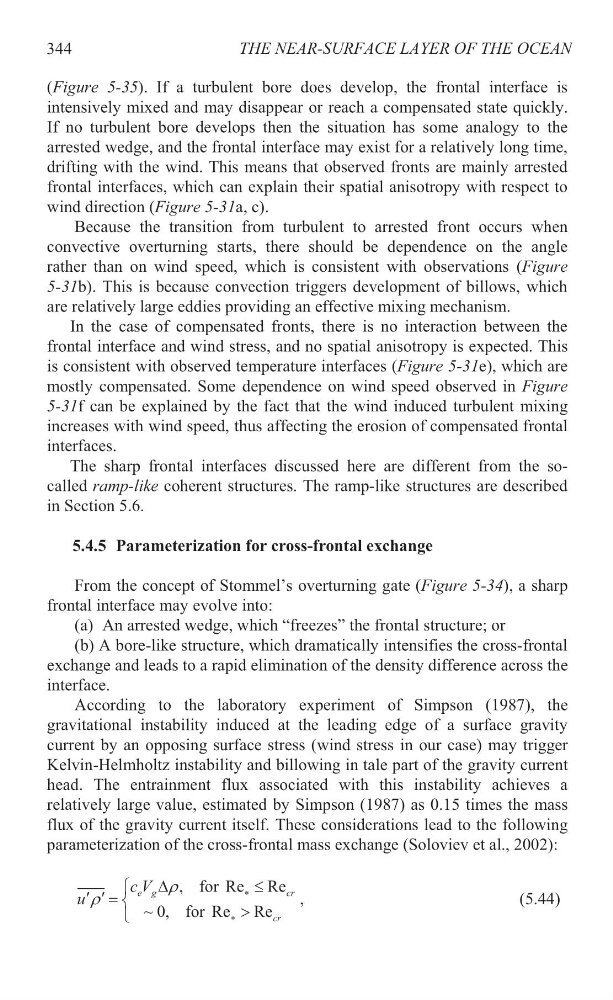
parameterization of the cross-frontal mass exchange (Soloviev et al., 2002):
, for Re Re
~ 0, for Re Re
e g
cr
cr
c V
u
U
U
'
d
c c ®
!
¯
,
(5.44)
344
(Figure 5-35). If a turbulent bore does develop, the frontal interface is
intensively mixed and may disappear or reach a compensated state quickly.
If no turbulent bore develops then the situation has some analogy to the
arrested wedge, and the frontal interface may exist for a relatively long time,
drifting with the wind. This means that observed fronts are mainly arrested
frontal interfaces, which can explain their spatial anisotropy with respect to
wind direction (Figure 5-31a, c).
Because the transition from turbulent to arrested front occurs when
convective overturning starts, there should be dependence on the angle
rather than on wind speed, which is consistent with observations (Figure
5-31b). This is because convection triggers development of billows, which
are relatively large eddies providing an effective mixing mechanism.
In the case of compensated fronts, there is no interaction between the
frontal interface and wind stress, and no spatial anisotropy is expected. This
is consistent with observed temperature interfaces (Figure 5-31e), which are
mostly compensated. Some dependence on wind speed observed in Figure
5-31f can be explained by the fact that the wind induced turbulent mixing
increases with wind speed, thus affecting the erosion of compensated frontal
interfaces.
The sharp frontal interfaces discussed here are different from the socalled ramp-like coherent structures. The ramp-like structures are described
in Section 5.6.
5.4.5 Parameterization for cross-frontal exchange
From the concept of Stommel’s overturning gate (Figure 5-34), a sharp
frontal interface may evolve into:
(a) An arrested wedge, which “freezes” the frontal structure; or
(b) A bore-like structure, which dramatically intensifies the cross-frontal
exchange and leads to a rapid elimination of the density difference across the
interface.
According to the laboratory experiment of Simpson (1987), the
gravitational instability induced at the leading edge of a surface gravity
current by an opposing surface stress (wind stress in our case) may trigger
Kelvin-Helmholtz instability and billowing in tale part of the gravity current
head. The entrainment flux associated with this instability achieves a
relatively large value, estimated by Simpson (1987) as 0.15 times the mass
flux of the gravity current itself. These considerations lead to the following
parameterization of the cross-frontal mass exchange (Soloviev et al., 2002):
, for Re Re
~ 0, for Re Re
e g
cr
cr
c V
u
U
U
'
d
c c ®
!
¯
,
(5.44)
344