

THE NEAR-SURFACE LAYER OF THE OCEAN
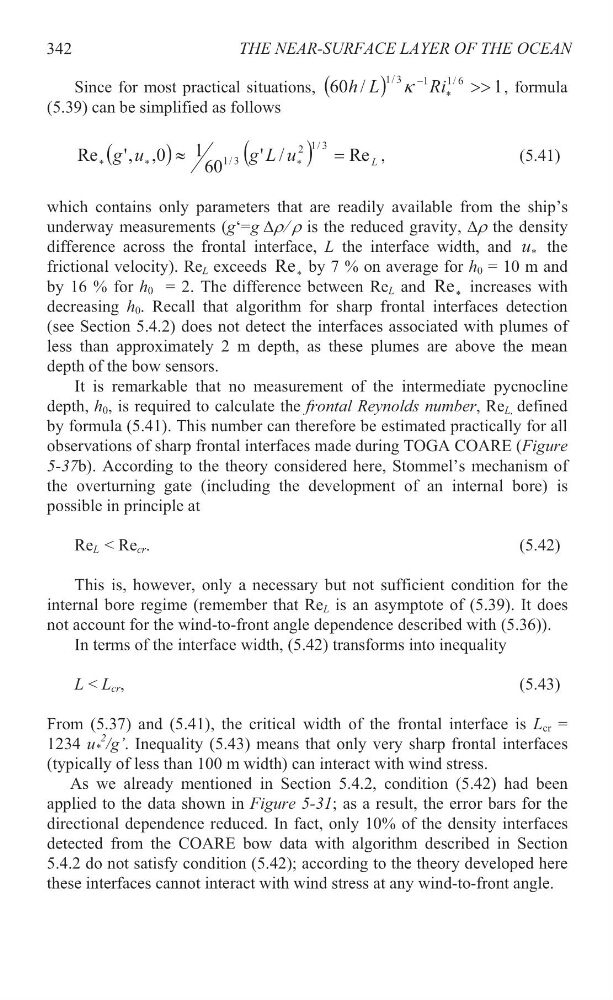
Since for most practical situations,
1
/
60
6
/
1
1
3
/
1
!!
Ri
L
h
N
, formula
(5.39) can be simplified as follows
L
u
L
g
u
g
Re
/
'
60
1
0
,
,
'
Re
3
/
1
2
3
/
1
|
,
(5.41)
which contains only parameters that are readily available from the ship’s
underway measurements (g‘=g'UU is the reduced gravity, 'U the density
difference across the frontal interface, L the interface width, and *
u the
frictional velocity). Re L exceeds
Re by 7 % on average for h 0 = 10 m and
by 16 % for h 0 = 2. The difference between Re L and
Re increases with
decreasing h 0 . Recall that algorithm for sharp frontal interfaces detection
(see Section 5.4.2) does not detect the interfaces associated with plumes of
less than approximately 2 m depth, as these plumes are above the mean
depth of the bow sensors.
It is remarkable that no measurement of the intermediate pycnocline
depth, h 0 , is required to calculate the frontal Reynolds number, Re L, defined
by formula (5.41). This number can therefore be estimated practically for all
observations of sharp frontal interfaces made during TOGA COARE (Figure
5-37b). According to the theory considered here, Stommel’s mechanism of
the overturning gate (including the development of an internal bore) is
possible in principle at
Re L < Re cr .
(5.42)
This is, however, only a necessary but not sufficient condition for the
internal bore regime (remember that Re L is an asymptote of (5.39). It does
not account for the wind-to-front angle dependence described with (5.36)).
In terms of the interface width, (5.42) transforms into inequality
L < L cr ,
(5.43)
From (5.37) and (5.41), the critical width of the frontal interface is L cr =
1234 u *
2 /g’. Inequality (5.43) means that only very sharp frontal interfaces
(typically of less than 100 m width) can interact with wind stress.
As we already mentioned in Section 5.4.2, condition (5.42) had been
applied to the data shown in Figure 5-31; as a result, the error bars for the
directional dependence reduced. In fact, only 10% of the density interfaces
detected from the COARE bow data with algorithm described in Section
5.4.2 do not satisfy condition (5.42); according to the theory developed here
these interfaces cannot interact with wind stress at any wind-to-front angle.
342
Since for most practical situations,
1
/
60
6
/
1
1
3
/
1
!!
Ri
L
h
N
, formula
(5.39) can be simplified as follows
L
u
L
g
u
g
Re
/
'
60
1
0
,
,
'
Re
3
/
1
2
3
/
1
|
,
(5.41)
which contains only parameters that are readily available from the ship’s
underway measurements (g‘=g'UU is the reduced gravity, 'U the density
difference across the frontal interface, L the interface width, and *
u the
frictional velocity). Re L exceeds
Re by 7 % on average for h 0 = 10 m and
by 16 % for h 0 = 2. The difference between Re L and
Re increases with
decreasing h 0 . Recall that algorithm for sharp frontal interfaces detection
(see Section 5.4.2) does not detect the interfaces associated with plumes of
less than approximately 2 m depth, as these plumes are above the mean
depth of the bow sensors.
It is remarkable that no measurement of the intermediate pycnocline
depth, h 0 , is required to calculate the frontal Reynolds number, Re L, defined
by formula (5.41). This number can therefore be estimated practically for all
observations of sharp frontal interfaces made during TOGA COARE (Figure
5-37b). According to the theory considered here, Stommel’s mechanism of
the overturning gate (including the development of an internal bore) is
possible in principle at
Re L < Re cr .
(5.42)
This is, however, only a necessary but not sufficient condition for the
internal bore regime (remember that Re L is an asymptote of (5.39). It does
not account for the wind-to-front angle dependence described with (5.36)).
In terms of the interface width, (5.42) transforms into inequality
L < L cr ,
(5.43)
From (5.37) and (5.41), the critical width of the frontal interface is L cr =
1234 u *
2 /g’. Inequality (5.43) means that only very sharp frontal interfaces
(typically of less than 100 m width) can interact with wind stress.
As we already mentioned in Section 5.4.2, condition (5.42) had been
applied to the data shown in Figure 5-31; as a result, the error bars for the
directional dependence reduced. In fact, only 10% of the density interfaces
detected from the COARE bow data with algorithm described in Section
5.4.2 do not satisfy condition (5.42); according to the theory developed here
these interfaces cannot interact with wind stress at any wind-to-front angle.
342