

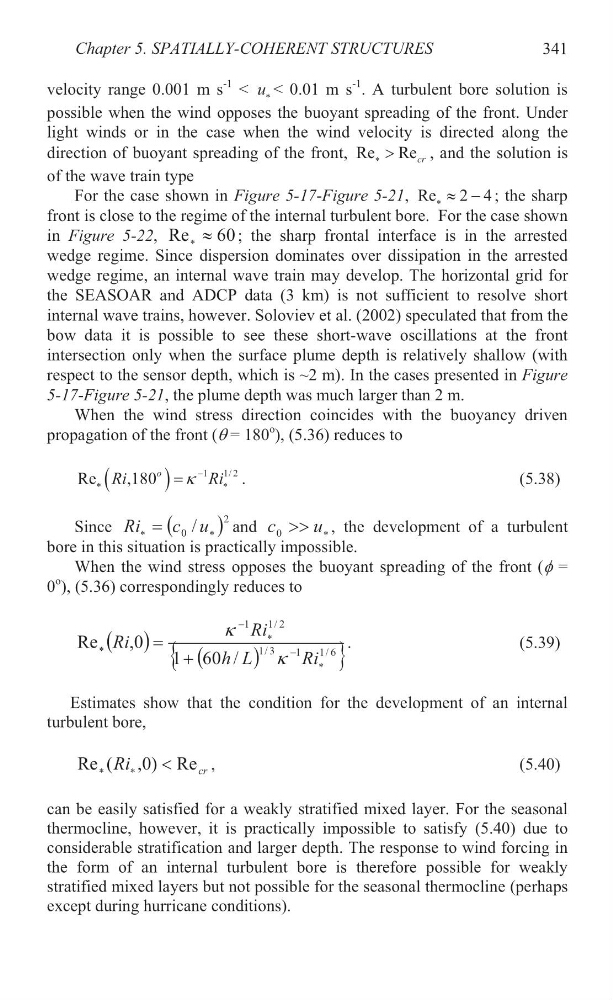
Chapter 5. SPATIALLY-COHERENT STRUCTURES
velocity range 0.001 m s
-1 < u < 0.01 m s
-1 . A turbulent bore solution is
possible when the wind opposes the buoyant spreading of the front. Under
light winds or in the case when the wind velocity is directed along the
direction of buoyant spreading of the front, Re Re cr
!
, and the solution is
of the wave train type
For the case shown in Figure 5-17-Figure 5-21, Re 2 4
| ; the sharp
front is close to the regime of the internal turbulent bore. For the case shown
in Figure 5-22,
60
Re |
; the sharp frontal interface is in the arrested
wedge regime. Since dispersion dominates over dissipation in the arrested
wedge regime, an internal wave train may develop. The horizontal grid for
the SEASOAR and ADCP data (3 km) is not sufficient to resolve short
internal wave trains, however. Soloviev et al. (2002) speculated that from the
bow data it is possible to see these short-wave oscillations at the front
intersection only when the surface plume depth is relatively shallow (with
respect to the sensor depth, which is ~2 m). In the cases presented in Figure
5-17-Figure 5-21, the plume depth was much larger than 2 m.
When the wind stress direction coincides with the buoyancy driven
propagation of the front (T = 180
o ), (5.36) reduces to
1
1/2
Re
,180
o
Ri
R i
N
.
(5.38)
Since
2
0 /
u
c
Ri
and
!! u
c 0
, the development of a turbulent
bore in this situation is practically impossible.
When the wind stress opposes the buoyant spreading of the front (I =
0
o ), (5.36) correspondingly reduces to
^
`
6
/
1
1
3
/
1
2
/
1
1
/
60
1
0
,
Re
Ri
L
h
Ri
Ri
N
N
.
(5.39)
Estimates show that the condition for the development of an internal
turbulent bore,
cr
Ri
Re
)
0
,
(
Re
,
(5.40)
can be easily satisfied for a weakly stratified mixed layer. For the seasonal
thermocline, however, it is practically impossible to satisfy (5.40) due to
considerable stratification and larger depth. The response to wind forcing in
the form of an internal turbulent bore is therefore possible for weakly
stratified mixed layers but not possible for the seasonal thermocline (perhaps
except during hurricane conditions).
341
velocity range 0.001 m s
-1 < u < 0.01 m s
-1 . A turbulent bore solution is
possible when the wind opposes the buoyant spreading of the front. Under
light winds or in the case when the wind velocity is directed along the
direction of buoyant spreading of the front, Re Re cr
!
, and the solution is
of the wave train type
For the case shown in Figure 5-17-Figure 5-21, Re 2 4
| ; the sharp
front is close to the regime of the internal turbulent bore. For the case shown
in Figure 5-22,
60
Re |
; the sharp frontal interface is in the arrested
wedge regime. Since dispersion dominates over dissipation in the arrested
wedge regime, an internal wave train may develop. The horizontal grid for
the SEASOAR and ADCP data (3 km) is not sufficient to resolve short
internal wave trains, however. Soloviev et al. (2002) speculated that from the
bow data it is possible to see these short-wave oscillations at the front
intersection only when the surface plume depth is relatively shallow (with
respect to the sensor depth, which is ~2 m). In the cases presented in Figure
5-17-Figure 5-21, the plume depth was much larger than 2 m.
When the wind stress direction coincides with the buoyancy driven
propagation of the front (T = 180
o ), (5.36) reduces to
1
1/2
Re
,180
o
Ri
R i
N
.
(5.38)
Since
2
0 /
u
c
Ri
and
!! u
c 0
, the development of a turbulent
bore in this situation is practically impossible.
When the wind stress opposes the buoyant spreading of the front (I =
0
o ), (5.36) correspondingly reduces to
^
`
6
/
1
1
3
/
1
2
/
1
1
/
60
1
0
,
Re
Ri
L
h
Ri
Ri
N
N
.
(5.39)
Estimates show that the condition for the development of an internal
turbulent bore,
cr
Ri
Re
)
0
,
(
Re
,
(5.40)
can be easily satisfied for a weakly stratified mixed layer. For the seasonal
thermocline, however, it is practically impossible to satisfy (5.40) due to
considerable stratification and larger depth. The response to wind forcing in
the form of an internal turbulent bore is therefore possible for weakly
stratified mixed layers but not possible for the seasonal thermocline (perhaps
except during hurricane conditions).
341