

THE NEAR-SURFACE LAYER OF THE OCEAN
case where the wind stress was in the same direction as the direction of the
buoyant spreading of the front. The turbulence dissipation level doesn’t
change at the interface intersection
These three cases represent noncompensated fronts. The differences in
the turbulence signals in the vicinity of the fronts are possibly associated
with the interaction of frontal interfaces with wind stress. Figure 5-24
suggests that when the wind stress opposes the buoyant spreading of a sharp
front, intensive mixing occurs at the front. It should be stressed that in most
cases, however, the turbulence signals could not be confidently associated
with the presence of sharp frontal interfaces. We also do not know the exact
orientation of the front with respect to the ship track or wind.
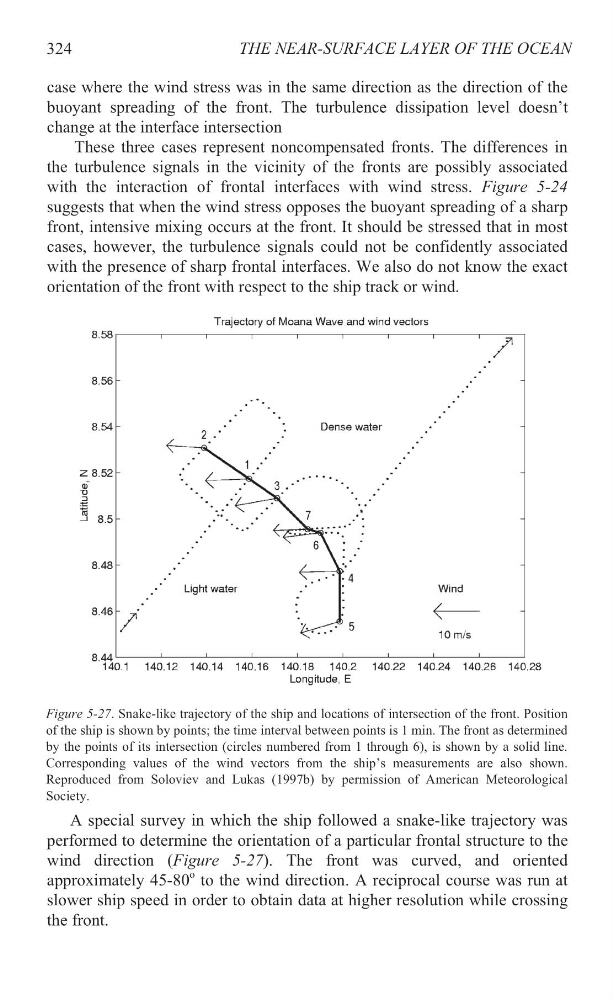
A special survey in which the ship followed a snake-like trajectory was
performed to determine the orientation of a particular frontal structure to the
wind direction (Figure 5-27). The front was curved, and oriented
approximately 45-80
o to the wind direction. A reciprocal course was run at
slower ship speed in order to obtain data at higher resolution while crossing
324
the front.
Figure 5-27. Snake-like trajectory of the ship and locations of intersection of the front. Position
of the ship is shown by points; the time interval between points is 1 min. The front as determined
by the points of its intersection (circles numbered from 1 through 6), is shown by a solid line.
Corresponding values of the wind vectors from the ship’s measurements are also shown.
Reproduced from Soloviev and Lukas (1997b) by permission of American Meteorological
Society.
case where the wind stress was in the same direction as the direction of the
buoyant spreading of the front. The turbulence dissipation level doesn’t
change at the interface intersection
These three cases represent noncompensated fronts. The differences in
the turbulence signals in the vicinity of the fronts are possibly associated
with the interaction of frontal interfaces with wind stress. Figure 5-24
suggests that when the wind stress opposes the buoyant spreading of a sharp
front, intensive mixing occurs at the front. It should be stressed that in most
cases, however, the turbulence signals could not be confidently associated
with the presence of sharp frontal interfaces. We also do not know the exact
orientation of the front with respect to the ship track or wind.
A special survey in which the ship followed a snake-like trajectory was
performed to determine the orientation of a particular frontal structure to the
wind direction (Figure 5-27). The front was curved, and oriented
approximately 45-80
o to the wind direction. A reciprocal course was run at
slower ship speed in order to obtain data at higher resolution while crossing
324
the front.
Figure 5-27. Snake-like trajectory of the ship and locations of intersection of the front. Position
of the ship is shown by points; the time interval between points is 1 min. The front as determined
by the points of its intersection (circles numbered from 1 through 6), is shown by a solid line.
Corresponding values of the wind vectors from the ship’s measurements are also shown.
Reproduced from Soloviev and Lukas (1997b) by permission of American Meteorological
Society.