

THE NEAR-SURFACE LAYER OF THE OCEAN
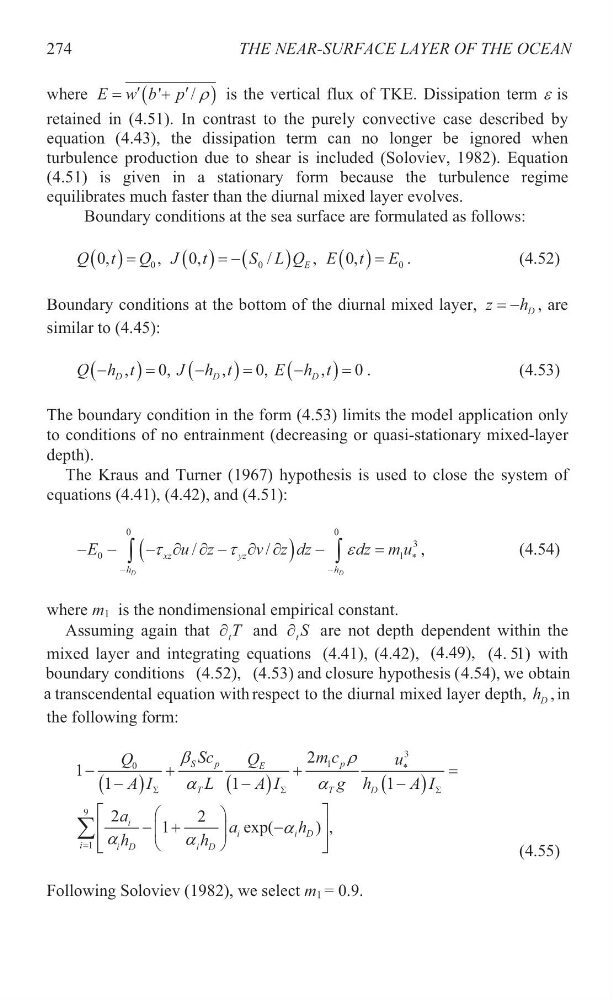
where
'
/
E w b p U
c
c
is the vertical flux of TKE. Dissipation term H is
retained in X (4.51)X . In contrast to the purely convective case described by
equation X (4.43)X , the dissipation term can no longer be ignored when
turbulence production due to shear is included (Soloviev, 1982). Equation
X (4.51)X is given in a stationary form because the turbulence regime
equilibrates much faster than the diurnal mixed layer evolves.
Boundary conditions at the sea surface are formulated as follows:
0
0
0
0,
,
0,
/
,
0,
E
Q t Q J t
S L Q E t E
.
(4.52)
Boundary conditions at the bottom of the diurnal mixed layer,
D
z
h
, are
similar to X (4.45)X :
,
0,
,
0,
,
0
D
D
D
Q h t
J h t
E h t
.
(4.53)
The boundary condition in the form X (4.53)X limits the model application only
to conditions of no entrainment (decreasing or quasi-stationary mixed-layer
depth).
The Kraus and Turner (1967) hypothesis is used to close the system of
equations X (4.41)X , X (4.42)X , and X (4.51)X :
0
0
3
0
1
/
/
D
D
xz
yz
h
h
E
u z
v z dz
dz m u
W
W
H
w w w w
³
³
,
(4.54)
where mB 1 B is the nondimensional empirical constant.
Assuming again that t T
w and t S
w are not depth dependent within the
mixed layer and integrating equations X (4.41)X ,X (4.42)X , X
(4. 51)X with
boundary conditions X (4.52)X , X (4.53)X and closure hypothesis X
(4.54)X , we obtain
a transcendental equation with respect to the diurnal mixed layer depth, D
h , in
the following form:
3
1
0
9
1
2
1
1
1
1
2
2
1
e x p (
),
S
p
p
E
T
T
D
i
i
iD
i
i D
i D
Sc
m c
Q
Q
u
A I
L
A I
g h
A I
a
a
h
h
h
E
U
D
D
6
6
6
ª
º
§
·
«
»
¨
¸
«
»
©
¹
¬
¼
¦
(4.55)
Following Soloviev (1982), we select mB 1 B = 0.9.
X
274
X
X
(4.49),
D
D
D
where
'
/
E w b p U
c
c
is the vertical flux of TKE. Dissipation term H is
retained in X (4.51)X . In contrast to the purely convective case described by
equation X (4.43)X , the dissipation term can no longer be ignored when
turbulence production due to shear is included (Soloviev, 1982). Equation
X (4.51)X is given in a stationary form because the turbulence regime
equilibrates much faster than the diurnal mixed layer evolves.
Boundary conditions at the sea surface are formulated as follows:
0
0
0
0,
,
0,
/
,
0,
E
Q t Q J t
S L Q E t E
.
(4.52)
Boundary conditions at the bottom of the diurnal mixed layer,
D
z
h
, are
similar to X (4.45)X :
,
0,
,
0,
,
0
D
D
D
Q h t
J h t
E h t
.
(4.53)
The boundary condition in the form X (4.53)X limits the model application only
to conditions of no entrainment (decreasing or quasi-stationary mixed-layer
depth).
The Kraus and Turner (1967) hypothesis is used to close the system of
equations X (4.41)X , X (4.42)X , and X (4.51)X :
0
0
3
0
1
/
/
D
D
xz
yz
h
h
E
u z
v z dz
dz m u
W
W
H
w w w w
³
³
,
(4.54)
where mB 1 B is the nondimensional empirical constant.
Assuming again that t T
w and t S
w are not depth dependent within the
mixed layer and integrating equations X (4.41)X ,X (4.42)X , X
(4. 51)X with
boundary conditions X (4.52)X , X (4.53)X and closure hypothesis X
(4.54)X , we obtain
a transcendental equation with respect to the diurnal mixed layer depth, D
h , in
the following form:
3
1
0
9
1
2
1
1
1
1
2
2
1
e x p (
),
S
p
p
E
T
T
D
i
i
iD
i
i D
i D
Sc
m c
Q
Q
u
A I
L
A I
g h
A I
a
a
h
h
h
E
U
D
D
6
6
6
ª
º
§
·
«
»
¨
¸
«
»
©
¹
¬
¼
¦
(4.55)
Following Soloviev (1982), we select mB 1 B = 0.9.
X
274
X
X
(4.49),
D
D
D