

THE NEAR-SURFACE LAYER OF THE OCEAN
For the rotational regime, the equilibrium diurnal mixed layer depth is
proportional to the Ekman length scale, ( ~
D
E
h
L ). In the model with
isolating boundary conditions at the bottom of the diurnal mixed layer the
rate of diurnal warming is accordingly as follows:
1
1
10
10
1/ 2
10
/
~
n
n
n
n
p
D
p
E
p
p
Q
Q
Q
Q
f
f
T t
U
U
c h
c L
c u
c C
U
U
U
U
' '
.
(4.38)
For the buoyant regime, which is associated with low wind speed
conditions, the rate of the diurnal warming from equation X (4.5)X is
3
10
/ ~
T t U
' '
. The cubic dependence of the diurnal warming rate on wind
speed leads to substantial distinction between the high and low wind speed
regimes, which are separated by a critical wind speed of about 4-5 m sP
-1
P.
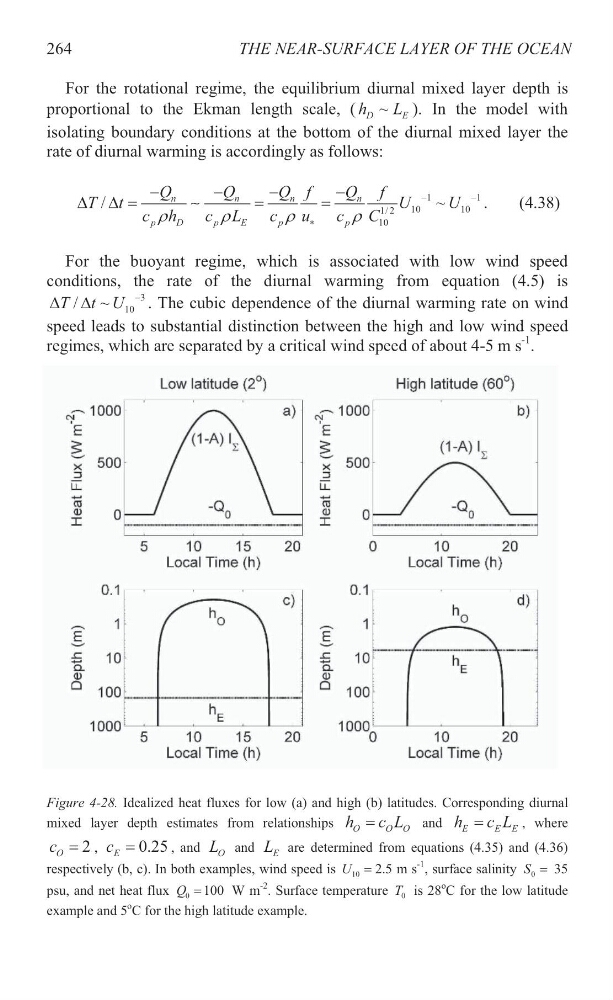
Figure 4-28. Idealized heat fluxes for low (a) and high (b) latitudes. Corresponding diurnal
mixed layer depth estimates from relationships O
O O
h c L and E
E E
h c L , where
2
O
c
,
0.25
E
c
, and O
L and E
L are determined from equations X (4.35)X and X (4.36)X
respectively (b, c). In both examples, wind speed is 10
U
2.5 m sP
-1
P,
surface salinity 0
S
35
psu, and net heat flux 0 100
Q
W mP
-2
P.
Surface temperature 0
T is 28P
o
PC
for the low latitude
example and 5P
o
PC
for the high latitude example.
264
For the rotational regime, the equilibrium diurnal mixed layer depth is
proportional to the Ekman length scale, ( ~
D
E
h
L ). In the model with
isolating boundary conditions at the bottom of the diurnal mixed layer the
rate of diurnal warming is accordingly as follows:
1
1
10
10
1/ 2
10
/
~
n
n
n
n
p
D
p
E
p
p
Q
Q
Q
Q
f
f
T t
U
U
c h
c L
c u
c C
U
U
U
U
' '
.
(4.38)
For the buoyant regime, which is associated with low wind speed
conditions, the rate of the diurnal warming from equation X (4.5)X is
3
10
/ ~
T t U
' '
. The cubic dependence of the diurnal warming rate on wind
speed leads to substantial distinction between the high and low wind speed
regimes, which are separated by a critical wind speed of about 4-5 m sP
-1
P.
Figure 4-28. Idealized heat fluxes for low (a) and high (b) latitudes. Corresponding diurnal
mixed layer depth estimates from relationships O
O O
h c L and E
E E
h c L , where
2
O
c
,
0.25
E
c
, and O
L and E
L are determined from equations X (4.35)X and X (4.36)X
respectively (b, c). In both examples, wind speed is 10
U
2.5 m sP
-1
P,
surface salinity 0
S
35
psu, and net heat flux 0 100
Q
W mP
-2
P.
Surface temperature 0
T is 28P
o
PC
for the low latitude
example and 5P
o
PC
for the high latitude example.
264