

Chapter 4: FINE STRUCTURE AND MICROSTRUCTURE
Applying these data to mixed layer modeling faces some problems. In
particular, the relative error of wind speed measurement with microwave
methods approaches 100% in low wind speed zones. Fortunately, the
sensitivities of the diurnal mixed layer depth and warming rate to wind
diminish with decreasing wind speed, because of increased contributions
from convection (Soloviev, 1981).
The convective mixing is driven by the net surface heat flux QB 0 B , which is
the sum of sensible, latent, and net longwave radiation fluxes. The accuracy
of the retrieval of these fluxes depends on averaging period. Achieving a
time resolution of a few hours necessary for accurately modeling the diurnal
cycle is still a challenge but one, which can be addressed with a multisatellite approach.
4.4.3 Physics of large diurnal warming events
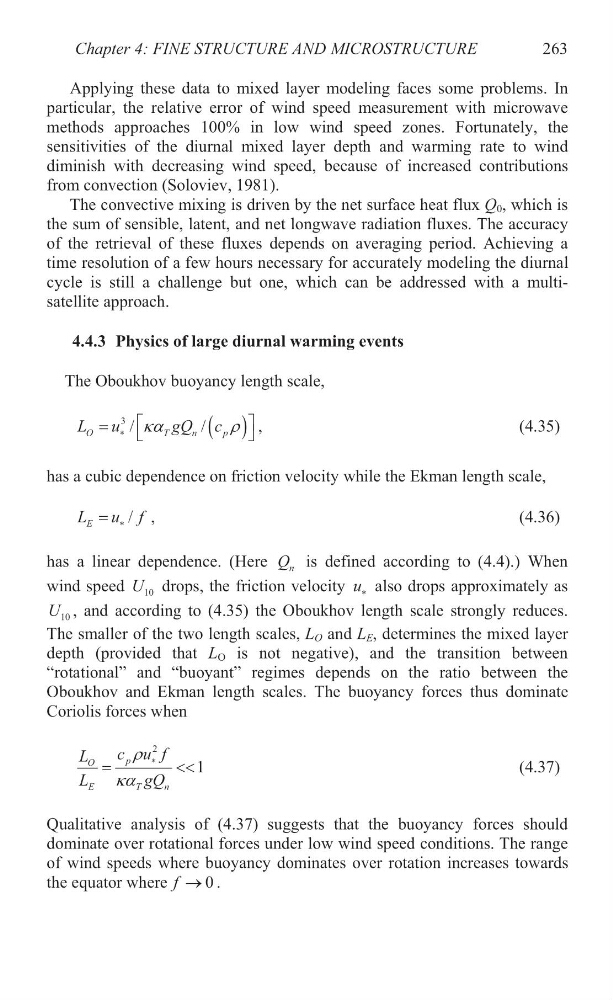
The Oboukhov buoyancy length scale,
3 /
/
O
T
n
p
L u
gQ c
ND
U
ª
º
¬
¼ ,
(4.35)
has a cubic dependence on friction velocity while the Ekman length scale,
/
E
L u f
,
(4.36)
has a linear dependence. (Here n
Q is defined according to X (4.4)X .) When
wind speed 10
U drops, the friction velocity u also drops approximately as
10
U , and according to X (4.35)X the Oboukhov length scale strongly reduces.
The smaller of the two length scales, LB O B and LB E B , determines the mixed layer
depth (provided that LB O B is not negative), and the transition between
“rotational” and “buoyant” regimes depends on the ratio between the
Oboukhov and Ekman length scales. The buoyancy forces thus dominate
Coriolis forces when
2
1
p
O
E
T
n
c u f
L
L
g Q
U
ND
(4.37)
Qualitative analysis of X (4.37)X suggests that the buoyancy forces should
dominate over rotational forces under low wind speed conditions. The range
of wind speeds where buoyancy dominates over rotation increases towards
the equator where
0
f o .
263
Applying these data to mixed layer modeling faces some problems. In
particular, the relative error of wind speed measurement with microwave
methods approaches 100% in low wind speed zones. Fortunately, the
sensitivities of the diurnal mixed layer depth and warming rate to wind
diminish with decreasing wind speed, because of increased contributions
from convection (Soloviev, 1981).
The convective mixing is driven by the net surface heat flux QB 0 B , which is
the sum of sensible, latent, and net longwave radiation fluxes. The accuracy
of the retrieval of these fluxes depends on averaging period. Achieving a
time resolution of a few hours necessary for accurately modeling the diurnal
cycle is still a challenge but one, which can be addressed with a multisatellite approach.
4.4.3 Physics of large diurnal warming events
The Oboukhov buoyancy length scale,
3 /
/
O
T
n
p
L u
gQ c
ND
U
ª
º
¬
¼ ,
(4.35)
has a cubic dependence on friction velocity while the Ekman length scale,
/
E
L u f
,
(4.36)
has a linear dependence. (Here n
Q is defined according to X (4.4)X .) When
wind speed 10
U drops, the friction velocity u also drops approximately as
10
U , and according to X (4.35)X the Oboukhov length scale strongly reduces.
The smaller of the two length scales, LB O B and LB E B , determines the mixed layer
depth (provided that LB O B is not negative), and the transition between
“rotational” and “buoyant” regimes depends on the ratio between the
Oboukhov and Ekman length scales. The buoyancy forces thus dominate
Coriolis forces when
2
1
p
O
E
T
n
c u f
L
L
g Q
U
ND
(4.37)
Qualitative analysis of X (4.37)X suggests that the buoyancy forces should
dominate over rotational forces under low wind speed conditions. The range
of wind speeds where buoyancy dominates over rotation increases towards
the equator where
0
f o .
263