

THE NEAR-SURFACE LAYER OF THE OCEAN
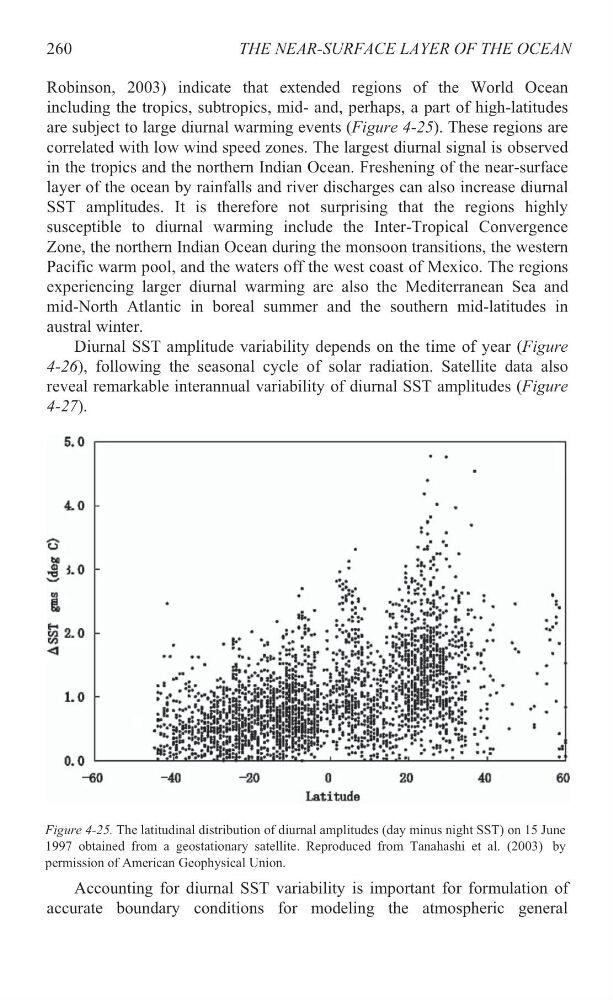
Robinson, 2003) indicate that extended regions of the World Ocean
including the tropics, subtropics, mid- and, perhaps, a part of high-latitudes
are subject to large diurnal warming events (X Figure 4-25X ). These regions are
correlated with low wind speed zones. The largest diurnal signal is observed
in the tropics and the northern Indian Ocean. Freshening of the near-surface
layer of the ocean by rainfalls and river discharges can also increase diurnal
SST amplitudes. It is therefore not surprising that the regions highly
susceptible to diurnal warming include the Inter-Tropical Convergence
Zone, the northern Indian Ocean during the monsoon transitions, the western
Pacific warm pool, and the waters off the west coast of Mexico. The regions
experiencing larger diurnal warming are also the Mediterranean Sea and
mid-North Atlantic in boreal summer and the southern mid-latitudes in
austral winter.
Diurnal SST amplitude variability depends on the time of year (Figure
reveal remarkable interannual variability of diurnal SST amplitudes (Figure
4-27).
Accounting for diurnal SST variability is important for formulation of
accurate boundary conditions for modeling the atmospheric general
260
4-26), following the seasonal cycle of solar radiation. Satellite data also
1997 obtained from a geostationary satellite. Reproduced from Tanahashi et al. (2003) by
permission of American Geophysical Union.
Figure 4-25. The latitudinal distribution of diurnal amplitudes (day minus night SST) on 15 June
Robinson, 2003) indicate that extended regions of the World Ocean
including the tropics, subtropics, mid- and, perhaps, a part of high-latitudes
are subject to large diurnal warming events (X Figure 4-25X ). These regions are
correlated with low wind speed zones. The largest diurnal signal is observed
in the tropics and the northern Indian Ocean. Freshening of the near-surface
layer of the ocean by rainfalls and river discharges can also increase diurnal
SST amplitudes. It is therefore not surprising that the regions highly
susceptible to diurnal warming include the Inter-Tropical Convergence
Zone, the northern Indian Ocean during the monsoon transitions, the western
Pacific warm pool, and the waters off the west coast of Mexico. The regions
experiencing larger diurnal warming are also the Mediterranean Sea and
mid-North Atlantic in boreal summer and the southern mid-latitudes in
austral winter.
Diurnal SST amplitude variability depends on the time of year (Figure
reveal remarkable interannual variability of diurnal SST amplitudes (Figure
4-27).
Accounting for diurnal SST variability is important for formulation of
accurate boundary conditions for modeling the atmospheric general
260
4-26), following the seasonal cycle of solar radiation. Satellite data also
1997 obtained from a geostationary satellite. Reproduced from Tanahashi et al. (2003) by
permission of American Geophysical Union.
Figure 4-25. The latitudinal distribution of diurnal amplitudes (day minus night SST) on 15 June