

THE NEAR-SURFACE LAYER OF THE OCEAN
Figure 4-10 are taken during the early evening and show a gradual
deepening of the diurnal mixed layer.
Double-diffusion effects may also contribute to mixing in the stably
stratified near-surface layer. (See the description of the phenomena of salt
fingers and layering convection, for instance, in Turner, 1973.)
Conditions leading to salt fingers can occur in the diurnal thermocline
because excess salinity due to evaporation accumulates within the diurnal
mixed layer. There is a slight but systematic increase of salinity within the
diurnal mixed layer and diurnal thermocline in the profiles of Figure 4-10.
The increase of salinity of about 0.01-0.02 psu within the layer of diurnal
heating is also clearly seen in X Figure 4-23X (except at 19:00 LST because of
rain). The corresponding density profiles are stable excluding the diurnal
mixed layer where some inversions are associated with convective cooling
and excess salinity. Remember that due to volume absorption of solar
radiation in the upper ocean convective cooling may exist even during the
daytime. Evaporation usually increases the destabilizing buoyancy flux on
the order of 10%. The step-like structure after strong rain, presumably
connected to layering convection, is shown in X Figure 4-11X .
X
232
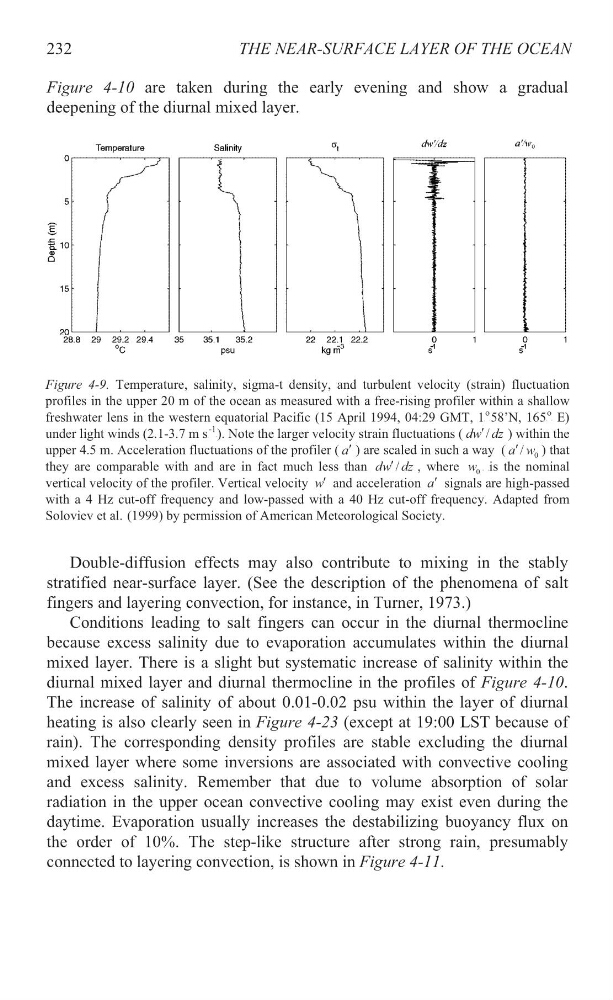
Figure 4-9. Temperature, salinity, sigma-t density, and turbulent velocity (strain) fluctuation
profiles in the upper 20 m of the ocean as measured with a free-rising profiler within a shallow
freshwater lens in the western equatorial Pacific (15 April 1994, 04:29 GMT, 1P
o
P58’N,
165P
o
P
E)
under light winds (2.1-3.7 m sP
-1
P).
Note the larger velocity strain fluctuations (
/
dw dz
c
) within the
upper 4.5 m. Acceleration fluctuations of the profiler ( ac ) are scaled in such a way (
0
/
a w
c
) that
they are comparable with and are in fact much less than
/
dw dz
c
, where 0
w BB is the nominal
vertical velocity of the profiler. Vertical velocity wc and acceleration ac signals are high-passed
with a 4 Hz cut-off frequency and low-passed with a 40 Hz cut-off frequency. Adapted from
Soloviev et al. (1999) by permission of American Meteorological Society.
Figure 4-10 are taken during the early evening and show a gradual
deepening of the diurnal mixed layer.
Double-diffusion effects may also contribute to mixing in the stably
stratified near-surface layer. (See the description of the phenomena of salt
fingers and layering convection, for instance, in Turner, 1973.)
Conditions leading to salt fingers can occur in the diurnal thermocline
because excess salinity due to evaporation accumulates within the diurnal
mixed layer. There is a slight but systematic increase of salinity within the
diurnal mixed layer and diurnal thermocline in the profiles of Figure 4-10.
The increase of salinity of about 0.01-0.02 psu within the layer of diurnal
heating is also clearly seen in X Figure 4-23X (except at 19:00 LST because of
rain). The corresponding density profiles are stable excluding the diurnal
mixed layer where some inversions are associated with convective cooling
and excess salinity. Remember that due to volume absorption of solar
radiation in the upper ocean convective cooling may exist even during the
daytime. Evaporation usually increases the destabilizing buoyancy flux on
the order of 10%. The step-like structure after strong rain, presumably
connected to layering convection, is shown in X Figure 4-11X .
X
232
Figure 4-9. Temperature, salinity, sigma-t density, and turbulent velocity (strain) fluctuation
profiles in the upper 20 m of the ocean as measured with a free-rising profiler within a shallow
freshwater lens in the western equatorial Pacific (15 April 1994, 04:29 GMT, 1P
o
P58’N,
165P
o
P
E)
under light winds (2.1-3.7 m sP
-1
P).
Note the larger velocity strain fluctuations (
/
dw dz
c
) within the
upper 4.5 m. Acceleration fluctuations of the profiler ( ac ) are scaled in such a way (
0
/
a w
c
) that
they are comparable with and are in fact much less than
/
dw dz
c
, where 0
w BB is the nominal
vertical velocity of the profiler. Vertical velocity wc and acceleration ac signals are high-passed
with a 4 Hz cut-off frequency and low-passed with a 40 Hz cut-off frequency. Adapted from
Soloviev et al. (1999) by permission of American Meteorological Society.