

THE NEAR-SURFACE LAYER OF THE OCEAN
The contour plot of temperature from the bow record on 1 May 1994, just
after the measurements of Figure 4-3c, is shown in Figure 4-4b. It is much
more “quiet” than that in Figure 4-4a.
Other sources of the horizontal variability in the diurnal thermocline
include spatially coherent organized motions, which are considered in
Chapter 5.
4.1.4 Rain-formed mixed layer and halocline
In addition to the diurnal cycle, near-surface freshening due to rain is
another fundamental mode of upper ocean variability. A rain-formed mixed
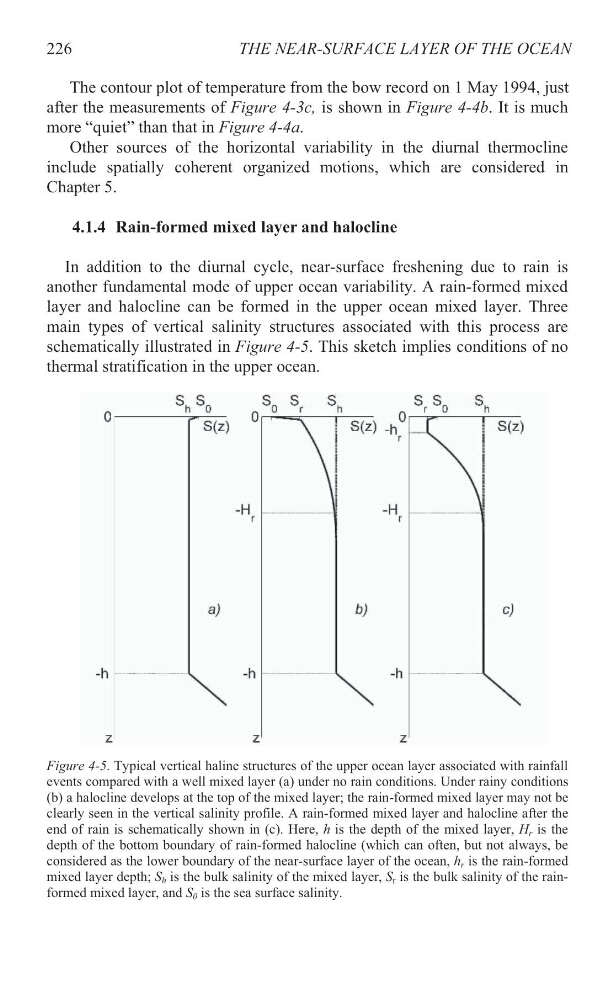
layer and halocline can be formed in the upper ocean mixed layer. Three
main types of vertical salinity structures associated with this process are
schematically illustrated in X Figure 4-5X . This sketch implies conditions of no
thermal stratification in the upper ocean.
Figure 4-5. Typical vertical haline structures of the upper ocean layer associated with rainfall
events compared with a well mixed layer (a) under no rain conditions. Under rainy conditions
(b) a halocline develops at the top of the mixed layer; the rain-formed mixed layer may not be
clearly seen in the vertical salinity profile. A rain-formed mixed layer and halocline after the
end of rain is schematically shown in (c). Here, h is the depth of the mixed layer, HB r B is the
depth of the bottom boundary of rain-formed halocline (which can often, but not always, be
considered as the lower boundary of the near-surface layer of the ocean, hB r B is the rain-formed
mixed layer depth; SB h B is the bulk salinity of the mixed layer, SB r B is the bulk salinity of the rainformed mixed layer, and SB 0 B is the sea surface salinity.
226
The contour plot of temperature from the bow record on 1 May 1994, just
after the measurements of Figure 4-3c, is shown in Figure 4-4b. It is much
more “quiet” than that in Figure 4-4a.
Other sources of the horizontal variability in the diurnal thermocline
include spatially coherent organized motions, which are considered in
Chapter 5.
4.1.4 Rain-formed mixed layer and halocline
In addition to the diurnal cycle, near-surface freshening due to rain is
another fundamental mode of upper ocean variability. A rain-formed mixed
layer and halocline can be formed in the upper ocean mixed layer. Three
main types of vertical salinity structures associated with this process are
schematically illustrated in X Figure 4-5X . This sketch implies conditions of no
thermal stratification in the upper ocean.
Figure 4-5. Typical vertical haline structures of the upper ocean layer associated with rainfall
events compared with a well mixed layer (a) under no rain conditions. Under rainy conditions
(b) a halocline develops at the top of the mixed layer; the rain-formed mixed layer may not be
clearly seen in the vertical salinity profile. A rain-formed mixed layer and halocline after the
end of rain is schematically shown in (c). Here, h is the depth of the mixed layer, HB r B is the
depth of the bottom boundary of rain-formed halocline (which can often, but not always, be
considered as the lower boundary of the near-surface layer of the ocean, hB r B is the rain-formed
mixed layer depth; SB h B is the bulk salinity of the mixed layer, SB r B is the bulk salinity of the rainformed mixed layer, and SB 0 B is the sea surface salinity.
226