

THE NEAR-SURFACE LAYER OF THE OCEAN
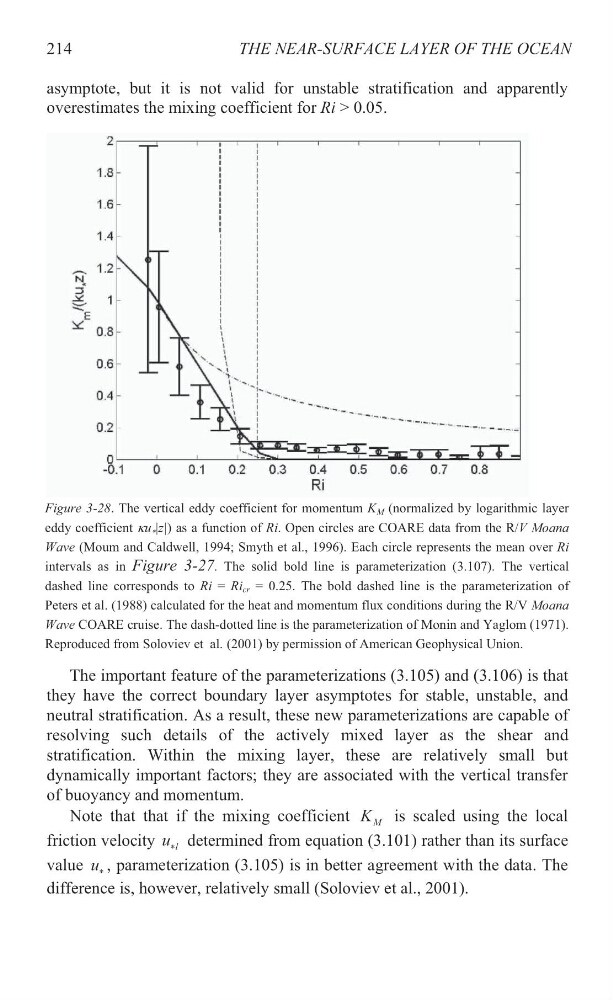
asymptote, but it is not valid for unstable stratification and apparently
overestimates the mixing coefficient for Ri > 0.05.
The important feature of the parameterizations (3.105) and (3.106) is that
they have the correct boundary layer asymptotes for stable, unstable, and
neutral stratification. As a result, these new parameterizations are capable of
resolving such details of the actively mixed layer as the shear and
stratification. Within the mixing layer, these are relatively small but
dynamically important factors; they are associated with the vertical transfer
of buoyancy and momentum.
Note that that if the mixing coefficient M
K is scaled using the local
friction velocity l
u determined from equation (3.101) rather than its surface
value u , parameterization (3.105) is in better agreement with the data. The
difference is, however, relatively small (Soloviev et al., 2001).
214
Figure 3-28. The vertical eddy coefficient for momentum K M (normalized by logarithmic layer
eddy coefficient Nu _z|) as a function of Ri. Open circles are COARE data from the R/V Moana
Wave (Moum and Caldwell, 1994; Smyth et al., 1996). Each circle represents the mean over Ri
intervals as in Figure 3-27. The solid bold line is parameterization (3.107). The vertical
dashed line corresponds to Ri = Ri cr = 0.25. The bold dashed line is the parameterization of
Peters et al. (1988) calculated for the heat and momentum flux conditions during the R/V Moana
Wave COARE cruise. The dash-dotted line is the parameterization of Monin and Yaglom (1971).
Reproduced from Soloviev et al. (2001) by permission of American Geophysical Union.
asymptote, but it is not valid for unstable stratification and apparently
overestimates the mixing coefficient for Ri > 0.05.
The important feature of the parameterizations (3.105) and (3.106) is that
they have the correct boundary layer asymptotes for stable, unstable, and
neutral stratification. As a result, these new parameterizations are capable of
resolving such details of the actively mixed layer as the shear and
stratification. Within the mixing layer, these are relatively small but
dynamically important factors; they are associated with the vertical transfer
of buoyancy and momentum.
Note that that if the mixing coefficient M
K is scaled using the local
friction velocity l
u determined from equation (3.101) rather than its surface
value u , parameterization (3.105) is in better agreement with the data. The
difference is, however, relatively small (Soloviev et al., 2001).
214
Figure 3-28. The vertical eddy coefficient for momentum K M (normalized by logarithmic layer
eddy coefficient Nu _z|) as a function of Ri. Open circles are COARE data from the R/V Moana
Wave (Moum and Caldwell, 1994; Smyth et al., 1996). Each circle represents the mean over Ri
intervals as in Figure 3-27. The solid bold line is parameterization (3.107). The vertical
dashed line corresponds to Ri = Ri cr = 0.25. The bold dashed line is the parameterization of
Peters et al. (1988) calculated for the heat and momentum flux conditions during the R/V Moana
Wave COARE cruise. The dash-dotted line is the parameterization of Monin and Yaglom (1971).
Reproduced from Soloviev et al. (2001) by permission of American Geophysical Union.