

2
2
/
/
/
M
K
u z
v z
H ª
º
' ' ' '
¬
¼
,
(3.110)
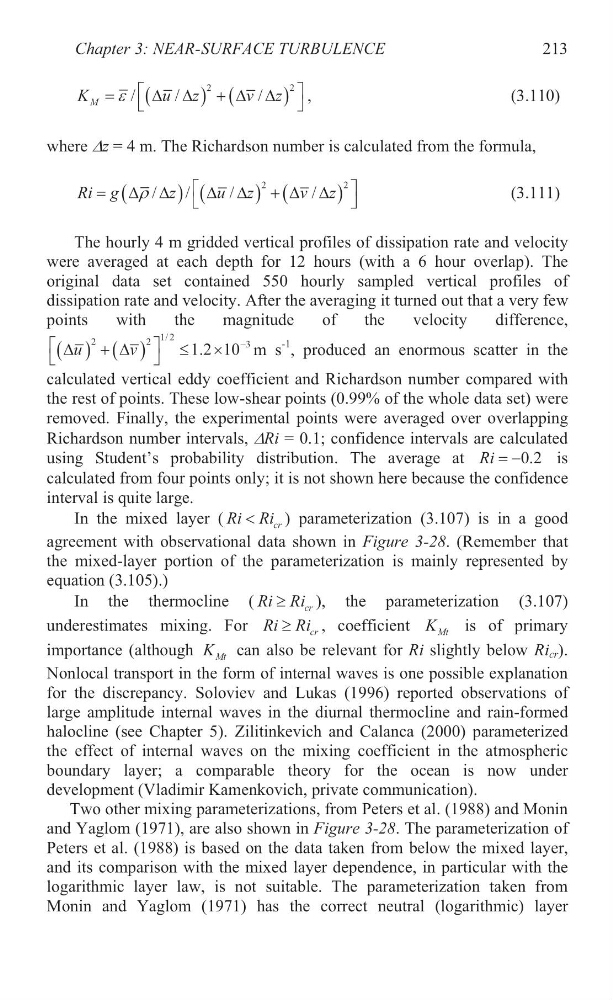
where 'z = 4 m. The Richardson number is calculated from the formula,
2
2
/
/
/
/
Ri g
z
u z
v z
U
ª
º
' '
' ' ' '
¬
¼
(3.111)
The hourly 4 m gridded vertical profiles of dissipation rate and velocity
were averaged at each depth for 12 hours (with a 6 hour overlap). The
original data set contained 550 hourly sampled vertical profiles of
dissipation rate and velocity. After the averaging it turned out that a very few
points
with
the
magnitude
of
the
velocity
difference,
1/ 2
2
2
3
1.2 10
u
v
ª
º
'
'
d u
¬
¼
m s
-1 , produced an enormous scatter in the
calculated vertical eddy coefficient and Richardson number compared with
the rest of points. These low-shear points (0.99% of the whole data set) were
removed. Finally, the experimental points were averaged over overlapping
Richardson number intervals, 'Ri = 0.1; confidence intervals are calculated
using Student’s probability distribution. The average at
0.2
Ri
is
calculated from four points only; it is not shown here because the confidence
interval is quite large.
In the mixed layer (
cr
Ri Ri
) parameterization (3.107) is in a good
agreement with observational data shown in Figure 3-28. (Remember that
the mixed-layer portion of the parameterization is mainly represented by
equation (3.105).)
In the thermocline (
cr
Ri Ri
t
), the parameterization (3.107)
underestimates mixing. For
cr
Ri Ri
t
, coefficient
Mt
K
is of primary
importance (although Mt
K can also be relevant for Ri slightly below Ri cr ).
Nonlocal transport in the form of internal waves is one possible explanation
for the discrepancy. Soloviev and Lukas (1996) reported observations of
large amplitude internal waves in the diurnal thermocline and rain-formed
halocline (see Chapter 5). Zilitinkevich and Calanca (2000) parameterized
the effect of internal waves on the mixing coefficient in the atmospheric
boundary layer; a comparable theory for the ocean is now under
development (Vladimir Kamenkovich, private communication).
Two other mixing parameterizations, from Peters et al. (1988) and Monin
and Yaglom (1971), are also shown in Figure 3-28. The parameterization of
Peters et al. (1988) is based on the data taken from below the mixed layer,
and its comparison with the mixed layer dependence, in particular with the
logarithmic layer law, is not suitable. The parameterization taken from
Monin and Yaglom (1971) has the correct neutral (logarithmic) layer
Chapter 3: NEAR-SURFACE TURBULENCE
213
2
/
/
/
M
K
u z
v z
H ª
º
' ' ' '
¬
¼
,
(3.110)
where 'z = 4 m. The Richardson number is calculated from the formula,
2
2
/
/
/
/
Ri g
z
u z
v z
U
ª
º
' '
' ' ' '
¬
¼
(3.111)
The hourly 4 m gridded vertical profiles of dissipation rate and velocity
were averaged at each depth for 12 hours (with a 6 hour overlap). The
original data set contained 550 hourly sampled vertical profiles of
dissipation rate and velocity. After the averaging it turned out that a very few
points
with
the
magnitude
of
the
velocity
difference,
1/ 2
2
2
3
1.2 10
u
v
ª
º
'
'
d u
¬
¼
m s
-1 , produced an enormous scatter in the
calculated vertical eddy coefficient and Richardson number compared with
the rest of points. These low-shear points (0.99% of the whole data set) were
removed. Finally, the experimental points were averaged over overlapping
Richardson number intervals, 'Ri = 0.1; confidence intervals are calculated
using Student’s probability distribution. The average at
0.2
Ri
is
calculated from four points only; it is not shown here because the confidence
interval is quite large.
In the mixed layer (
cr
Ri Ri
) parameterization (3.107) is in a good
agreement with observational data shown in Figure 3-28. (Remember that
the mixed-layer portion of the parameterization is mainly represented by
equation (3.105).)
In the thermocline (
cr
Ri Ri
t
), the parameterization (3.107)
underestimates mixing. For
cr
Ri Ri
t
, coefficient
Mt
K
is of primary
importance (although Mt
K can also be relevant for Ri slightly below Ri cr ).
Nonlocal transport in the form of internal waves is one possible explanation
for the discrepancy. Soloviev and Lukas (1996) reported observations of
large amplitude internal waves in the diurnal thermocline and rain-formed
halocline (see Chapter 5). Zilitinkevich and Calanca (2000) parameterized
the effect of internal waves on the mixing coefficient in the atmospheric
boundary layer; a comparable theory for the ocean is now under
development (Vladimir Kamenkovich, private communication).
Two other mixing parameterizations, from Peters et al. (1988) and Monin
and Yaglom (1971), are also shown in Figure 3-28. The parameterization of
Peters et al. (1988) is based on the data taken from below the mixed layer,
and its comparison with the mixed layer dependence, in particular with the
logarithmic layer law, is not suitable. The parameterization taken from
Monin and Yaglom (1971) has the correct neutral (logarithmic) layer
Chapter 3: NEAR-SURFACE TURBULENCE
213