

1 0.7 /
l
c r
u
u
Ri Ri
|
.
(3.101)
A possible approach to account for the vertical momentum flux change
with depth is to parameterize K M using the profile of local friction velocity
rather than its surface value u . This does not follow directly from the
boundary layer theory but was previously employed by several investigators
(e.g., Large et al., 1994) including non-equatorial (in fact, polar) conditions
(McPhee, 1987).
The mixing parameterization should match to a small but finite
turbulence level below the boundary layer because the background mixing
levels are non-zero due to internal wave breaking. Comprehensive
discussions of the eddy momentum exchange coefficient parameterization
below the surface turbulent boundary layer are given in McComas and
Muller (1981), Peters et al. (1988), Gregg et al. (1993), Polzin (1996), and
Gregg et al. (2003). Peters et al. (1988) approximated the momentum eddy
coefficient in the upper shear zone, 23–81 m depth, as follows:
8
8 . 2
5.6 10
Mb
K
R i
u
m
2 s
-1 .
(3.102)
For the higher Ri range, Peters et al. (1988) obtained the semi-empirical
formula
1.5
4
5
5 10 1 5
2 10
Mt
K
R i
u
u
m
2 s
-1 .
(3.103)
The final parameterization of the eddy viscosity coefficient K M by Peters
et al. (1988) is obtained by adding (3.102) and (3.103):
M
M b
M t
K
K
K
(3.104)
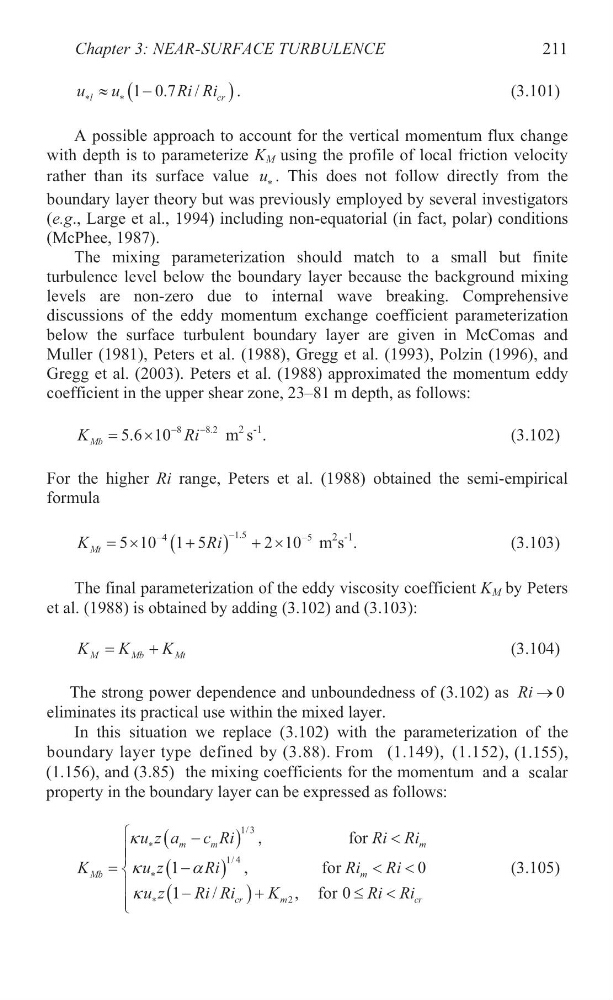
The strong power dependence and unboundedness of (3.102) as
0
Ri o
eliminates its practical use within the mixed layer.
In this situation we replace (3.102) with the parameterization of the
(1.155),
(1.156), and (3.85) the mixing coefficients for the momentum and a scalar
property in the boundary layer can be expressed as follows:
1/ 3
1/ 4
2
,
for
1
,
for
0
1
/
, for 0
m
m
m
Mb
m
cr
m
cr
u z a c Ri
Ri Ri
K
uz
Ri
Ri
Ri
u z
Ri Ri
K
Ri Ri
N
N
D
N
° °
®
°
d
° ¯
(3.105)
Chapter 3: NEAR-SURFACE TURBULENCE
211
boundary layer type defined by (3.88). From (1.149), (1.152),
l
c r
u
u
Ri Ri
|
.
(3.101)
A possible approach to account for the vertical momentum flux change
with depth is to parameterize K M using the profile of local friction velocity
rather than its surface value u . This does not follow directly from the
boundary layer theory but was previously employed by several investigators
(e.g., Large et al., 1994) including non-equatorial (in fact, polar) conditions
(McPhee, 1987).
The mixing parameterization should match to a small but finite
turbulence level below the boundary layer because the background mixing
levels are non-zero due to internal wave breaking. Comprehensive
discussions of the eddy momentum exchange coefficient parameterization
below the surface turbulent boundary layer are given in McComas and
Muller (1981), Peters et al. (1988), Gregg et al. (1993), Polzin (1996), and
Gregg et al. (2003). Peters et al. (1988) approximated the momentum eddy
coefficient in the upper shear zone, 23–81 m depth, as follows:
8
8 . 2
5.6 10
Mb
K
R i
u
m
2 s
-1 .
(3.102)
For the higher Ri range, Peters et al. (1988) obtained the semi-empirical
formula
1.5
4
5
5 10 1 5
2 10
Mt
K
R i
u
u
m
2 s
-1 .
(3.103)
The final parameterization of the eddy viscosity coefficient K M by Peters
et al. (1988) is obtained by adding (3.102) and (3.103):
M
M b
M t
K
K
K
(3.104)
The strong power dependence and unboundedness of (3.102) as
0
Ri o
eliminates its practical use within the mixed layer.
In this situation we replace (3.102) with the parameterization of the
(1.155),
(1.156), and (3.85) the mixing coefficients for the momentum and a scalar
property in the boundary layer can be expressed as follows:
1/ 3
1/ 4
2
,
for
1
,
for
0
1
/
, for 0
m
m
m
Mb
m
cr
m
cr
u z a c Ri
Ri Ri
K
uz
Ri
Ri
Ri
u z
Ri Ri
K
Ri Ri
N
N
D
N
° °
®
°
d
° ¯
(3.105)
Chapter 3: NEAR-SURFACE TURBULENCE
211
boundary layer type defined by (3.88). From (1.149), (1.152),