

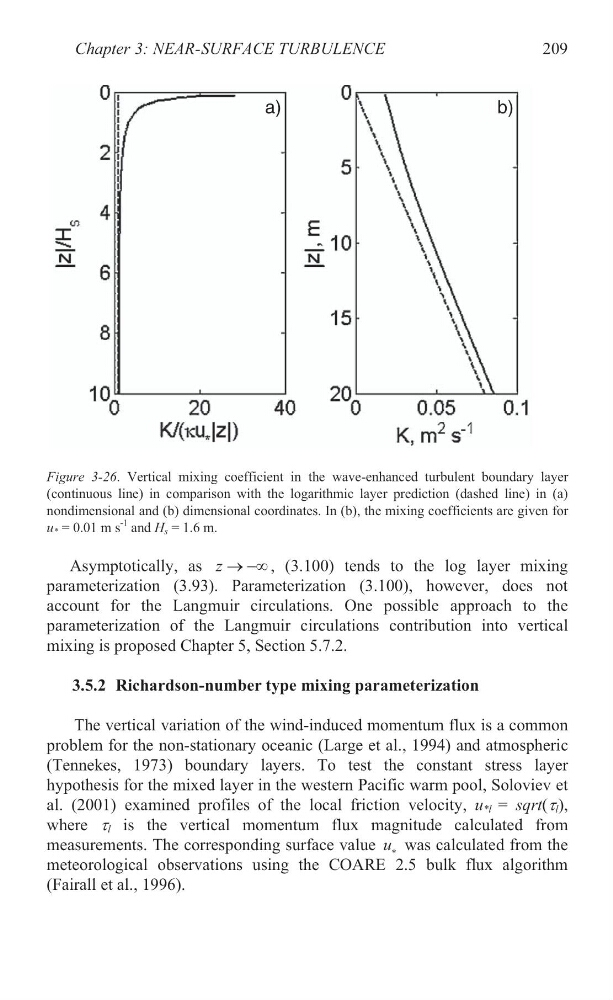
Figure 3-26. Vertical mixing coefficient in the wave-enhanced turbulent boundary layer
(continuous line) in comparison with the logarithmic layer prediction (dashed line) in (a)
nondimensional and (b) dimensional coordinates. In (b), the mixing coefficients are given for
u * = 0.01 m s
-1 and H s = 1.6 m.
Asymptotically, as z o f , (3.100) tends to the log layer mixing
parameterization (3.93). Parameterization (3.100), however, does not
account for the Langmuir circulations. One possible approach to the
parameterization of the Langmuir circulations contribution into vertical
mixing is proposed Chapter 5, Section 5.7.2.
3.5.2 Richardson-number type mixing parameterization
The vertical variation of the wind-induced momentum flux is a common
problem for the non-stationary oceanic (Large et al., 1994) and atmospheric
(Tennekes, 1973) boundary layers. To test the constant stress layer
hypothesis for the mixed layer in the western Pacific warm pool, Soloviev et
al. (2001) examined profiles of the local friction velocity, u *l = sqrt(W l ),
where W l is the vertical momentum flux magnitude calculated from
measurements. The corresponding surface value u was calculated from the
meteorological observations using the COARE 2.5 bulk flux algorithm
(Fairall et al., 1996).
Chapter 3: NEAR-SURFACE TURBULENCE
209
a)
b)
(continuous line) in comparison with the logarithmic layer prediction (dashed line) in (a)
nondimensional and (b) dimensional coordinates. In (b), the mixing coefficients are given for
u * = 0.01 m s
-1 and H s = 1.6 m.
Asymptotically, as z o f , (3.100) tends to the log layer mixing
parameterization (3.93). Parameterization (3.100), however, does not
account for the Langmuir circulations. One possible approach to the
parameterization of the Langmuir circulations contribution into vertical
mixing is proposed Chapter 5, Section 5.7.2.
3.5.2 Richardson-number type mixing parameterization
The vertical variation of the wind-induced momentum flux is a common
problem for the non-stationary oceanic (Large et al., 1994) and atmospheric
(Tennekes, 1973) boundary layers. To test the constant stress layer
hypothesis for the mixed layer in the western Pacific warm pool, Soloviev et
al. (2001) examined profiles of the local friction velocity, u *l = sqrt(W l ),
where W l is the vertical momentum flux magnitude calculated from
measurements. The corresponding surface value u was calculated from the
meteorological observations using the COARE 2.5 bulk flux algorithm
(Fairall et al., 1996).
Chapter 3: NEAR-SURFACE TURBULENCE
209
a)
b)