

was positioned in the tail part of the bow probe. An RMS uncertainty of <0.1
dbar (equivalent to less than 0.1 m) in pressure-to-depth conversion at a ship
speed of 10-11 knots was estimated by Soloviev and Lukas (1996) using the
pressure readings at the intersections of the water-air interface as detected by
the conductivity sensor. The sensor depth variation profiled the vertical
structure of the near-surface layer of the ocean.
The data were collected at a sampling rate of either 400 Hz or 40 Hz. Due
to pitching of the vessel at times the sensors broke through the surface. The
segments of signal corresponding to the probe surfacing or entering bubble
clouds were removed from the analysis using the algorithm described in
Soloviev et al. (1995). (A significant part of the turbulent kinetic energy in
the near-surface layer dissipates within the actively breaking waves that
produce bubble clouds. Removing the segments affected by bubbles may
Chapter 3: NEAR-SURFACE TURBULENCE
163
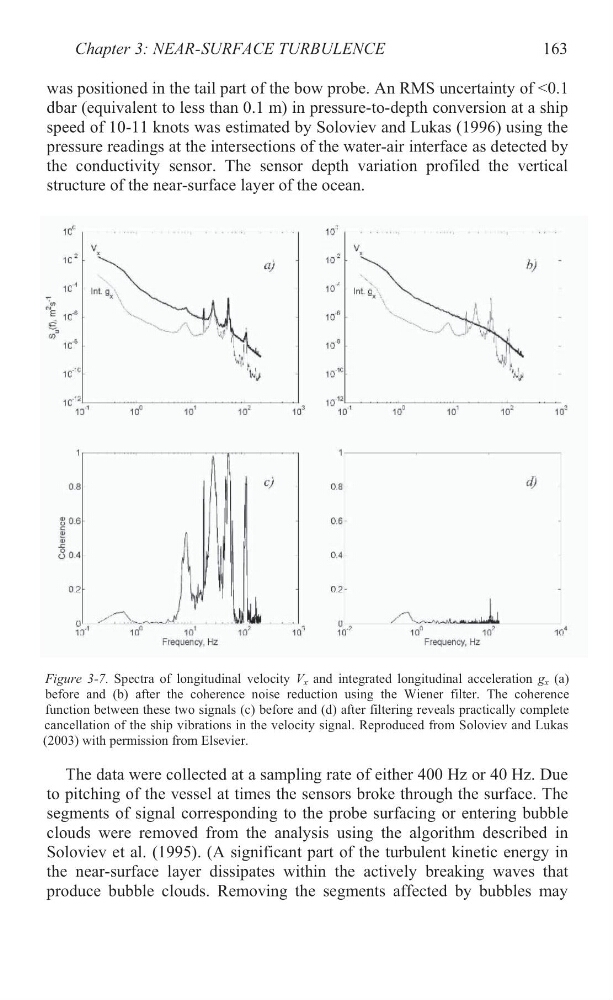
Figure 3-7. Spectra of longitudinal velocity V x and integrated longitudinal acceleration g x (a)
before and (b) after the coherence noise reduction using the Wiener filter. The coherence
function between these two signals (c) before and (d) after filtering reveals practically complete
cancellation of the ship vibrations in the velocity signal. Reproduced from Soloviev and Lukas
(2003) with permission from Elsevier.
dbar (equivalent to less than 0.1 m) in pressure-to-depth conversion at a ship
speed of 10-11 knots was estimated by Soloviev and Lukas (1996) using the
pressure readings at the intersections of the water-air interface as detected by
the conductivity sensor. The sensor depth variation profiled the vertical
structure of the near-surface layer of the ocean.
The data were collected at a sampling rate of either 400 Hz or 40 Hz. Due
to pitching of the vessel at times the sensors broke through the surface. The
segments of signal corresponding to the probe surfacing or entering bubble
clouds were removed from the analysis using the algorithm described in
Soloviev et al. (1995). (A significant part of the turbulent kinetic energy in
the near-surface layer dissipates within the actively breaking waves that
produce bubble clouds. Removing the segments affected by bubbles may
Chapter 3: NEAR-SURFACE TURBULENCE
163
Figure 3-7. Spectra of longitudinal velocity V x and integrated longitudinal acceleration g x (a)
before and (b) after the coherence noise reduction using the Wiener filter. The coherence
function between these two signals (c) before and (d) after filtering reveals practically complete
cancellation of the ship vibrations in the velocity signal. Reproduced from Soloviev and Lukas
(2003) with permission from Elsevier.