

3
0
p
O
T
c u
L
gQ
U
D
N
,
(3.6)
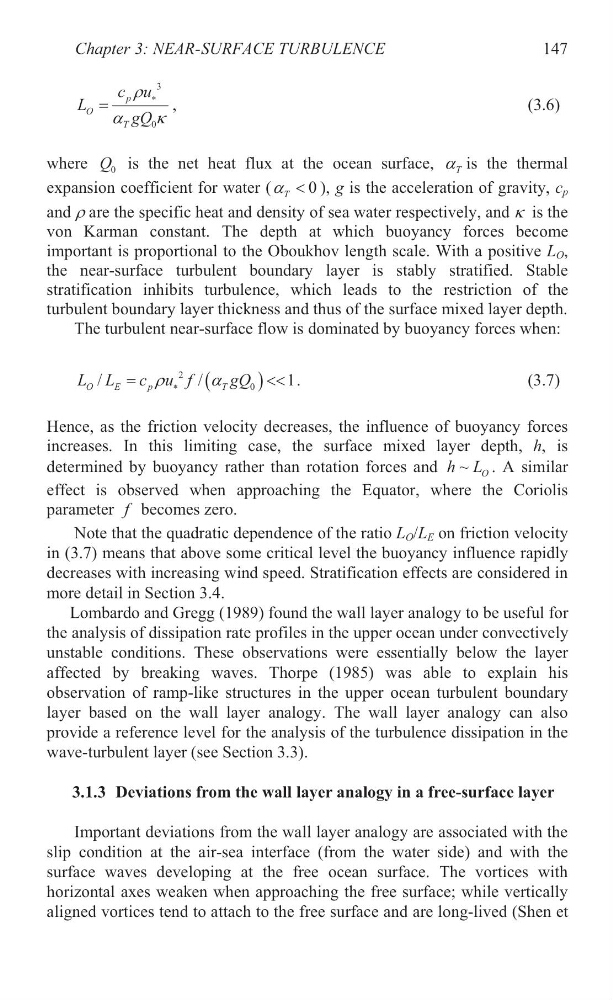
where 0
Q is the net heat flux at the ocean surface, T
D is the thermal
expansion coefficient for water (
0
T
D ), g is the acceleration of gravity, c p
and U are the specific heat and density of sea water respectively, and N is the
von Karman constant. The depth at which buoyancy forces become
important is proportional to the Oboukhov length scale. With a positive L O ,
the near-surface turbulent boundary layer is stably stratified. Stable
stratification inhibits turbulence, which leads to the restriction of the
turbulent boundary layer thickness and thus of the surface mixed layer depth.
The turbulent near-surface flow is dominated by buoyancy forces when:
2
0
/
/
1
O
E
p
T
L L c u f
gQ
U
D
.
(3.7)
Hence, as the friction velocity decreases, the influence of buoyancy forces
increases. In this limiting case, the surface mixed layer depth, h, is
determined by buoyancy rather than rotation forces and ~ O
h L . A similar
effect is observed when approaching the Equator, where the Coriolis
parameter f becomes zero.
Note that the quadratic dependence of the ratio L O /L E on friction velocity
in (3.7) means that above some critical level the buoyancy influence rapidly
decreases with increasing wind speed. Stratification effects are considered in
more detail in Section 3.4.
Lombardo and Gregg (1989) found the wall layer analogy to be useful for
the analysis of dissipation rate profiles in the upper ocean under convectively
unstable conditions. These observations were essentially below the layer
affected by breaking waves. Thorpe (1985) was able to explain his
observation of ramp-like structures in the upper ocean turbulent boundary
layer based on the wall layer analogy. The wall layer analogy can also
provide a reference level for the analysis of the turbulence dissipation in the
wave-turbulent layer (see Section 3.3).
3.1.3 Deviations from the wall layer analogy in a free-surface layer
Important deviations from the wall layer analogy are associated with the
slip condition at the air-sea interface (from the water side) and with the
surface waves developing at the free ocean surface. The vortices with
horizontal axes weaken when approaching the free surface; while vertically
aligned vortices tend to attach to the free surface and are long-lived (Shen et
Chapter 3: NEAR-SURFACE TURBULENCE
147
0
p
O
T
c u
L
gQ
U
D
N
,
(3.6)
where 0
Q is the net heat flux at the ocean surface, T
D is the thermal
expansion coefficient for water (
0
T
D ), g is the acceleration of gravity, c p
and U are the specific heat and density of sea water respectively, and N is the
von Karman constant. The depth at which buoyancy forces become
important is proportional to the Oboukhov length scale. With a positive L O ,
the near-surface turbulent boundary layer is stably stratified. Stable
stratification inhibits turbulence, which leads to the restriction of the
turbulent boundary layer thickness and thus of the surface mixed layer depth.
The turbulent near-surface flow is dominated by buoyancy forces when:
2
0
/
/
1
O
E
p
T
L L c u f
gQ
U
D
.
(3.7)
Hence, as the friction velocity decreases, the influence of buoyancy forces
increases. In this limiting case, the surface mixed layer depth, h, is
determined by buoyancy rather than rotation forces and ~ O
h L . A similar
effect is observed when approaching the Equator, where the Coriolis
parameter f becomes zero.
Note that the quadratic dependence of the ratio L O /L E on friction velocity
in (3.7) means that above some critical level the buoyancy influence rapidly
decreases with increasing wind speed. Stratification effects are considered in
more detail in Section 3.4.
Lombardo and Gregg (1989) found the wall layer analogy to be useful for
the analysis of dissipation rate profiles in the upper ocean under convectively
unstable conditions. These observations were essentially below the layer
affected by breaking waves. Thorpe (1985) was able to explain his
observation of ramp-like structures in the upper ocean turbulent boundary
layer based on the wall layer analogy. The wall layer analogy can also
provide a reference level for the analysis of the turbulence dissipation in the
wave-turbulent layer (see Section 3.3).
3.1.3 Deviations from the wall layer analogy in a free-surface layer
Important deviations from the wall layer analogy are associated with the
slip condition at the air-sea interface (from the water side) and with the
surface waves developing at the free ocean surface. The vortices with
horizontal axes weaken when approaching the free surface; while vertically
aligned vortices tend to attach to the free surface and are long-lived (Shen et
Chapter 3: NEAR-SURFACE TURBULENCE
147