

THE NEAR-SURFACE LAYER OF THE OCEAN
authors define the inner part of the wall layer as 0
0.1
z
h
d
; the outer part
is then defined as 0.1h z h
d d , respectively.
In the inner boundary layer, the current velocity profile,
u z , depends
on boundary conditions (surface stress and hydrodynamic surface roughness)
and distance z . The properties of the inner boundary layer near a rigid wall
are well known from classical works in hydrodynamics (Hinze, 1955, Monin
and Yaglom, 1971; and others). In particular, a logarithmic layer may
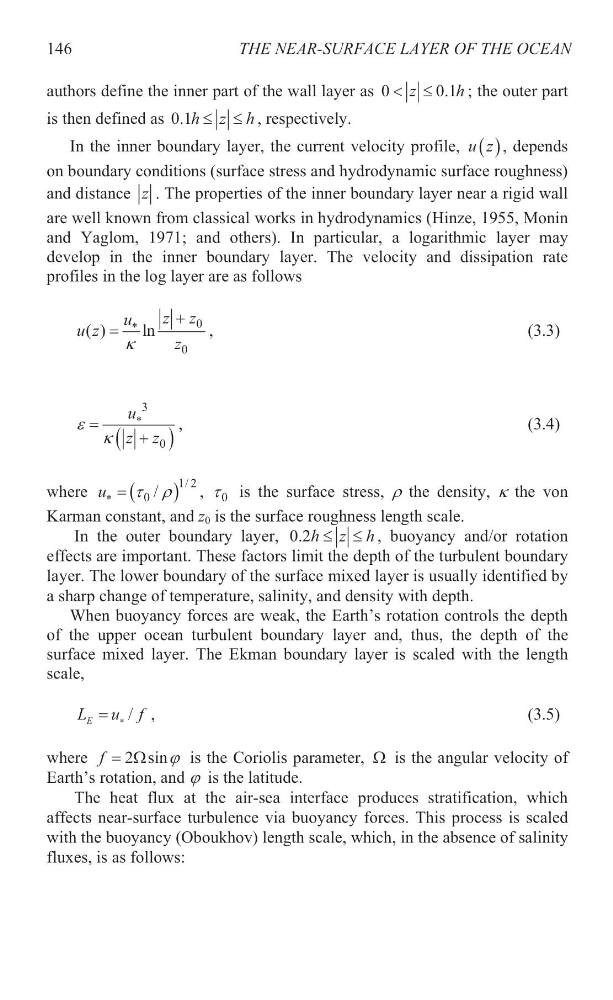
develop in the inner boundary layer. The velocity and dissipation rate
profiles in the log layer are as follows
0
0
( )
ln
z z
u
u z
z
N
,
(3.3)
3
0
u
z z
H
N
,
(3.4)
where
1/ 2
0 /
u
W U
, 0
W is the surface stress, U the density, N the von
Karman constant, and z 0 is the surface roughness length scale.
In the outer boundary layer, 0.2h z h
d d , buoyancy and/or rotation
effects are important. These factors limit the depth of the turbulent boundary
layer. The lower boundary of the surface mixed layer is usually identified by
a sharp change of temperature, salinity, and density with depth.
When buoyancy forces are weak, the Earth’s rotation controls the depth
of the upper ocean turbulent boundary layer and, thus, the depth of the
surface mixed layer. The Ekman boundary layer is scaled with the length
scale,
/
E
L u f
,
(3.5)
where
2 sin
f
M
:
is the Coriolis parameter, : is the angular velocity of
Earth’s rotation, and Mis the latitude.
The heat flux at the air-sea interface produces stratification, which
affects near-surface turbulence via buoyancy forces. This process is scaled
with the buoyancy (Oboukhov) length scale, which, in the absence of salinity
fluxes, is as follows:
146
authors define the inner part of the wall layer as 0
0.1
z
h
d
; the outer part
is then defined as 0.1h z h
d d , respectively.
In the inner boundary layer, the current velocity profile,
u z , depends
on boundary conditions (surface stress and hydrodynamic surface roughness)
and distance z . The properties of the inner boundary layer near a rigid wall
are well known from classical works in hydrodynamics (Hinze, 1955, Monin
and Yaglom, 1971; and others). In particular, a logarithmic layer may
develop in the inner boundary layer. The velocity and dissipation rate
profiles in the log layer are as follows
0
0
( )
ln
z z
u
u z
z
N
,
(3.3)
3
0
u
z z
H
N
,
(3.4)
where
1/ 2
0 /
u
W U
, 0
W is the surface stress, U the density, N the von
Karman constant, and z 0 is the surface roughness length scale.
In the outer boundary layer, 0.2h z h
d d , buoyancy and/or rotation
effects are important. These factors limit the depth of the turbulent boundary
layer. The lower boundary of the surface mixed layer is usually identified by
a sharp change of temperature, salinity, and density with depth.
When buoyancy forces are weak, the Earth’s rotation controls the depth
of the upper ocean turbulent boundary layer and, thus, the depth of the
surface mixed layer. The Ekman boundary layer is scaled with the length
scale,
/
E
L u f
,
(3.5)
where
2 sin
f
M
:
is the Coriolis parameter, : is the angular velocity of
Earth’s rotation, and Mis the latitude.
The heat flux at the air-sea interface produces stratification, which
affects near-surface turbulence via buoyancy forces. This process is scaled
with the buoyancy (Oboukhov) length scale, which, in the absence of salinity
fluxes, is as follows:
146