

Chapter 2: SEA SURFACE MICROLAYER
In order to extend the parameterization to cases with positive latent heat flux
(condensation), Rf 0 should be reset equal to zero if it becomes positive
according to expression (2.97).
2.4.4 Model calculations
Penetrating solar radiation is specified according to (1.61)-(1.62). There
are also material coefficients to be set in the model as functions of
temperature and salinity; they are , , , , , and
T
T
p
L c
Q N D
U . As a first
approximation, the influence of sea surface temperature and salinity
variability on the material coefficients is ignored, while the dimensionless
product
0
T S
E
is fixed at 0.026.
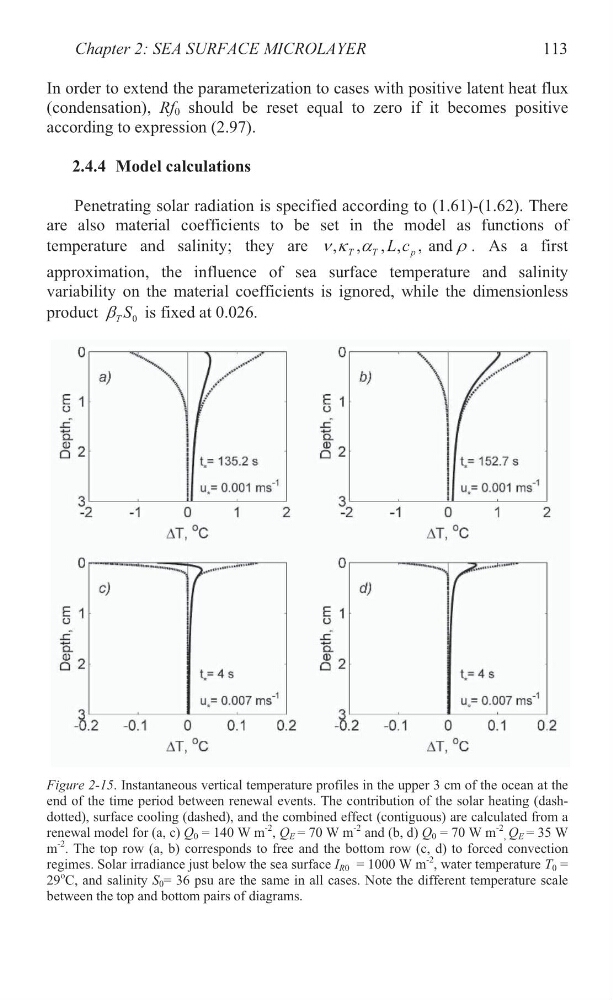
Figure 2-15. Instantaneous vertical temperature profiles in the upper 3 cm of the ocean at the
end of the time period between renewal events. The contribution of the solar heating (dashdotted), surface cooling (dashed), and the combined effect (contiguous) are calculated from a
renewal model for (a, c) Q 0 = 140 W m
-2 , Q E = 70 W m
-2 and (b, d) Q 0 = 70 W m
-2
, Q E = 35 W
m
-2 . The top row (a, b) corresponds to free and the bottom row (c, d) to forced convection
regimes. Solar irradiance just below the sea surface I R0 = 1000 W m
-2 , water temperature T 0 =
29
o C, and salinity S 0 = 36 psu are the same in all cases. Note the different temperature scale
between the top and bottom pairs of diagrams.
113
In order to extend the parameterization to cases with positive latent heat flux
(condensation), Rf 0 should be reset equal to zero if it becomes positive
according to expression (2.97).
2.4.4 Model calculations
Penetrating solar radiation is specified according to (1.61)-(1.62). There
are also material coefficients to be set in the model as functions of
temperature and salinity; they are , , , , , and
T
T
p
L c
Q N D
U . As a first
approximation, the influence of sea surface temperature and salinity
variability on the material coefficients is ignored, while the dimensionless
product
0
T S
E
is fixed at 0.026.
Figure 2-15. Instantaneous vertical temperature profiles in the upper 3 cm of the ocean at the
end of the time period between renewal events. The contribution of the solar heating (dashdotted), surface cooling (dashed), and the combined effect (contiguous) are calculated from a
renewal model for (a, c) Q 0 = 140 W m
-2 , Q E = 70 W m
-2 and (b, d) Q 0 = 70 W m
-2
, Q E = 35 W
m
-2 . The top row (a, b) corresponds to free and the bottom row (c, d) to forced convection
regimes. Solar irradiance just below the sea surface I R0 = 1000 W m
-2 , water temperature T 0 =
29
o C, and salinity S 0 = 36 psu are the same in all cases. Note the different temperature scale
between the top and bottom pairs of diagrams.
113