

Chapter 2: SEA SURFACE MICROLAYER
Wind-induced surface current constitutes only a tiny part of the total
velocity difference between air and sea (about 2%). The condition of
constant momentum flux rather than constant velocity difference is therefore
appropriate in (2.23). Waves are a volume source of momentum in the nearsurface layer of the ocean; formally, they do not enter the surface boundary
condition for velocity. We nevertheless neglect here the second order effect
relating to the modification of the gravity-capillary waves and, thereby, the
surface roughness and momentum fluxes by surface drift current. This
secondary effect, however, may become of primary importance under
conditions of very high wind speed (see Chapter 6).
The dependence of the net longwave irradiance I L and latent heat flux Q E
on the temperature difference due to the cool skin is typically within several
% (Paulson and Simpson, 1981). Only Q T may depend appreciably on the
cool skin presence. Usually L
E
T
I Q
Q
!!
, which means that the net
surface flux, q 0 , does not depend strongly on the cool skin presence. As a
result, the condition of constant heat flux is justified for deriving dependence
(2.24). Solar radiation is a volume source of heat for the near-surface layer
of the ocean and does not enter the surface boundary condition.
The condition of constant concentration difference accepted in (2.25)
follows from the assumption that the aqueous diffusion sublayer provides the main
resistance to the gas transfer and thereby contains the main gas concentration
difference across the air-sea interface.
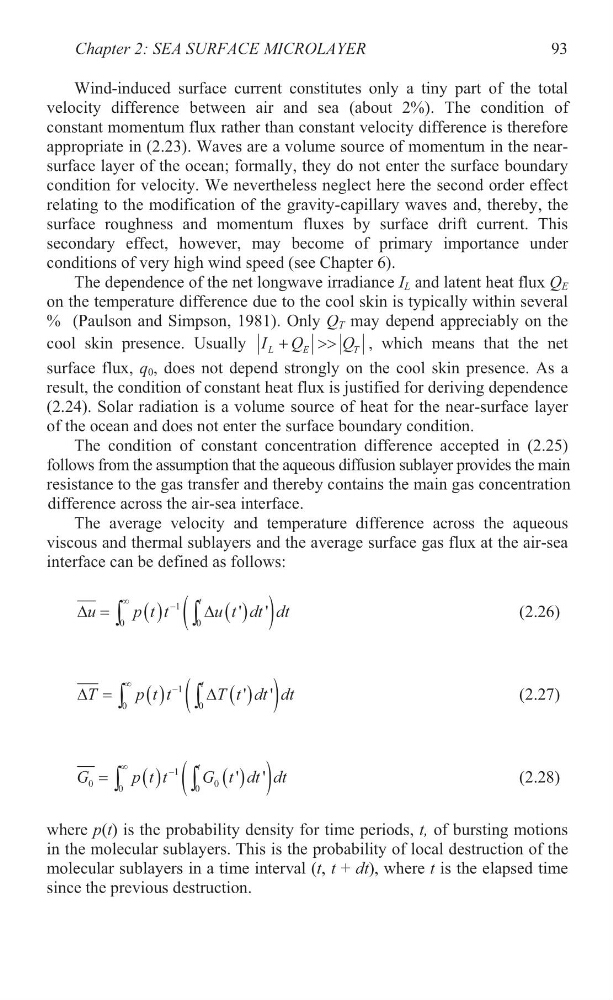
The average velocity and temperature difference across the aqueous
viscous and thermal sublayers and the average surface gas flux at the air-sea
interface can be defined as follows:
1
0
0
' '
t
u
p t t
u t dt dt
f
'
'
³
³
(2.26)
1
0
0
' '
t
T
p t t
T t dt dt
f
'
'
³
³
(2.27)
1
0
0
0
0
' '
t
G
p t t
G t dt dt
f
³
³
(2.28)
where p(t) is the probability density for time periods, t, of bursting motions
in the molecular sublayers. This is the probability of local destruction of the
molecular sublayers in a time interval (t, t + dt), where t is the elapsed time
since the previous destruction.
93
Wind-induced surface current constitutes only a tiny part of the total
velocity difference between air and sea (about 2%). The condition of
constant momentum flux rather than constant velocity difference is therefore
appropriate in (2.23). Waves are a volume source of momentum in the nearsurface layer of the ocean; formally, they do not enter the surface boundary
condition for velocity. We nevertheless neglect here the second order effect
relating to the modification of the gravity-capillary waves and, thereby, the
surface roughness and momentum fluxes by surface drift current. This
secondary effect, however, may become of primary importance under
conditions of very high wind speed (see Chapter 6).
The dependence of the net longwave irradiance I L and latent heat flux Q E
on the temperature difference due to the cool skin is typically within several
% (Paulson and Simpson, 1981). Only Q T may depend appreciably on the
cool skin presence. Usually L
E
T
I Q
Q
!!
, which means that the net
surface flux, q 0 , does not depend strongly on the cool skin presence. As a
result, the condition of constant heat flux is justified for deriving dependence
(2.24). Solar radiation is a volume source of heat for the near-surface layer
of the ocean and does not enter the surface boundary condition.
The condition of constant concentration difference accepted in (2.25)
follows from the assumption that the aqueous diffusion sublayer provides the main
resistance to the gas transfer and thereby contains the main gas concentration
difference across the air-sea interface.
The average velocity and temperature difference across the aqueous
viscous and thermal sublayers and the average surface gas flux at the air-sea
interface can be defined as follows:
1
0
0
' '
t
u
p t t
u t dt dt
f
'
'
³
³
(2.26)
1
0
0
' '
t
T
p t t
T t dt dt
f
'
'
³
³
(2.27)
1
0
0
0
0
' '
t
G
p t t
G t dt dt
f
³
³
(2.28)
where p(t) is the probability density for time periods, t, of bursting motions
in the molecular sublayers. This is the probability of local destruction of the
molecular sublayers in a time interval (t, t + dt), where t is the elapsed time
since the previous destruction.
93