

THE NEAR-SURFACE LAYER OF THE OCEAN
corresponding bulk-water values. As the fluid element is exposed to the
interface, the appropriate molecular diffusion laws (1.6), (1.10), and (1.12)
govern the velocity ('u) and temperature ('7) differences, and the
interfacial gas flux (G o ). Under assumption of horizontal homogeneity, no
insolation and no rain, one-dimensional molecular diffusion laws are as
follows:
u
u
t
z
z
Q
w
w
w
§
·
¨
¸
w
w
w
©
¹
,
(2.20)
T
T
T
t
z
z
N
w
w
w
§
·
¨
¸
w
w
w
©
¹
,
(2.21)
C
C
t
z
z
P
w
w
w
§
·
¨
¸
w
w
w
©
¹
.
(2.22)
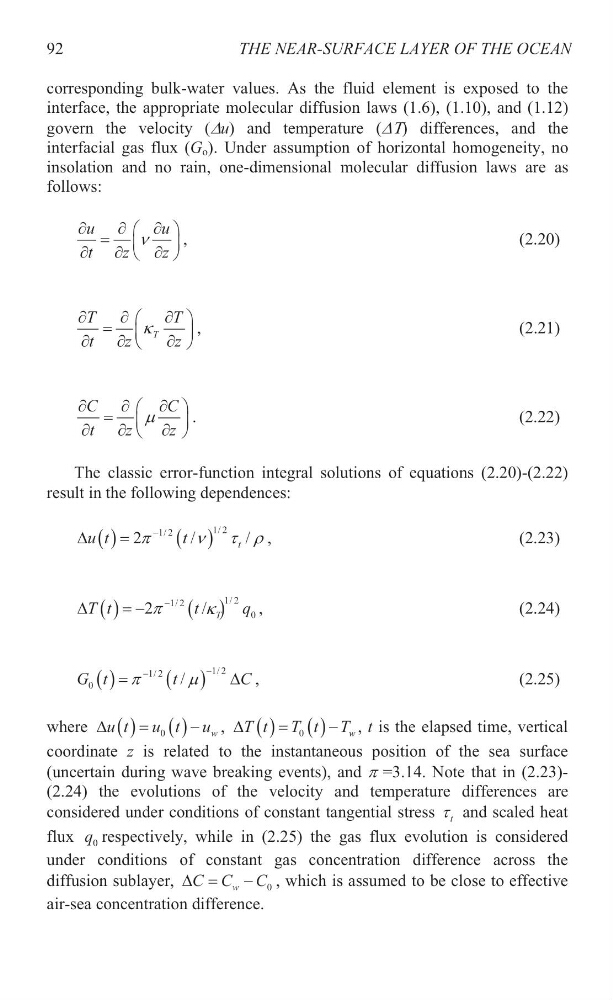
The classic error-function integral solutions of equations (2.20)-(2.22)
result in the following dependences:
1/ 2
1/ 2
2
/
/
t
u t
t
S
Q W U
'
,
(2.23)
1/ 2
1/ 2
0
T t
q
'
,
(2.24)
1/ 2
1/ 2
0
/
G t
t
C
S
P
' ,
(2.25)
where
0
w
u t u t u
'
,
0
w
T t T t T
'
, t is the elapsed time, vertical
coordinate z is related to the instantaneous position of the sea surface
(uncertain during wave breaking events), and S =3.14. Note that in (2.23)(2.24) the evolutions of the velocity and temperature differences are
considered under conditions of constant tangential stress t
W and scaled heat
flux 0
q respectively, while in (2.25) the gas flux evolution is considered
under conditions of constant gas concentration difference across the
diffusion sublayer,
0
w
C C C
'
, which is assumed to be close to effective
air-sea concentration difference.
92
2
/
S
t T
N
corresponding bulk-water values. As the fluid element is exposed to the
interface, the appropriate molecular diffusion laws (1.6), (1.10), and (1.12)
govern the velocity ('u) and temperature ('7) differences, and the
interfacial gas flux (G o ). Under assumption of horizontal homogeneity, no
insolation and no rain, one-dimensional molecular diffusion laws are as
follows:
u
u
t
z
z
Q
w
w
w
§
·
¨
¸
w
w
w
©
¹
,
(2.20)
T
T
T
t
z
z
N
w
w
w
§
·
¨
¸
w
w
w
©
¹
,
(2.21)
C
C
t
z
z
P
w
w
w
§
·
¨
¸
w
w
w
©
¹
.
(2.22)
The classic error-function integral solutions of equations (2.20)-(2.22)
result in the following dependences:
1/ 2
1/ 2
2
/
/
t
u t
t
S
Q W U
'
,
(2.23)
1/ 2
1/ 2
0
T t
q
'
,
(2.24)
1/ 2
1/ 2
0
/
G t
t
C
S
P
' ,
(2.25)
where
0
w
u t u t u
'
,
0
w
T t T t T
'
, t is the elapsed time, vertical
coordinate z is related to the instantaneous position of the sea surface
(uncertain during wave breaking events), and S =3.14. Note that in (2.23)(2.24) the evolutions of the velocity and temperature differences are
considered under conditions of constant tangential stress t
W and scaled heat
flux 0
q respectively, while in (2.25) the gas flux evolution is considered
under conditions of constant gas concentration difference across the
diffusion sublayer,
0
w
C C C
'
, which is assumed to be close to effective
air-sea concentration difference.
92
2
/
S
t T
N