

THE NEAR-SURFACE LAYER OF THE OCEAN
0
/
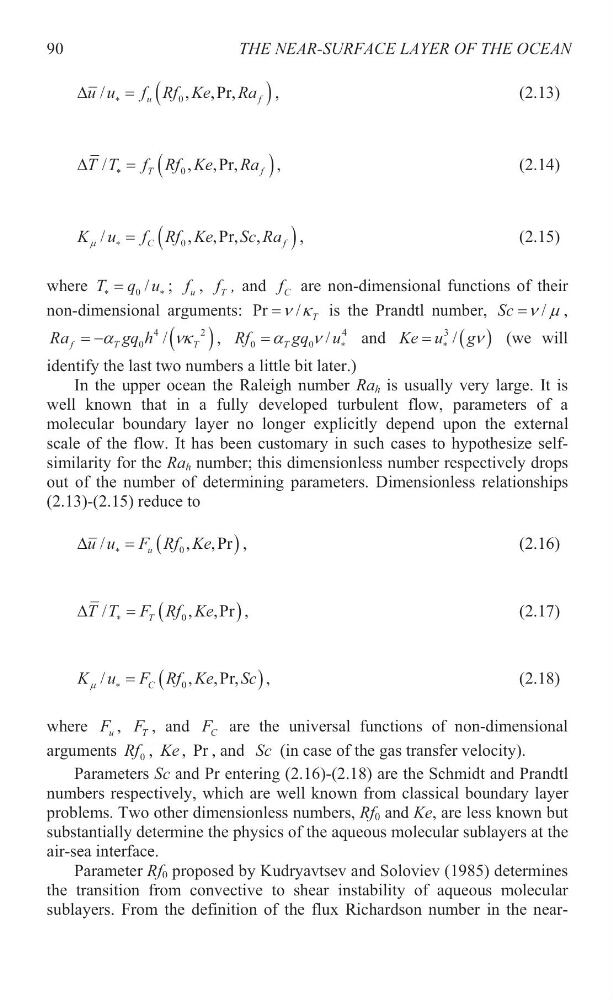
, , P r ,
u
f
u u
f Rf Ke
Ra
'
,
(2.13)
0
/
, , P r ,
T
f
T T f Rf Ke
Ra
'
,
(2.14)
0
/
, , P r , ,
C
f
K u
f Rf Ke
Sc Ra
P
,
(2.15)
where
0 /
T q u
; u
f , T
f , and C
f are non-dimensional functions of their
non-dimensional arguments: Pr
/ T
Q N is the Prandtl number,
/
Sc Q P ,
4
2
0
/
f
T
T
Ra
gq h
D
Q N
,
4
0
0 /
T
Rf
gq u
D
Q and
3 /
Ke u gQ
(we will
identify the last two numbers a little bit later.)
In the upper ocean the Raleigh number Ra h is usually very large. It is
well known that in a fully developed turbulent flow, parameters of a
molecular boundary layer no longer explicitly depend upon the external
scale of the flow. It has been customary in such cases to hypothesize selfsimilarity for the Ra h number; this dimensionless number respectively drops
out of the number of determining parameters. Dimensionless relationships
(2.13)-(2.15) reduce to
0
/
, , P r
u
u u F Rf Ke
'
,
(2.16)
0
/
, , P r
T
T T F Rf Ke
'
,
(2.17)
0
/
, , P r ,
C
K u F Rf Ke
Sc
P
,
(2.18)
where u
F , T
F , and C
F are the universal functions of non-dimensional
arguments 0
Rf , Ke , Pr , and Sc (in case of the gas transfer velocity).
Parameters Sc and Pr entering (2.16)-(2.18) are the Schmidt and Prandtl
numbers respectively, which are well known from classical boundary layer
problems. Two other dimensionless numbers, Rf 0 and Ke, are less known but
substantially determine the physics of the aqueous molecular sublayers at the
air-sea interface.
Parameter Rf 0 proposed by Kudryavtsev and Soloviev (1985) determines
the transition from convective to shear instability of aqueous molecular
sublayers. From the definition of the flux Richardson number in the near90
0
/
, , P r ,
u
f
u u
f Rf Ke
Ra
'
,
(2.13)
0
/
, , P r ,
T
f
T T f Rf Ke
Ra
'
,
(2.14)
0
/
, , P r , ,
C
f
K u
f Rf Ke
Sc Ra
P
,
(2.15)
where
0 /
T q u
; u
f , T
f , and C
f are non-dimensional functions of their
non-dimensional arguments: Pr
/ T
Q N is the Prandtl number,
/
Sc Q P ,
4
2
0
/
f
T
T
Ra
gq h
D
Q N
,
4
0
0 /
T
Rf
gq u
D
Q and
3 /
Ke u gQ
(we will
identify the last two numbers a little bit later.)
In the upper ocean the Raleigh number Ra h is usually very large. It is
well known that in a fully developed turbulent flow, parameters of a
molecular boundary layer no longer explicitly depend upon the external
scale of the flow. It has been customary in such cases to hypothesize selfsimilarity for the Ra h number; this dimensionless number respectively drops
out of the number of determining parameters. Dimensionless relationships
(2.13)-(2.15) reduce to
0
/
, , P r
u
u u F Rf Ke
'
,
(2.16)
0
/
, , P r
T
T T F Rf Ke
'
,
(2.17)
0
/
, , P r ,
C
K u F Rf Ke
Sc
P
,
(2.18)
where u
F , T
F , and C
F are the universal functions of non-dimensional
arguments 0
Rf , Ke , Pr , and Sc (in case of the gas transfer velocity).
Parameters Sc and Pr entering (2.16)-(2.18) are the Schmidt and Prandtl
numbers respectively, which are well known from classical boundary layer
problems. Two other dimensionless numbers, Rf 0 and Ke, are less known but
substantially determine the physics of the aqueous molecular sublayers at the
air-sea interface.
Parameter Rf 0 proposed by Kudryavtsev and Soloviev (1985) determines
the transition from convective to shear instability of aqueous molecular
sublayers. From the definition of the flux Richardson number in the near90