

Chapter 2: SEA SURFACE MICROLAYER
0
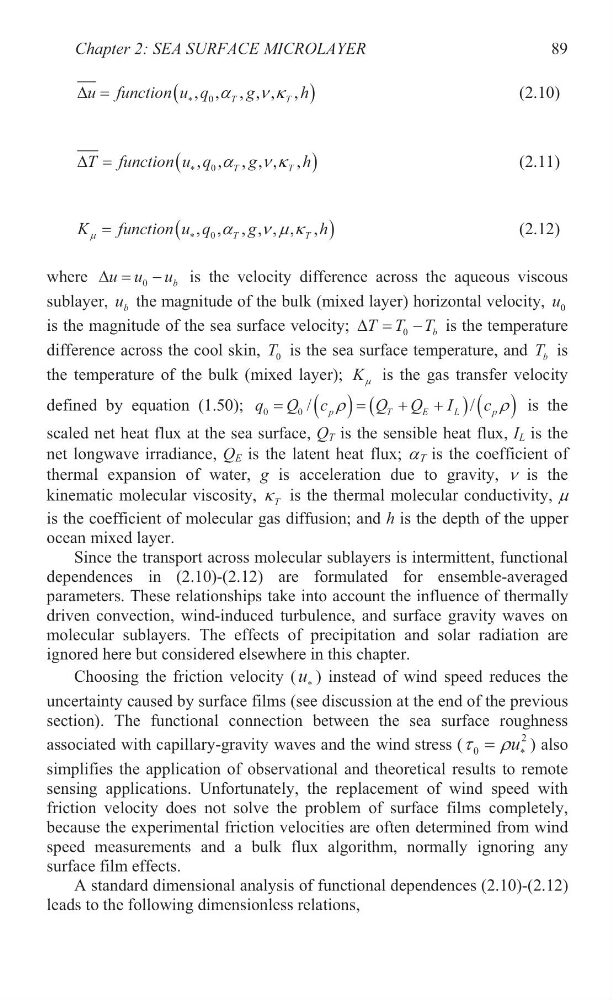
, , , , , ,
T
T
u function u q
g
h
D
Q N
'
(2.10)
0
, , , , , ,
T
T
T function u q
g
h
D
Q N
'
(2.11)
0
, , , , , , ,
T
T
K
function u q
g
h
P
D
Q P N
(2.12)
where
0
b
u u u
'
is the velocity difference across the aqueous viscous
sublayer, b
u the magnitude of the bulk (mixed layer) horizontal velocity, 0
u
is the magnitude of the sea surface velocity;
0
b
T T T
'
is the temperature
difference across the cool skin, 0
T is the sea surface temperature, and b
T is
the temperature of the bulk (mixed layer); K P is the gas transfer velocity
defined by equation (1.50);
0
0 /
/
p
T
E
L
p
q Q c
Q Q I
c
U
U
is the
scaled net heat flux at the sea surface, Q T is the sensible heat flux, I L is the
net longwave irradiance, Q E is the latent heat flux; D 7 is the coefficient of
thermal expansion of water, g is acceleration due to gravity, Q is the
kinematic molecular viscosity, T
N is the thermal molecular conductivity, P
is the coefficient of molecular gas diffusion; and h is the depth of the upper
ocean mixed layer.
Since the transport across molecular sublayers is intermittent, functional
dependences in (2.10)-(2.12) are formulated for ensemble-averaged
parameters. These relationships take into account the influence of thermally
driven convection, wind-induced turbulence, and surface gravity waves on
molecular sublayers. The effects of precipitation and solar radiation are
ignored here but considered elsewhere in this chapter.
Choosing the friction velocity ( u ) instead of wind speed reduces the
uncertainty caused by surface films (see discussion at the end of the previous
section). The functional connection between the sea surface roughness
associated with capillary-gravity waves and the wind stress (
2
0
u
W U ) also
simplifies the application of observational and theoretical results to remote
sensing applications. Unfortunately, the replacement of wind speed with
friction velocity does not solve the problem of surface films completely,
because the experimental friction velocities are often determined from wind
speed measurements and a bulk flux algorithm, normally ignoring any
surface film effects.
A standard dimensional analysis of functional dependences (2.10)-(2.12)
leads to the following dimensionless relations,
89
0
, , , , , ,
T
T
u function u q
g
h
D
Q N
'
(2.10)
0
, , , , , ,
T
T
T function u q
g
h
D
Q N
'
(2.11)
0
, , , , , , ,
T
T
K
function u q
g
h
P
D
Q P N
(2.12)
where
0
b
u u u
'
is the velocity difference across the aqueous viscous
sublayer, b
u the magnitude of the bulk (mixed layer) horizontal velocity, 0
u
is the magnitude of the sea surface velocity;
0
b
T T T
'
is the temperature
difference across the cool skin, 0
T is the sea surface temperature, and b
T is
the temperature of the bulk (mixed layer); K P is the gas transfer velocity
defined by equation (1.50);
0
0 /
/
p
T
E
L
p
q Q c
Q Q I
c
U
U
is the
scaled net heat flux at the sea surface, Q T is the sensible heat flux, I L is the
net longwave irradiance, Q E is the latent heat flux; D 7 is the coefficient of
thermal expansion of water, g is acceleration due to gravity, Q is the
kinematic molecular viscosity, T
N is the thermal molecular conductivity, P
is the coefficient of molecular gas diffusion; and h is the depth of the upper
ocean mixed layer.
Since the transport across molecular sublayers is intermittent, functional
dependences in (2.10)-(2.12) are formulated for ensemble-averaged
parameters. These relationships take into account the influence of thermally
driven convection, wind-induced turbulence, and surface gravity waves on
molecular sublayers. The effects of precipitation and solar radiation are
ignored here but considered elsewhere in this chapter.
Choosing the friction velocity ( u ) instead of wind speed reduces the
uncertainty caused by surface films (see discussion at the end of the previous
section). The functional connection between the sea surface roughness
associated with capillary-gravity waves and the wind stress (
2
0
u
W U ) also
simplifies the application of observational and theoretical results to remote
sensing applications. Unfortunately, the replacement of wind speed with
friction velocity does not solve the problem of surface films completely,
because the experimental friction velocities are often determined from wind
speed measurements and a bulk flux algorithm, normally ignoring any
surface film effects.
A standard dimensional analysis of functional dependences (2.10)-(2.12)
leads to the following dimensionless relations,
89