

46 G.M.R. Manzella and MFS-VOS Group
-High density sampling: is done in tracks from boundary to boundary with
closely spaced XBTs, in order to resolve mesoscale, fronts and boundary currents;
the repetition time is 3 months, the spatial resolution 10-S0 krn.
It is interesting to note the difference between high sampling and the sampling
requirements for the Mediterranean Sea, where for resolving the mesoscale and the
synopticity the temporal sampling must be lS days and the spatial one lS - 20 krn.
In the Mediterranean case the 'real time' data must be delivered in 2 - 7 days from
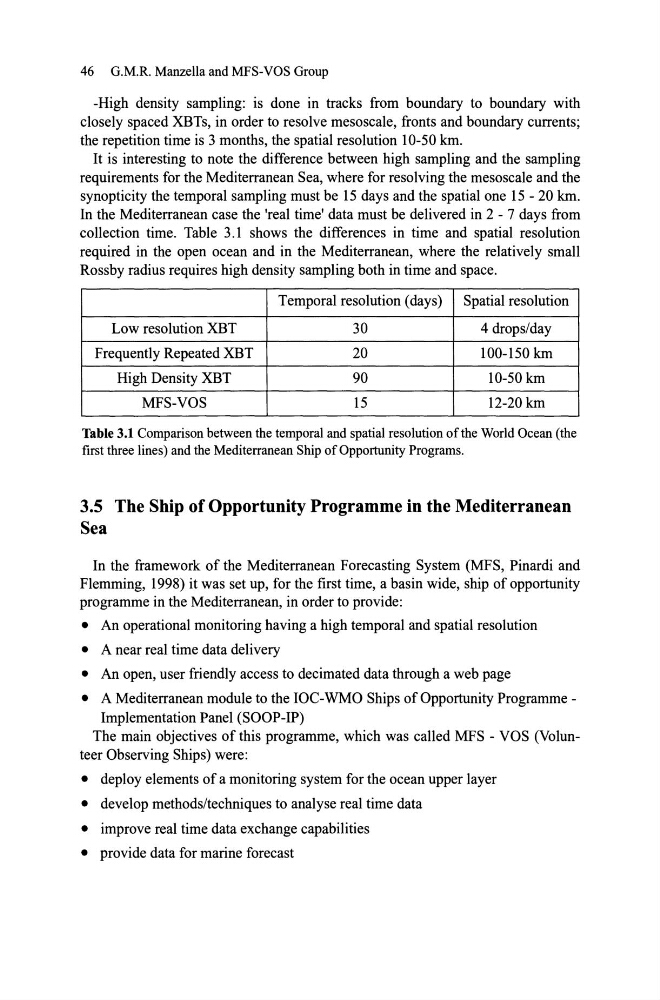
collection time. Table 3.1 shows the differences in time and spatial resolution
required in the open ocean and in the Mediterranean, where the relatively small
Rossby radius requires high density sampling both in time and space.
Temporal resolution (days) Spatial resolution
Low resolution XBT
30
4 drops/day
Frequently Repeated XBT
20
100-lS0 krn
High Density XBT
90
10-S0 krn
MFS-VOS
IS
12-20krn
Table 3.1 Comparison between the temporal and spatial resolution ofthe World Ocean (the
first three lines) and the Mediterranean Ship of Opportunity Programs.
3.5 The Ship of Opportunity Programme in the Mediterranean
Sea
In the framework of the Mediterranean Forecasting System (MFS, Pinardi and
Flemming, 1998) it was set up, for the first time, a basin wide, ship of opportunity
programme in the Mediterranean, in order to provide:
• An operational monitoring having a high temporal and spatial resolution
• A near real time data delivery
• An open, user friendly access to decimated data through a web page
• A Mediterranean module to the IOC-WMO Ships of Opportunity Programme -
Implementation Panel (SOOP-IP)
The main objectives of this programme, which was called MFS - VOS (Volunteer Observing Ships) were:
• deploy elements of a monitoring system for the ocean upper layer
• develop methods/techniques to analyse real time data
• improve real time data exchange capabilities
• provide data for marine forecast
-High density sampling: is done in tracks from boundary to boundary with
closely spaced XBTs, in order to resolve mesoscale, fronts and boundary currents;
the repetition time is 3 months, the spatial resolution 10-S0 krn.
It is interesting to note the difference between high sampling and the sampling
requirements for the Mediterranean Sea, where for resolving the mesoscale and the
synopticity the temporal sampling must be lS days and the spatial one lS - 20 krn.
In the Mediterranean case the 'real time' data must be delivered in 2 - 7 days from
collection time. Table 3.1 shows the differences in time and spatial resolution
required in the open ocean and in the Mediterranean, where the relatively small
Rossby radius requires high density sampling both in time and space.
Temporal resolution (days) Spatial resolution
Low resolution XBT
30
4 drops/day
Frequently Repeated XBT
20
100-lS0 krn
High Density XBT
90
10-S0 krn
MFS-VOS
IS
12-20krn
Table 3.1 Comparison between the temporal and spatial resolution ofthe World Ocean (the
first three lines) and the Mediterranean Ship of Opportunity Programs.
3.5 The Ship of Opportunity Programme in the Mediterranean
Sea
In the framework of the Mediterranean Forecasting System (MFS, Pinardi and
Flemming, 1998) it was set up, for the first time, a basin wide, ship of opportunity
programme in the Mediterranean, in order to provide:
• An operational monitoring having a high temporal and spatial resolution
• A near real time data delivery
• An open, user friendly access to decimated data through a web page
• A Mediterranean module to the IOC-WMO Ships of Opportunity Programme -
Implementation Panel (SOOP-IP)
The main objectives of this programme, which was called MFS - VOS (Volunteer Observing Ships) were:
• deploy elements of a monitoring system for the ocean upper layer
• develop methods/techniques to analyse real time data
• improve real time data exchange capabilities
• provide data for marine forecast