

374 Nadia Pinardi et al.
....,T["'!Pn~
.'
00
, ..
,
-2
,
-2
-2
,
,
-4
,
-4
2 .... ,
-6
- 6
...
-8
-8
...
-10
- 10
-..
- 12
- 12
-'2
-..
- 14
-14
-..
- 16
- 16
-..
-18
_20
18Z OOZ 06Z
18Z OOZ 06Z 121 18Z OOZ 06Z
20
.. .. . .
90eT 100CT
90CT IOOCT
I IOCT
1995
1995
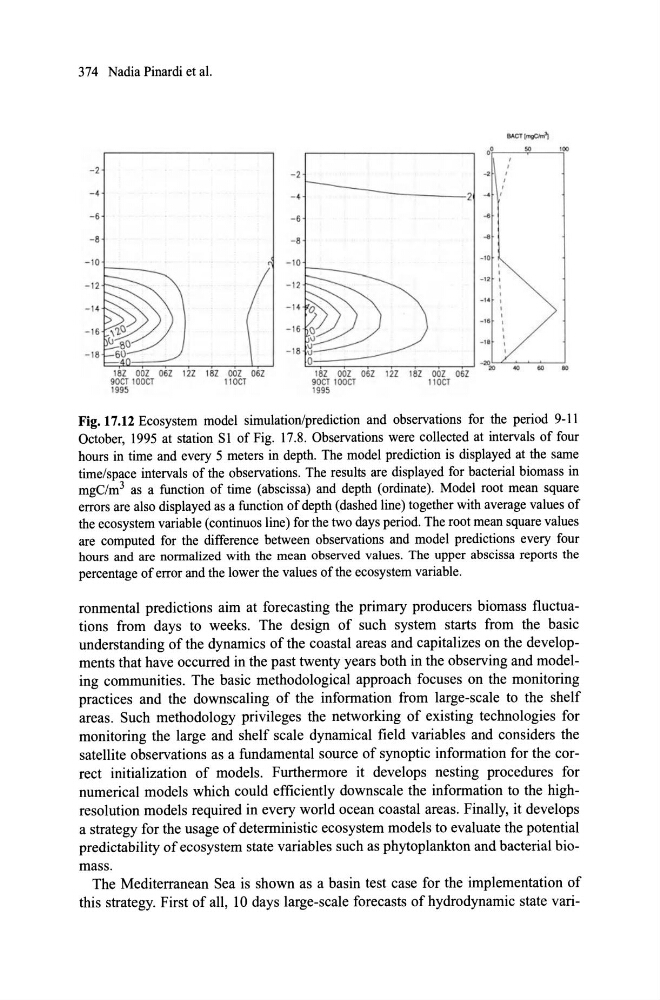
Fig. 17.12 Ecosystem model simulationlprediction and observations for the period 9-11
October, 1995 at station SI of Fig. 17.8. Observations were col\ected at intervals offour
hours in time and every 5 meters in depth. The model prediction is displayed at the same
time/space intervals of the observations. The results are displayed for bacterial biomass in
mgC/m 3 as a function of time (abscissa) and depth (ordinate). Model root mean square
errors are also displayed as a function of depth (dashed line) together with average values of
the ecosystem variable (continuos line) for the two days period. The root mean square values
are computed for the difference between observations and model predictions every four
hours and are normalized with the mean observed values. The upper abscissa reports the
percentage of error and the lower the values of the ecosystem variable.
ronmental predictions aim at forecasting the primary producers biomass fluctuations from days to weeks. The design of such system starts from the basic
understanding of the dynamics of the coastal areas and capitalizes on the developments that have occurred in the past twenty years both in the observ ing and modeling communities. The basic methodological approach focuses on the monitoring
practices and the downscaling of the information from large-scale to the shelf
areas. Such methodology privileges the networking of existing technologies for
monitoring the large and shelf scale dynamical field variables and considers the
satellite observations as a fundamental source of synoptic information for the correct initialization of models. Furthermore it develops nesting procedures for
numerical models which could efficiently downscale the information to the highresolution models required in every world ocean coastal areas. Finally, it develops
a strategy for the usage of deterministic ecosystem models to evaluate the potential
predictability of ecosystem state variables such as phytoplankton and bacterial biomass.
The Mediterranean Sea is shown as a basin test case for the implementation of
this strategy. First of ali, 10 days large-scale forecasts of hydrodynamic state vari-
....,T["'!Pn~
.'
00
, ..
,
-2
,
-2
-2
,
,
-4
,
-4
2 .... ,
-6
- 6
...
-8
-8
...
-10
- 10
-..
- 12
- 12
-'2
-..
- 14
-14
-..
- 16
- 16
-..
-18
_20
18Z OOZ 06Z
18Z OOZ 06Z 121 18Z OOZ 06Z
20
.. .. . .
90eT 100CT
90CT IOOCT
I IOCT
1995
1995
Fig. 17.12 Ecosystem model simulationlprediction and observations for the period 9-11
October, 1995 at station SI of Fig. 17.8. Observations were col\ected at intervals offour
hours in time and every 5 meters in depth. The model prediction is displayed at the same
time/space intervals of the observations. The results are displayed for bacterial biomass in
mgC/m 3 as a function of time (abscissa) and depth (ordinate). Model root mean square
errors are also displayed as a function of depth (dashed line) together with average values of
the ecosystem variable (continuos line) for the two days period. The root mean square values
are computed for the difference between observations and model predictions every four
hours and are normalized with the mean observed values. The upper abscissa reports the
percentage of error and the lower the values of the ecosystem variable.
ronmental predictions aim at forecasting the primary producers biomass fluctuations from days to weeks. The design of such system starts from the basic
understanding of the dynamics of the coastal areas and capitalizes on the developments that have occurred in the past twenty years both in the observ ing and modeling communities. The basic methodological approach focuses on the monitoring
practices and the downscaling of the information from large-scale to the shelf
areas. Such methodology privileges the networking of existing technologies for
monitoring the large and shelf scale dynamical field variables and considers the
satellite observations as a fundamental source of synoptic information for the correct initialization of models. Furthermore it develops nesting procedures for
numerical models which could efficiently downscale the information to the highresolution models required in every world ocean coastal areas. Finally, it develops
a strategy for the usage of deterministic ecosystem models to evaluate the potential
predictability of ecosystem state variables such as phytoplankton and bacterial biomass.
The Mediterranean Sea is shown as a basin test case for the implementation of
this strategy. First of ali, 10 days large-scale forecasts of hydrodynamic state vari-