

Toward Marine Environrnental Predictions in the Mediterranean Sea Coastal Areas
369
b)
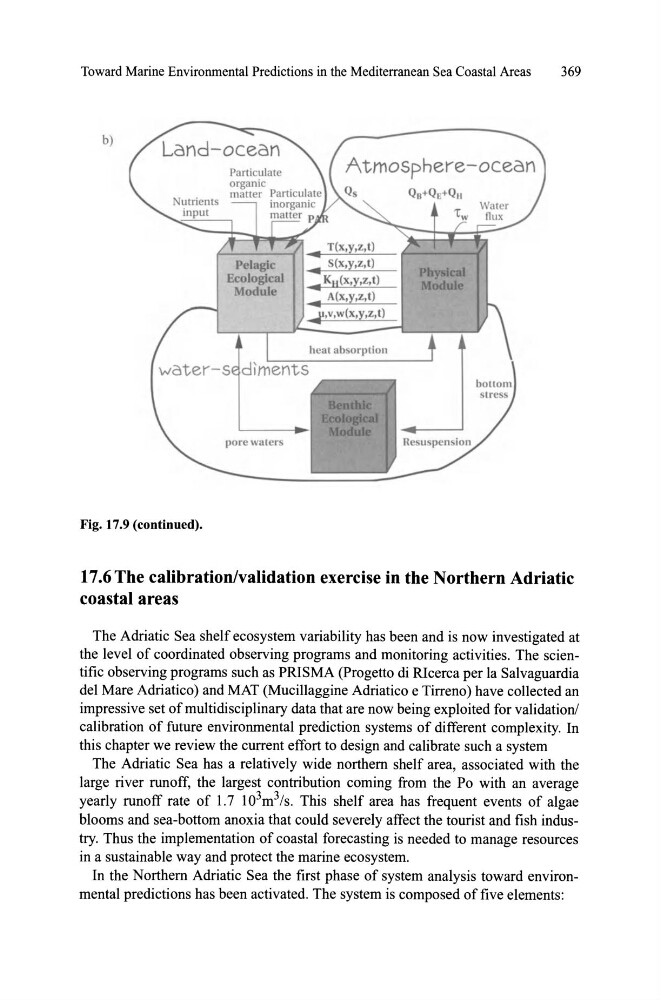
Fig. 17.9 (continued).
17.6 The calibration/validation exercise in the Northern Adriatic
coastal areas
The Adriatic Sea shelf ecosystem variability has been and is now investigated at
the level of coordinated observ ing programs and monitoring activities. The scientific observing programs such as PRISMA (Progetto di RIcerca per la Salvaguardia
del Mare Adriatico) and MAT (Muci1laggine Adriatico e Tirreno) have collected an
impressive set of multidisciplinary data that are now being exploited for validation/
calibration of future environmental prediction systems of different complexity. In
this chapter we review the current effort to design and calibrate such a system
The Adriatic Sea has a relatively wide northern shelf area, associated with the
large river runoff, the largest contribution coming from the Po with an average
yearly runoff rate of 1.7 10 3 m 3 /s. This shelf area has frequent events of algae
blooms and sea-bottom anoxia that could severely affect the tourist and fish industry. Thus the implementation of coastal forecasting is needed to manage resources
in a sustainable way and protect the marine ecosystem.
In the Northern Adriatic Sea the first phase of system analysis toward environmental predictions has been activated. The system is composed of five elements:
369
b)
Fig. 17.9 (continued).
17.6 The calibration/validation exercise in the Northern Adriatic
coastal areas
The Adriatic Sea shelf ecosystem variability has been and is now investigated at
the level of coordinated observ ing programs and monitoring activities. The scientific observing programs such as PRISMA (Progetto di RIcerca per la Salvaguardia
del Mare Adriatico) and MAT (Muci1laggine Adriatico e Tirreno) have collected an
impressive set of multidisciplinary data that are now being exploited for validation/
calibration of future environmental prediction systems of different complexity. In
this chapter we review the current effort to design and calibrate such a system
The Adriatic Sea has a relatively wide northern shelf area, associated with the
large river runoff, the largest contribution coming from the Po with an average
yearly runoff rate of 1.7 10 3 m 3 /s. This shelf area has frequent events of algae
blooms and sea-bottom anoxia that could severely affect the tourist and fish industry. Thus the implementation of coastal forecasting is needed to manage resources
in a sustainable way and protect the marine ecosystem.
In the Northern Adriatic Sea the first phase of system analysis toward environmental predictions has been activated. The system is composed of five elements: