

336 Martin Fischer
Appendix A - EOF Expansion
Here we shall give a very brief description of the idea of Empirical Orthogonal
Function (EOF) expansion. For a more detailed description we refer to the literature, e.g. (Lorenz 1956, Gallagher et al. 1991). The EOF expansion is a method to
extract pattems of maximum variability from an arbitrary data set. Let us as sume
we have a system that can be described by a state vector X(r,t) with n degrees of
freedom (e.g. n is the number ofpoints). Here r and tare arbitrary indices. In our
context they stand in general for a spatial index and for a time index, respectively .
Then this system has n normal modes. For a large system, these normal modes represent a huge number of data from which the important characteristics, i.e. the
dominant normal modes, may be hard to extract. To overcome this problem, a coordinate transformation can be carried out. The state of the system can be described
in a new orthonormal basis, the so called Empirical Orthogonal Functions (EOFs).
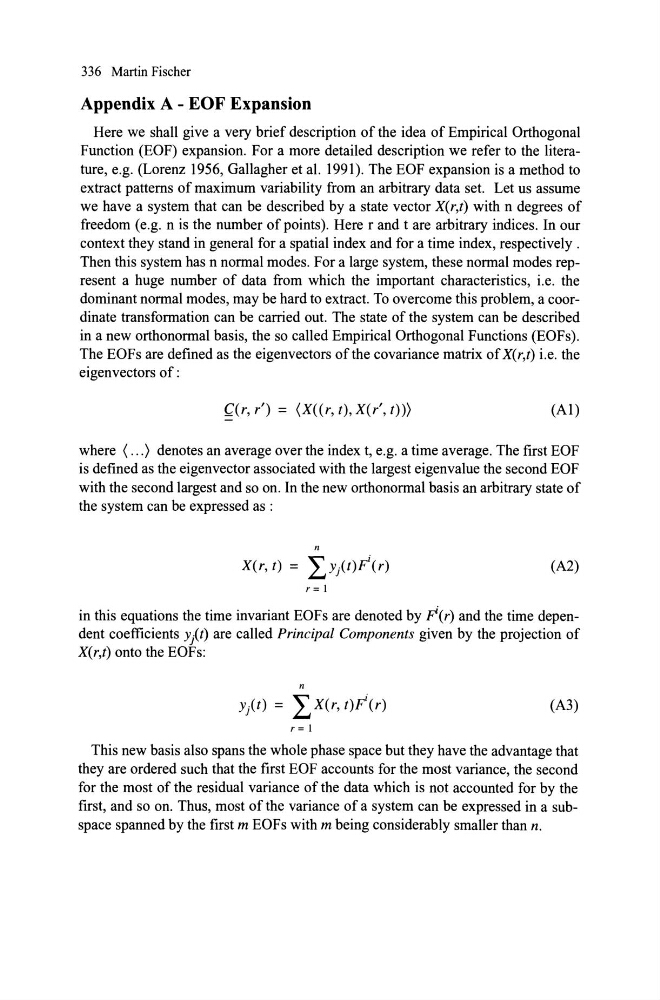
The EOFs are detined as the eigenvectors ofthe covariance matrix of X(r,t) i.e. the
eigenvectors of :
Qr, r') = (X«r, t), X(r', t»)
(Al)
where ( ... ) denotes an average over the index t, e.g. a time average. The tirst EOF
is detined as the eigenvector associated with the largest eigenvalue the second EOF
with the second largest and so ono In the new orthonormal basis an arbitrary state of
the system can be expres sed as :
n
X(r, t) = .~>p)Fi(r)
(A2)
r=!
in this equations the time invariant EOFs are denoted by per) and the time dependent coefficients yP) are called Principal Components given by the projection of
X(r,t) onto the EOFs:
n
y/t) = L X(r, t)Fi(r)
(A3)
r = !
This new basis also spans the whole phase space but they have the advantage that
they are ordered such that the tirst EOF accounts for the most variance, the second
for the most of the residual variance of the data which is not accounted for by the
tirst, and so ono Thus, most of the variance of a system can be expressed in a subspace spanned by the tirst m EOFs with m being considerably smaller than n.
Appendix A - EOF Expansion
Here we shall give a very brief description of the idea of Empirical Orthogonal
Function (EOF) expansion. For a more detailed description we refer to the literature, e.g. (Lorenz 1956, Gallagher et al. 1991). The EOF expansion is a method to
extract pattems of maximum variability from an arbitrary data set. Let us as sume
we have a system that can be described by a state vector X(r,t) with n degrees of
freedom (e.g. n is the number ofpoints). Here r and tare arbitrary indices. In our
context they stand in general for a spatial index and for a time index, respectively .
Then this system has n normal modes. For a large system, these normal modes represent a huge number of data from which the important characteristics, i.e. the
dominant normal modes, may be hard to extract. To overcome this problem, a coordinate transformation can be carried out. The state of the system can be described
in a new orthonormal basis, the so called Empirical Orthogonal Functions (EOFs).
The EOFs are detined as the eigenvectors ofthe covariance matrix of X(r,t) i.e. the
eigenvectors of :
Qr, r') = (X«r, t), X(r', t»)
(Al)
where ( ... ) denotes an average over the index t, e.g. a time average. The tirst EOF
is detined as the eigenvector associated with the largest eigenvalue the second EOF
with the second largest and so ono In the new orthonormal basis an arbitrary state of
the system can be expres sed as :
n
X(r, t) = .~>p)Fi(r)
(A2)
r=!
in this equations the time invariant EOFs are denoted by per) and the time dependent coefficients yP) are called Principal Components given by the projection of
X(r,t) onto the EOFs:
n
y/t) = L X(r, t)Fi(r)
(A3)
r = !
This new basis also spans the whole phase space but they have the advantage that
they are ordered such that the tirst EOF accounts for the most variance, the second
for the most of the residual variance of the data which is not accounted for by the
tirst, and so ono Thus, most of the variance of a system can be expressed in a subspace spanned by the tirst m EOFs with m being considerably smaller than n.