

ENSO Predictions with Coupled Ocean Atmosphere Models
333
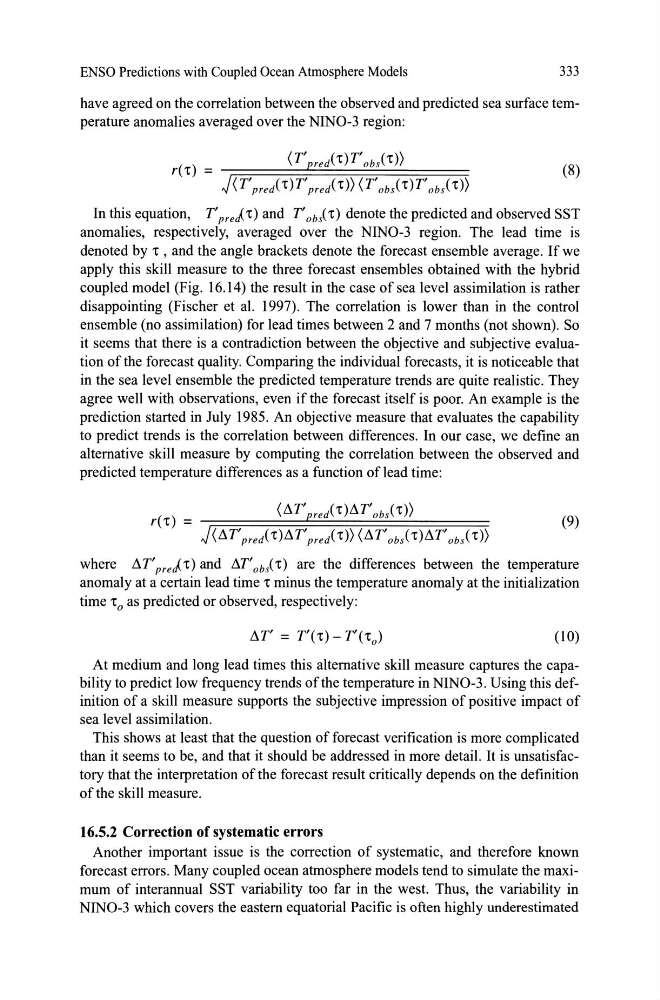
have agreed on the correlation between the observed and predicted sea surf ace temperature anomalies averaged over the NINO-3 region:
(T' prei 't) T' obs( 't»
r( 't) = -;:;::::::;=====.=-===.=~====~===;:
J( T' prei 't)T' prei 't» (T' obs( 't)T' obs( 't»
(8)
In this equation, T' preJ.. 't) and T' obi 't) denote the predicted and observed SST
anomalies, respectively, averaged over the NINO-3 region. The lead time is
denoted by 't , and the angle brackets denote the forecast ensemble average. If we
apply this skill measure to the three forecast ensembles obtained with the hybrid
coupled model (Fig. 16.14) the result in the case of sea level assimilation is rather
disappointing (Fischer et al. 1997). The correlation is lower than in the control
ensemble (no assimilation) for lead times between 2 and 7 months (not shown). So
it seems that there is a contradiction between the objective and subjective evaluation of the forecast quality. Comparing the individual forecasts, it is noticeable that
in the sea level ensemble the predicted temperature trends are quite realistic. They
agree well with observations, even if the forecast itself is p0of. An example is the
prediction started in July 1985. An objective measure that evaluates the capability
to predict trends is the correlation between differences. In our case, we define an
alternative skill measure by computing the correlation between the observed and
predicted temperature differences as a function of lead time:
(IlT' prei 't)IlT' obs( 't»
r('t) =
-
J (IlT' prei 't) Il T' prei 't» (IlT' obs( 't)IlT' obs( 't»
(9)
where llT' preJ.. 't) and llT' obi 't) are the differences between the temperature
anomaly at a certain lead time 't minus the temperature anomaly at the initialization
time 'to as predicted or observed, respectively:
(10)
At medium and long lead times this alternative skill measure captures the capability to predict low frequency trends ofthe temperature in NINO-3. Using this definition of a skill measure supports the subjective impression of positive impact of
sea level assimilation.
This shows at least that the question of forecast verification is more complicated
than it seems to be, and that it should be addressed in more detail. It is unsatisfactory that the interpretation of the forecast result critically depends on the definition
of the skill measure.
16.5.2 Correction of systematic errors
Another important issue is the correction of systematic, and therefore known
forecast errors. Many coupled ocean atmosphere models tend to simulate the maximum of interannual SST variability too far in the west. Thus, the variability in
NINO-3 which covers the eastern equatorial Pacific is often highly underestimated
333
have agreed on the correlation between the observed and predicted sea surf ace temperature anomalies averaged over the NINO-3 region:
(T' prei 't) T' obs( 't»
r( 't) = -;:;::::::;=====.=-===.=~====~===;:
J( T' prei 't)T' prei 't» (T' obs( 't)T' obs( 't»
(8)
In this equation, T' preJ.. 't) and T' obi 't) denote the predicted and observed SST
anomalies, respectively, averaged over the NINO-3 region. The lead time is
denoted by 't , and the angle brackets denote the forecast ensemble average. If we
apply this skill measure to the three forecast ensembles obtained with the hybrid
coupled model (Fig. 16.14) the result in the case of sea level assimilation is rather
disappointing (Fischer et al. 1997). The correlation is lower than in the control
ensemble (no assimilation) for lead times between 2 and 7 months (not shown). So
it seems that there is a contradiction between the objective and subjective evaluation of the forecast quality. Comparing the individual forecasts, it is noticeable that
in the sea level ensemble the predicted temperature trends are quite realistic. They
agree well with observations, even if the forecast itself is p0of. An example is the
prediction started in July 1985. An objective measure that evaluates the capability
to predict trends is the correlation between differences. In our case, we define an
alternative skill measure by computing the correlation between the observed and
predicted temperature differences as a function of lead time:
(IlT' prei 't)IlT' obs( 't»
r('t) =
-
J (IlT' prei 't) Il T' prei 't» (IlT' obs( 't)IlT' obs( 't»
(9)
where llT' preJ.. 't) and llT' obi 't) are the differences between the temperature
anomaly at a certain lead time 't minus the temperature anomaly at the initialization
time 'to as predicted or observed, respectively:
(10)
At medium and long lead times this alternative skill measure captures the capability to predict low frequency trends ofthe temperature in NINO-3. Using this definition of a skill measure supports the subjective impression of positive impact of
sea level assimilation.
This shows at least that the question of forecast verification is more complicated
than it seems to be, and that it should be addressed in more detail. It is unsatisfactory that the interpretation of the forecast result critically depends on the definition
of the skill measure.
16.5.2 Correction of systematic errors
Another important issue is the correction of systematic, and therefore known
forecast errors. Many coupled ocean atmosphere models tend to simulate the maximum of interannual SST variability too far in the west. Thus, the variability in
NINO-3 which covers the eastern equatorial Pacific is often highly underestimated