

328 Martin Fischer
1 . 0 . . . . - - - - - - - - - . . . ,
correlation
~~.
~
•...
'-' ...... .
, ............ _::;.: ...
, .
CMPlO
,
'"
CMP9
"
CMP6
,
0.8
0.6
0.4
0.2
PERSIST.
' .
0.0 LO--2--4--6--8--1-0......l12
Forecast Lead (months)
1 . 6 . . . . - - - - - - - - - . . . ,
1.4
1.2
1.0
0.8
0.6
0.6
0.4
/.
CMPlO
CMP9
" .... -
CMP6
"
PERSIST. ,,"
,,/ .,..."".
/" ".,. . .-.
/ .<"!..
RMS error
0.2 OL--2--4-......,.6-~8--1O~ ..... 12
Forecast Lead (months)
a: dlfferent model verslons. NINO·3. Jun. 82 - Mar. 95
1.0
1.6
correlation
F·RA2
1.4
F·NTAO
0.8
~
1.2 _.- F-HFSU
...... -.-.,.
_.-' .~
0.6
1.0
~
·,· .. · .. · ... 2\.. .
0.8
./
.. '
0.4
0.6
/" ...... ~ ......
F-RA2
.... ' -......
0.6
. ...........
0.2
F-NTAO
\.\
F-HFSU
0.4
RMS error
0.00
......
0.2
2
4
6
8
10 12
O
2
4
6
8
10 1.
Forecast Lead (months)
Forecast Lead (months)
b:assimilation experiments. SST-3. May 89 - Oct. 93
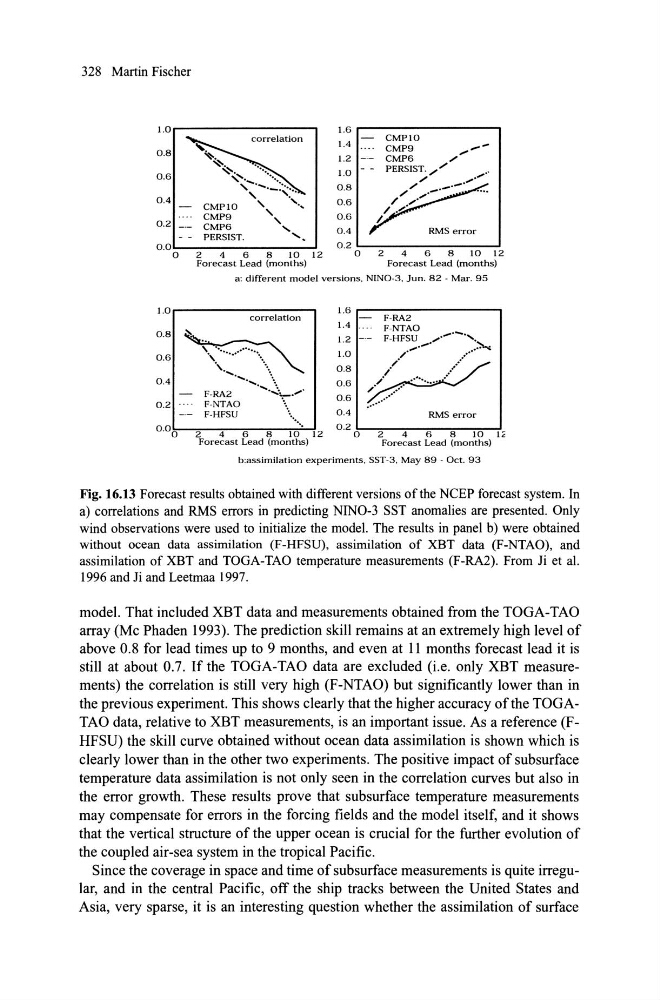
Fig. 16.13 Forecast results obtained with different versions ofthe NCEP forecast system. In
a) correlations and RMS errors in predicting NINO-3 SST anomalies are presented. Only
wind observations were used to initialize the model. The results in panel b) were obtained
without ocean data assimilation (F-HFSU), assimilation of XBT data (F-NTAO), and
assimilation of XBT and TOGA-TAO temperature measurements (F-RA2). From Ji et al.
1996 and Ji and Leetmaa 1997.
model. That included XBT data and measurements obtained from the TOGA-TAO
array (Mc Phaden 1993). The prediction skill remains at an extremely high level of
above 0.8 for lead times up to 9 months, and even at 11 months forecast lead it is
still at about 0.7. Ifthe TOGA-TAO data are excluded (i.e. only XBT measurements) the correlation is still very high (F-NTAO) but significantly lower than in
the previous experiment. This shows clearly that the higher accuracy ofthe TOGATAO data, relative to XBT measurements, is an important issue. As a reference (FHFSU) the skill curve obtained without ocean data assimilation is shown which is
clearly lower than in the other two experiments. The positive impact of sub surf ace
temperature data assimilation is not only seen in the correlation curves but also in
the error growth. These results prove that subsurface temperature measurements
may compensate for errors in the forcing fields and the model itself, and it shows
that the vertical structure of the upper ocean is crucial for the further evolution of
the coupled air-sea system in the tropical Pacific.
Since the coverage in space and time of subsurface measurements is quite irreguIar, and in the central Pacific, off the ship tracks between the United States and
Asia, very sparse, it is an interesting question whether the assimilation of surf ace
1 . 0 . . . . - - - - - - - - - . . . ,
correlation
~~.
~
•...
'-' ...... .
, ............ _::;.: ...
, .
CMPlO
,
'"
CMP9
"
CMP6
,
0.8
0.6
0.4
0.2
PERSIST.
' .
0.0 LO--2--4--6--8--1-0......l12
Forecast Lead (months)
1 . 6 . . . . - - - - - - - - - . . . ,
1.4
1.2
1.0
0.8
0.6
0.6
0.4
/.
CMPlO
CMP9
" .... -
CMP6
"
PERSIST. ,,"
,,/ .,..."".
/" ".,. . .-.
/ .<"!..
RMS error
0.2 OL--2--4-......,.6-~8--1O~ ..... 12
Forecast Lead (months)
a: dlfferent model verslons. NINO·3. Jun. 82 - Mar. 95
1.0
1.6
correlation
F·RA2
1.4
F·NTAO
0.8
~
1.2 _.- F-HFSU
...... -.-.,.
_.-' .~
0.6
1.0
~
·,· .. · .. · ... 2\.. .
0.8
./
.. '
0.4
0.6
/" ...... ~ ......
F-RA2
.... ' -......
0.6
. ...........
0.2
F-NTAO
\.\
F-HFSU
0.4
RMS error
0.00
......
0.2
2
4
6
8
10 12
O
2
4
6
8
10 1.
Forecast Lead (months)
Forecast Lead (months)
b:assimilation experiments. SST-3. May 89 - Oct. 93
Fig. 16.13 Forecast results obtained with different versions ofthe NCEP forecast system. In
a) correlations and RMS errors in predicting NINO-3 SST anomalies are presented. Only
wind observations were used to initialize the model. The results in panel b) were obtained
without ocean data assimilation (F-HFSU), assimilation of XBT data (F-NTAO), and
assimilation of XBT and TOGA-TAO temperature measurements (F-RA2). From Ji et al.
1996 and Ji and Leetmaa 1997.
model. That included XBT data and measurements obtained from the TOGA-TAO
array (Mc Phaden 1993). The prediction skill remains at an extremely high level of
above 0.8 for lead times up to 9 months, and even at 11 months forecast lead it is
still at about 0.7. Ifthe TOGA-TAO data are excluded (i.e. only XBT measurements) the correlation is still very high (F-NTAO) but significantly lower than in
the previous experiment. This shows clearly that the higher accuracy ofthe TOGATAO data, relative to XBT measurements, is an important issue. As a reference (FHFSU) the skill curve obtained without ocean data assimilation is shown which is
clearly lower than in the other two experiments. The positive impact of sub surf ace
temperature data assimilation is not only seen in the correlation curves but also in
the error growth. These results prove that subsurface temperature measurements
may compensate for errors in the forcing fields and the model itself, and it shows
that the vertical structure of the upper ocean is crucial for the further evolution of
the coupled air-sea system in the tropical Pacific.
Since the coverage in space and time of subsurface measurements is quite irreguIar, and in the central Pacific, off the ship tracks between the United States and
Asia, very sparse, it is an interesting question whether the assimilation of surf ace