

264 David Prandle
Appendix E - Seasonal Cycles
Influence of horizontal circulation on the seasonal cyele
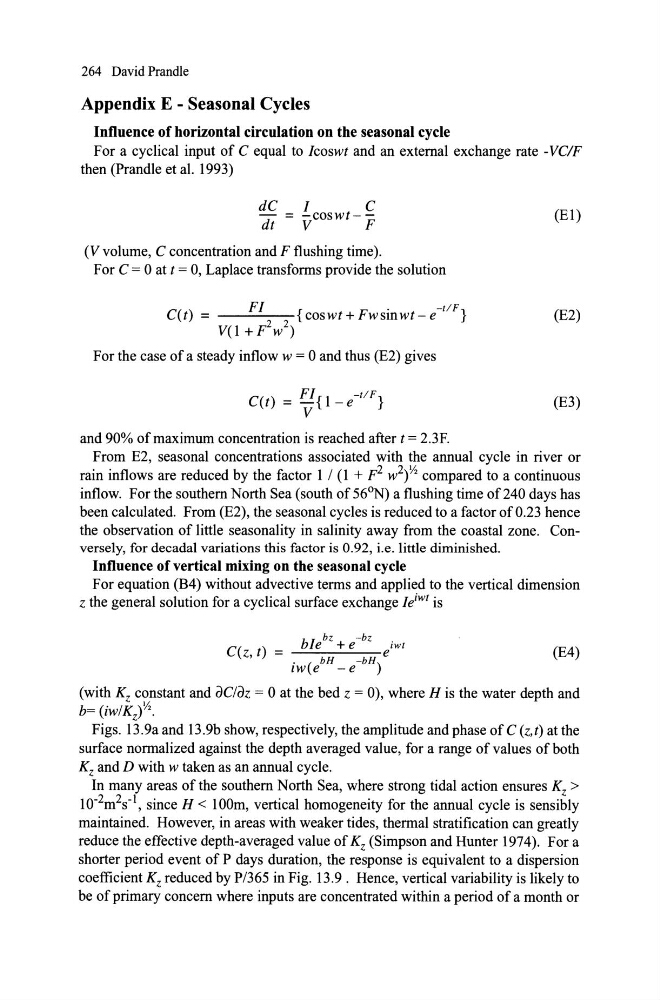
For a cyclical input of C equal to Icoswt and an external exchange rate -VC/F
then (Prandle et al. 1993)
dC
1
C
= -coswt-dt
V
F
(V volume, C concentration and F flushing time).
For C = O at t = O, Laplace transforms provide the solution
)
FI
{
F '
-t/F}
C(t =
coswt + wsmwt - e
V(l + F 2 w 2 )
For the case of a steady inflow w = O and thus (E2) gives
C(t) = FI {1 _ e -t/F}
V
and 90% of maximum concentration is reached after t = 2.3F.
(El)
(E2)
(E3)
From E2, seasona1 concentrations associated with the annual cycle in river or
rain inflows are reduced by the factor 1 / (1 + F 2 w 2 )Y:z compared to a continuous
inflow. For the southern North Sea (south of 56~) a flushing time of240 days has
been calculated. From (E2), the seasonal cycles is reduced to a factor of 0.23 hence
the observation of little seasonality in salinity away from the coastal zone. Conversely, for decadal variations this factor is 0.92, i.e. little diminished.
Influence of vertical mixing on the seasonal cyele
For equation (B4) without advective terms and applied to the vertical dimension
z the general solution for a cyclical surface exchange Ie iwt is
ble bz + e -bz iwt
C(z, t) =
e
(E4)
iw(lH _e- bH )
(with Kz constant and ac/az = O at the bed z = O), where H is the water depth and
b= (iw/Kz)Y:z.
Figs. 13.9a and 13.9b show, respectively, the amplitude and phase of C (z,t) at the
surface normalized against the depth averaged value, for a range of values of both
Kz and D with w taken as an annual cycle.
In many areas ofthe southern North Sea, where strong tidal action ensures Kz>
1O- 2 m 2 s- 1 , since H < 100m, vertical homogeneity for the annual cycle is sensibly
maintained. However, in areas with weaker tides, thermal stratification can greatly
reduce the effective depth-averaged value of Kz (Simpson and Hunter 1974). For a
shorter period event of P days duration, the response is equivalent to a dispersion
coefficient Kz reduced by P/365 in Fig. 13.9. Hence, vertical variability is likely to
be of primary concern where inputs are concentrated within a period of a month or
Appendix E - Seasonal Cycles
Influence of horizontal circulation on the seasonal cyele
For a cyclical input of C equal to Icoswt and an external exchange rate -VC/F
then (Prandle et al. 1993)
dC
1
C
= -coswt-dt
V
F
(V volume, C concentration and F flushing time).
For C = O at t = O, Laplace transforms provide the solution
)
FI
{
F '
-t/F}
C(t =
coswt + wsmwt - e
V(l + F 2 w 2 )
For the case of a steady inflow w = O and thus (E2) gives
C(t) = FI {1 _ e -t/F}
V
and 90% of maximum concentration is reached after t = 2.3F.
(El)
(E2)
(E3)
From E2, seasona1 concentrations associated with the annual cycle in river or
rain inflows are reduced by the factor 1 / (1 + F 2 w 2 )Y:z compared to a continuous
inflow. For the southern North Sea (south of 56~) a flushing time of240 days has
been calculated. From (E2), the seasonal cycles is reduced to a factor of 0.23 hence
the observation of little seasonality in salinity away from the coastal zone. Conversely, for decadal variations this factor is 0.92, i.e. little diminished.
Influence of vertical mixing on the seasonal cyele
For equation (B4) without advective terms and applied to the vertical dimension
z the general solution for a cyclical surface exchange Ie iwt is
ble bz + e -bz iwt
C(z, t) =
e
(E4)
iw(lH _e- bH )
(with Kz constant and ac/az = O at the bed z = O), where H is the water depth and
b= (iw/Kz)Y:z.
Figs. 13.9a and 13.9b show, respectively, the amplitude and phase of C (z,t) at the
surface normalized against the depth averaged value, for a range of values of both
Kz and D with w taken as an annual cycle.
In many areas ofthe southern North Sea, where strong tidal action ensures Kz>
1O- 2 m 2 s- 1 , since H < 100m, vertical homogeneity for the annual cycle is sensibly
maintained. However, in areas with weaker tides, thermal stratification can greatly
reduce the effective depth-averaged value of Kz (Simpson and Hunter 1974). For a
shorter period event of P days duration, the response is equivalent to a dispersion
coefficient Kz reduced by P/365 in Fig. 13.9. Hence, vertical variability is likely to
be of primary concern where inputs are concentrated within a period of a month or