

252 David Prandle
f?J
I
I
I
t
I
cl
~.
I
I
/
",
",
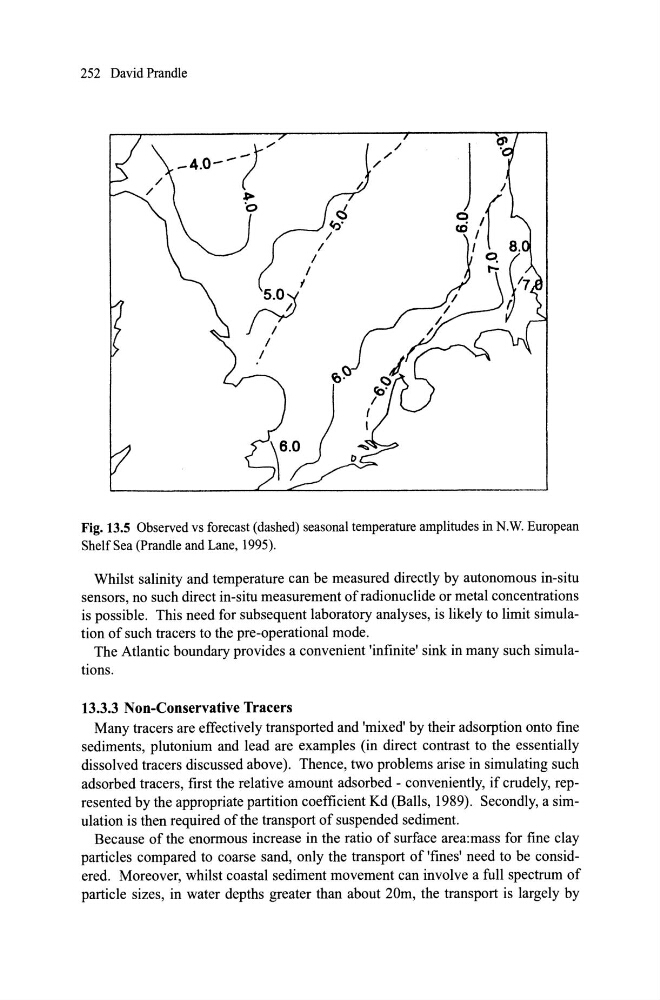
Fig. 13.5 Observed vs forecast (dashed) seasonal temperature amplitudes in N.W. European
Shelf Sea (Prandle and Lane, 1995).
Whilst salinity and temperature can be measured directly by autonomous in-situ
sensors, no such direct in-situ measurement ofradionuc1ide or metal concentrations
is possible. This need for subsequent laboratory analyses, is likely to limit simulation of such tracers to the pre-operational mode.
The Atlantic boundary provides a convenient 'infinite' sink in many such simulations.
13.3.3 Non-Conservative Tracers
Many tracers are effectively transported and 'mixed' by their adsorption onto fine
sediments, plutonium and lead are examples (in direct contrast to the essentially
dissolved tracers discussed above). Thence, two problems arise in simulating such
adsorbed tracers, first the relative amount adsorbed - conveniently, if crudely, represented by the appropriate partition coefficient Kd (Balls, 1989). Secondly, a simulation is then required of the transport of suspended sediment.
Because of the enormous increase in the ratio of surf ace area:mass for fine c1ay
partic1es compared to coarse sand, only the transport of 'fines' need to be considered. Moreover, whilst coastal sediment movement can involve a full spectrum of
partic1e sizes, in water depths greater than about 20m, the transport is largely by
f?J
I
I
I
t
I
cl
~.
I
I
/
",
",
Fig. 13.5 Observed vs forecast (dashed) seasonal temperature amplitudes in N.W. European
Shelf Sea (Prandle and Lane, 1995).
Whilst salinity and temperature can be measured directly by autonomous in-situ
sensors, no such direct in-situ measurement ofradionuc1ide or metal concentrations
is possible. This need for subsequent laboratory analyses, is likely to limit simulation of such tracers to the pre-operational mode.
The Atlantic boundary provides a convenient 'infinite' sink in many such simulations.
13.3.3 Non-Conservative Tracers
Many tracers are effectively transported and 'mixed' by their adsorption onto fine
sediments, plutonium and lead are examples (in direct contrast to the essentially
dissolved tracers discussed above). Thence, two problems arise in simulating such
adsorbed tracers, first the relative amount adsorbed - conveniently, if crudely, represented by the appropriate partition coefficient Kd (Balls, 1989). Secondly, a simulation is then required of the transport of suspended sediment.
Because of the enormous increase in the ratio of surf ace area:mass for fine c1ay
partic1es compared to coarse sand, only the transport of 'fines' need to be considered. Moreover, whilst coastal sediment movement can involve a full spectrum of
partic1e sizes, in water depths greater than about 20m, the transport is largely by