

182 Kikuro Miyakoda
Ocean
Surface boundary conditions
a-l)
Rigid-lid condition:
w=O at z=O
(l1a)
a-2)
Free surf ace condition:
The surf ace pressure is related to the displacement, 11 , of the free surface from
mean sea level (z=O), i.e., Ps = Po,g11 (x,y, t). The total pressure p vanishes at z = 11,
neglecting the pressure due to the overlying atmosphere
w = d11
dt
atz=O
The equation for 11 will be shown later, see (24).
10.2.3 Numerical aspects of atmospheric GCMs
i)Vertical representation
(l1b)
a-coordinates or a-p hybrid coordinates are often used more often than z-coordinates.
More recent1y, a a-a coordinate has been developed (Bleck 1984; Hsu and
Arakawa 1990; Zhu et al. 1992). The solutions ofthe GeM are very satisfactory.
ii)Spherical harmonic expansion
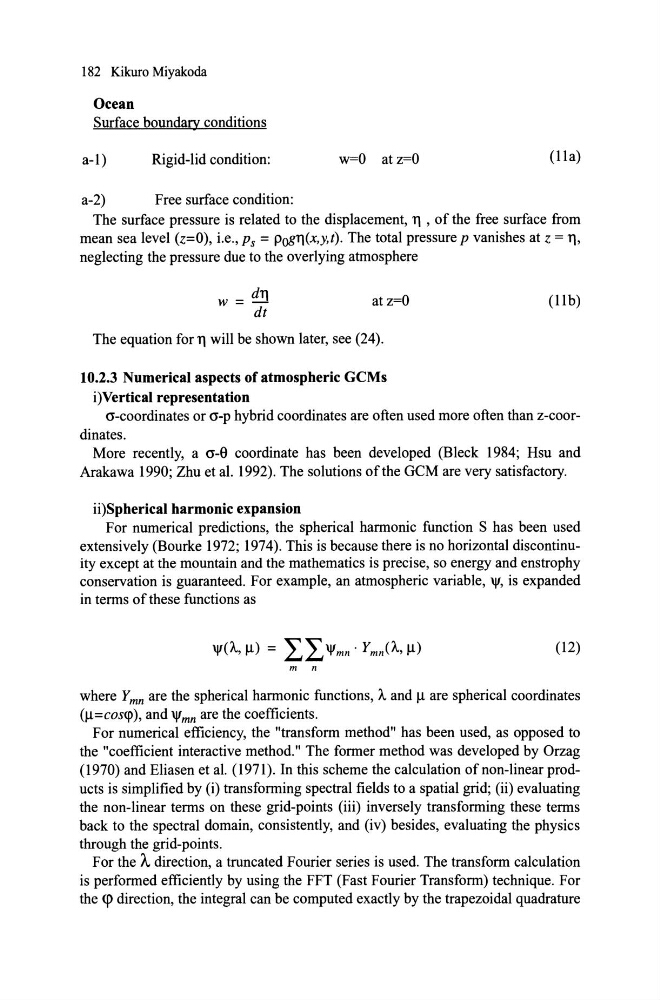
For numerical predictions, the spherical harmonic function S has been used
extensively (Bourke 1972; 1974). This is because there is no horizontal discontinuity except at the mountain and the mathematics is precise, so energy and enstrophy
conservation is guaranteed. For example, an atmospheric variable, '1', is expanded
in terms of these functions as
(12)
m n
where Y mn are the spherical harmonic functions, A and Il are spherical coordinates
(ll=cos
the "coefficient interactive method." The former method was developed by Orzag
(1970) and Eliasen et al. (1971). In this scheme the calculation of non-linear products is simplified by (i) transforming spectral fields to a spatial grid; (ii) evaluating
the non-linear terms on these grid-points (iii) inversely transforming these terms
back to the spectral domain, consistently, and (iv) besides, evaluating the physics
through the grid-points.
For the  direction, a truncated Fourier series is used. The transform calculation
is performed efficient1y by using the FFT (Fast Fourier Transform) technique. For
the
Ocean
Surface boundary conditions
a-l)
Rigid-lid condition:
w=O at z=O
(l1a)
a-2)
Free surf ace condition:
The surf ace pressure is related to the displacement, 11 , of the free surface from
mean sea level (z=O), i.e., Ps = Po,g11 (x,y, t). The total pressure p vanishes at z = 11,
neglecting the pressure due to the overlying atmosphere
w = d11
dt
atz=O
The equation for 11 will be shown later, see (24).
10.2.3 Numerical aspects of atmospheric GCMs
i)Vertical representation
(l1b)
a-coordinates or a-p hybrid coordinates are often used more often than z-coordinates.
More recent1y, a a-a coordinate has been developed (Bleck 1984; Hsu and
Arakawa 1990; Zhu et al. 1992). The solutions ofthe GeM are very satisfactory.
ii)Spherical harmonic expansion
For numerical predictions, the spherical harmonic function S has been used
extensively (Bourke 1972; 1974). This is because there is no horizontal discontinuity except at the mountain and the mathematics is precise, so energy and enstrophy
conservation is guaranteed. For example, an atmospheric variable, '1', is expanded
in terms of these functions as
(12)
m n
where Y mn are the spherical harmonic functions, A and Il are spherical coordinates
(ll=cos
the "coefficient interactive method." The former method was developed by Orzag
(1970) and Eliasen et al. (1971). In this scheme the calculation of non-linear products is simplified by (i) transforming spectral fields to a spatial grid; (ii) evaluating
the non-linear terms on these grid-points (iii) inversely transforming these terms
back to the spectral domain, consistently, and (iv) besides, evaluating the physics
through the grid-points.
For the  direction, a truncated Fourier series is used. The transform calculation
is performed efficient1y by using the FFT (Fast Fourier Transform) technique. For
the